A young woman whose body lay preserved in a Northern Ireland peat bog for more than 2,000 years was beheaded, possibly as part of a ritual killing, researchers have concluded. She was between 15 and 22 years old when she died.
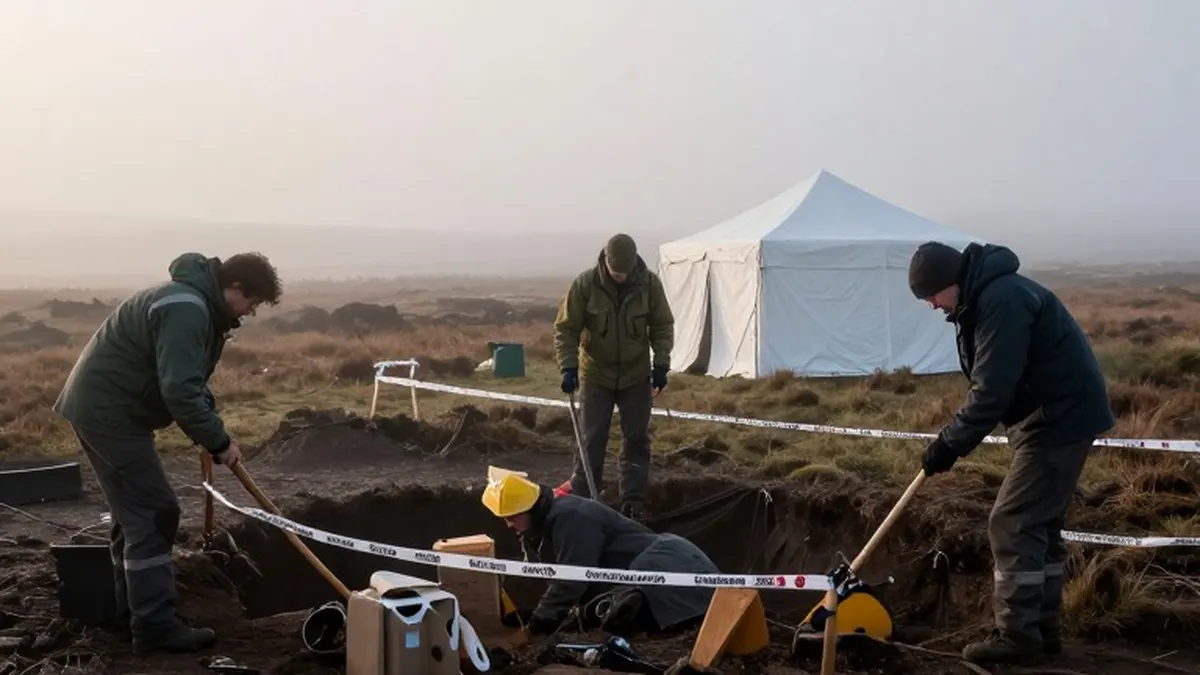
The remains, known as the Ballymacombs More Woman, were discovered in a bog in central Northern Ireland in October 2023. An investigation hosted by the Ulster Museum and modelled on a modern coroner's inquest determined that she was decapitated from behind, most likely with a bladed weapon.
"While the precise circumstances surrounding her death remain unknown, the evidence suggested that she may form part of a wider tradition of ritualized killing and sacrifice," the Ulster Museum said. It added that her death appeared similar to others documented among Iron Age bodies found in bogs across northwest Europe.
The woman's body dates from between 343 and 1 B.C., placing her in the prehistoric Iron Age period.
"Finds like this that are women are incredibly rare," Hannah Crowdy, head of curatorial for Northern Ireland's National Museums, told BBC News. "She's the first of her kind in Northern Ireland." Crowdy said the research "helps us piece together a part of history that is quite mysterious," adding that "to honor her, it's important to tell her story and bring that to the fore."
The research team used scientific mapping techniques, 3D imaging and analyses of bone, hair, skin and nails to build a picture of the woman's age, health, diet, physical condition and the injuries that killed her. The Ulster Museum described the inquiry as a unique public event modelled on a modern coroner's investigation.
Niamh Baker, the museum's curator of archaeology, told the BBC that an osteoarchaeologist, a specialist in archaeological human bones, examined the remains and identified cut marks on the woman's neck. "It would appear she was intentionally decapitated in the bog," Baker said. "No skull was recovered with further investigation."
Baker noted that male Iron Age remains found in the Republic of Ireland also appear to have met violent deaths, with some cases thought to be linked to kingship and sovereignty. "Was she a female sovereign? Or it may be that it was related to an agricultural or weather issue at the time," she said.
Residents of the nearby town of Balleghy have given the woman the name Aine. "We feel that Aine is one of our own," said Séamus Mac an Fhirléighinn of the town's historical society, who attended the inquest. "This is her inquest. She needed her people, her family there with her to act on her behalf as advocates."
"Local people are very interested," he added. "We wanted to know who this person was, how she died, how she lived."