For decades, international efforts to resolve the Israeli-Palestinian conflict have focused primarily on achieving a political settlement. However, recent analysis suggests this strategy may be overlooking a more immediate crisis. Palestinian civilian life and social structures are reportedly in grave danger due to continuing colonisation, with critics arguing that an international protection force is now urgently needed to preserve the foundations of Palestinian society.
The situation in Gaza has deteriorated significantly following a war that has claimed more than 74,000 lives. The conflict has created conditions for excess deaths of tens of thousands more, wiping out neighbourhoods and critical infrastructure. The education and healthcare systems in the strip have been driven to collapse, while the broader occupation in the West Bank and East Jerusalem operates through mechanisms such as settler violence, forced displacement, and fiscal pressure on the Palestinian Authority.
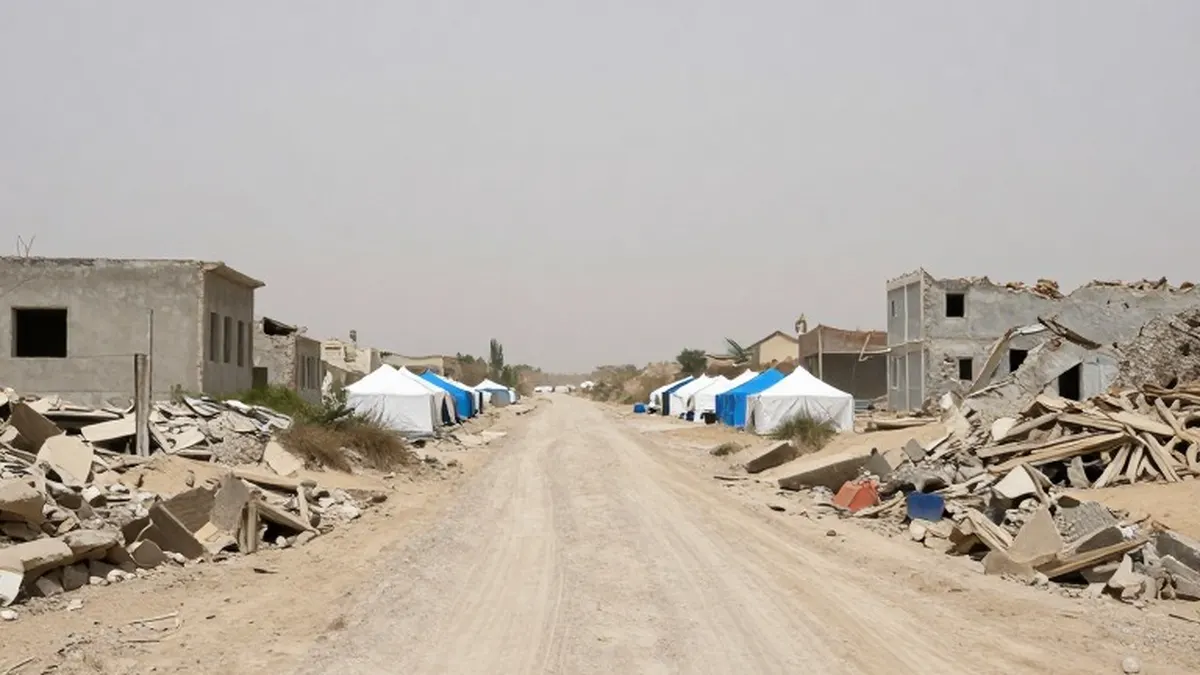
Since October 2023, the pace of colonisation has accelerated, leading to the destruction of key pillars of human life including housing, healthcare, and livelihoods. The Israeli army has destroyed roughly 81 percent of structures in Gaza, leaving 1.9 million people displaced. Most residents now live in tents or makeshift shelters that are deemed unfit for long-term habitation. In the West Bank, demolitions under the pretext of missing building permits have escalated, with 46 communities forcibly displaced between 2023 and mid-2025.
Healthcare and education systems are under severe strain across both territories. In Gaza, only 19 of 36 hospitals and 73 of 158 primary health centres remain partially functional. UNICEF reports that 98 percent of schools in the strip were destroyed or damaged. In the West Bank, hospitals operate at reduced capacity due to withheld tax revenues from the Palestinian Authority, while hundreds of checkpoints impede emergency care. At least 84 schools in the region face pending demolition or stop-work orders, and movement restrictions prevent many children from reaching their classrooms.
Palestinian livelihoods have also been devastated. The economy in Gaza, already weakened by the siege, was further damaged by intensive bombing campaigns. In the West Bank, settler violence and the designation of security zones have cut farmers off from their land, with many unable to harvest crops for three consecutive years. The World Food Programme has announced cuts to monthly food rations for hundreds of thousands of people, while employment opportunities have shrunk due to the withdrawal of work permits. Unemployment in the West Bank has doubled since 2023, reaching 29.5 percent in 2026.
The Palestinian Authority has been described as having been transformed into a security subcontractor for Israel. As of 2026, Israel is withholding an estimated $4.8 to 5 billion in tax and customs revenue, though it has transferred enough funds to keep the PA's security apparatus functioning. This backdrop of economic and physical pressure has led advocates to call for a protective force with a clear legal and political mandate.
The legal basis for such a force is supported by rulings from the International Court of Justice. The court found that Israel's occupation is illegal and that it has an obligation to facilitate aid access into Gaza. Although these advisory opinions are not binding, they place responsibility on the occupying power. The United Nations Security Council is often paralysed by vetoes, but the 1950 'Uniting for Peace' precedent allows the General Assembly to recommend collective measures, including the use of force, when the Council is stalled.
Proponents suggest that a coalition of states, potentially including South Africa, the Arab League, and Organisation of Islamic Cooperation members, could bring this recommendation to the General Assembly. This approach would provide political legitimacy for a force with a mandate to intervene and protect, rather than merely observe and report as previous missions in Hebron did. The deployment of such a force is viewed as a priority to ensure that the social and economic foundations of Palestinian civilian life are not lost before a political settlement can be reached.