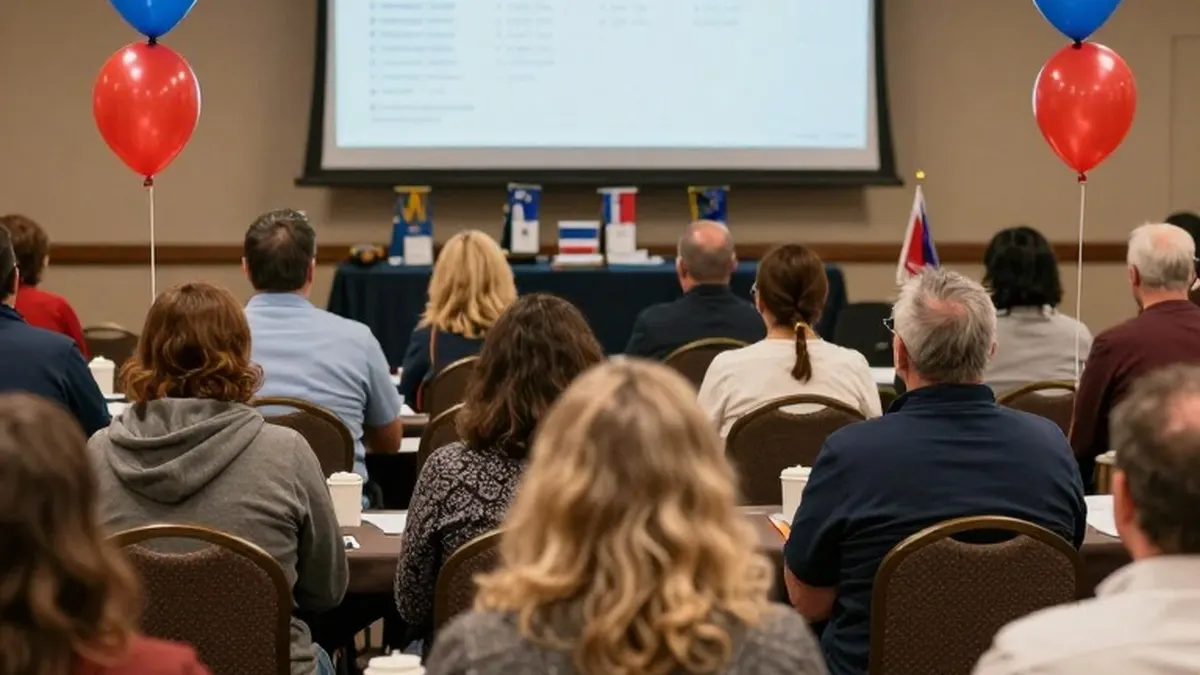
As the vote count came in on election night, a contingent calling themselves Jews For Abdul celebrated at the Michigan Democratic Party's watch party, cheering Abdul El-Sayed's rise toward victory in the state's US Senate race.
Eli Newell, Midwest field organizer for the left-wing Jewish group IfNotNow, told the Jewish Telegraphic Agency shortly before the victory speech that it was hard to capture the meaning of the moment for his movement. "We see our agenda of shared safety, equality, justice and a brighter future for all represented in Abdul's candidacy," he said. IfNotNow had mobilized intensively for El-Sayed, bringing Jewish volunteers from out of state, including Newell himself, who lives in Chicago, to canvass in Jewish neighborhoods.
Those activists, who leaned strongly left, especially on Israel, stood apart from Michigan's more established pro-Israel Jewish institutions. Leaders in that camp had organized against El-Sayed during the campaign, citing his sharp criticism of Israel, his initial response to the attack on Temple Israel, and his ties to far-left streamer Hasan Piker.
Among the opponents was Rabbi Asher Lopatin, community relations director at the Jewish Federation of Greater Ann Arbor, who took a leave from his job after the Democratic primary to campaign for Republican nominee Mike Rogers, one of the first Jewish figures in the state to do so publicly. He also appeared at a Republican Jewish Coalition event for Rogers in the campaign's final week. "I'm not taking anything back. But I think we have to work with what we have," Lopatin said the day after the election. "We have to build relationships with him. We have to build relationships with his supporters."
Decky Alexander, who chairs the Michigan Jewish Democratic Caucus, struck a similar note. Her caucus never endorsed El-Sayed, and some of its leaders openly backed Rogers, while progressive Jews formed a grassroots group, Michigan Jews for Democracy, to support the Democrat. Alexander said the caucus now needs to be inclusive and named Michigan Jews for Democracy and Bend the Arc, which endorsed El-Sayed, as partners she wants at the table. El-Sayed's campaign, meanwhile, pointed on Thursday to an analysis by the progressive PAC Millions of Michiganians arguing he had "virtually matched" Democrat Elissa Slotkin's 2024 Jewish vote, losing only 1.3% across 72 heavily Jewish precincts that went for Slotkin.
Signs of the split were visible on the ground. In one reliably Democratic, heavily Jewish Detroit suburb, residents repurposed old "Haley Stevens for US Senate" yard signs after the pro-Israel congresswoman, beaten by El-Sayed in the August primary, endorsed Rogers in the race's final days. Some signs later bore handwritten messages to Stevens: "Proud of you! Stand tall!!" More than 560 Michigan Jews signed a petition titled "Michigan Jews Against Extremism," pledging to vote for Rogers over El-Sayed's rhetoric. Signatories included the president of Detroit's Jewish federation, the head of the local Holocaust center, and Mark Davidoff of the Michigan-Israel Business Accelerator, who said after the vote that his group "is prepared to work with all newly elected and returning leaders across Michigan."
Troy Zukowski-Serlin, a Kalamazoo-based representative of that letter, acknowledged afterward it may have been too strongly worded, noting that the Rogers campaign faced its own accusations of extremism, including messaging critics called Islamophobic and associations with Christian nationalist donors, a point raised by El-Sayed surrogates such as state Sen. Mallory McMorrow. Zukowski-Serlin said his own daughter voted for El-Sayed. "There's plenty of other issues that I think we can find common ground on," he said. "I think we can get along."
Other institutions were blunter. Michigan's Anti-Defamation League chapter cited "serious concerns" over what it called El-Sayed's "history of minimizing the fears of the Jewish community and demonizing Israel," while saying he now has an opportunity and responsibility to hear Jewish Michiganders and confront antisemitism. Detroit's American Jewish Committee chapter recognized the "historic significance" of the first Muslim elected to the Senate but said the moment was tarnished by rhetoric it said alienates Jewish Michiganders. Detroit's Jewish federation congratulated all winners and urged elected officials to act with wisdom and compassion, without naming El-Sayed.
Gary Torgow, the Michigan-based chair of the Jewish Federations of North America who had urged Rogers to win, called in a post-election statement for the community to "move forward with optimism, dignity, and pride in who we are." For Lopatin, the task ahead is clear. "I think the election divided the Jewish community," he said. "I'm excited to get back to uniting them."