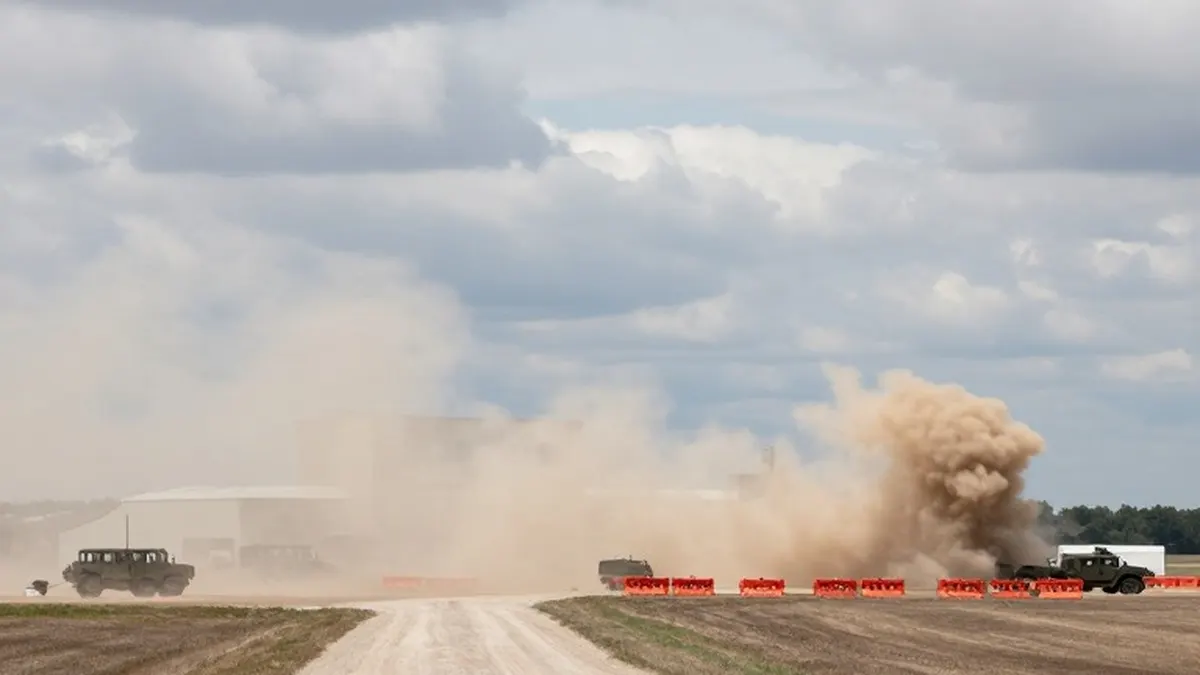
The U.S. Army has completed a controlled detonation of more than 60 barrels of unstable lead azide at the Iowa Army Ammunition Plant in Middletown. The explosion, which took place on Wednesday, involved roughly five tons of material that the military has utilized since World War I. The operation was designed to safely dispose of the hazardous substance, which had become increasingly difficult to manage due to its degraded state.
Missouri Governor Mike Kehoe posted on social media that initial analysis from federal partners and Iowa Homeland Security and Emergency Management suggests the mitigation measures were successful. He noted that the explosion appeared well-contained, though state agencies will continue monitoring efforts. The detonation was originally scheduled for the previous Friday but was rescheduled three times due to lawsuits filed by environmental groups seeking to block the blast.
The lead azide, used to ignite munitions, had been stored at the Middletown plant for decades. In recent years, crystals formed inside the storage containers, making the explosive acutely sensitive to movement and temperature changes. Administration officials stated at a Tuesday press briefing that chemical treatment was ruled out because the munitions had degraded to the point where moving them or opening their containers posed a risk of accidental detonation.
FEMA urged residents within 20 miles southwest of the plant to stay indoors with windows closed to minimize exposure to airborne lead dust, noise, and vibration. According to the Centers for Disease Control and Prevention, children and pregnant individuals face the greatest danger, as there is no safe level of lead exposure whether it is in the air or accumulated on surfaces. Some residents in the area have voluntarily evacuated from their homes.
Iowa National Guard forces have deployed 100 soldiers to assist local efforts and federal agencies. A statement from Iowa Governor Kim Reynolds indicated that these troops are supporting community outreach to 150 households. Iowa Public Radio compiled maps released by the Army showing that areas in southeast Iowa and northern Missouri could be affected by the explosion.
Professor Andrew Whelton of Purdue University, an expert in environmental disaster planning, criticized the timing and communication surrounding the event. He told NPR that the planning should have been better, noting that poor messaging caused anxiety and stress among residents and businesses. He added that some farmers reported they could not bring in their cattle due to a lack of facilities, highlighting the logistical challenges faced by the local community.
FEMA stated it was reaching out directly to homes in the highest risk areas to offer evacuation assistance. However, NPR reporters who called the FEMA hotline were informed that a callback regarding evacuation help could take several hours. Trump administration officials maintain that the detonation is the only safe method to dispose of the thousands of pounds of ordnance, which was moved to a bunker in Iowa 17 years ago. Authorities determined in March that the substance had become too unstable to transport.
On Tuesday, the acting Army Secretary and leaders of FEMA and the ATF addressed concerns that the explosion was a surprise. While acknowledging that the timing had been a moving target, they pointed to previous town hall meetings as evidence of ongoing communication. The military initially attempted a non-explosive neutralization method and worked on building berms while monitoring weather and the growing risk of an uncontrolled explosion.
Tom Croci, an official with the Environmental Protection Agency, explained that agencies focused on setting the right parameters with the Army to ensure the detonation occurred in the most optimal environment and at the best possible timing. This process involved significant back and forth to confirm safety conditions. Whelton expressed concern about the follow-through on toxic sampling and long-term cleanup, citing the government’s track record with events like the East Palestine chemical spill and Los Angeles wildfires.
Two Iowa environmental groups sued to block the blast, prompting President Donald Trump to tell the Army to wait for court approval and sign-off from Governor-elect Rob Sand. Trump stated he would blame Sand if anything went wrong. However, a federal appeals court cleared the way for the detonation on Monday, allowing the operation to proceed as scheduled.