St. Patrick's Day festivities brought diverse crowds into Chicago over the weekend, ahead of the holiday on Tuesday. On Saturday, a bar crawl at Williams Inn Pizza & Sports Bar on the Near South Side drew Black revelers dressed in green. The Black-owned bar played hip-hop classics and poured beer from Moor's Brewing Company, which is also Black-owned.
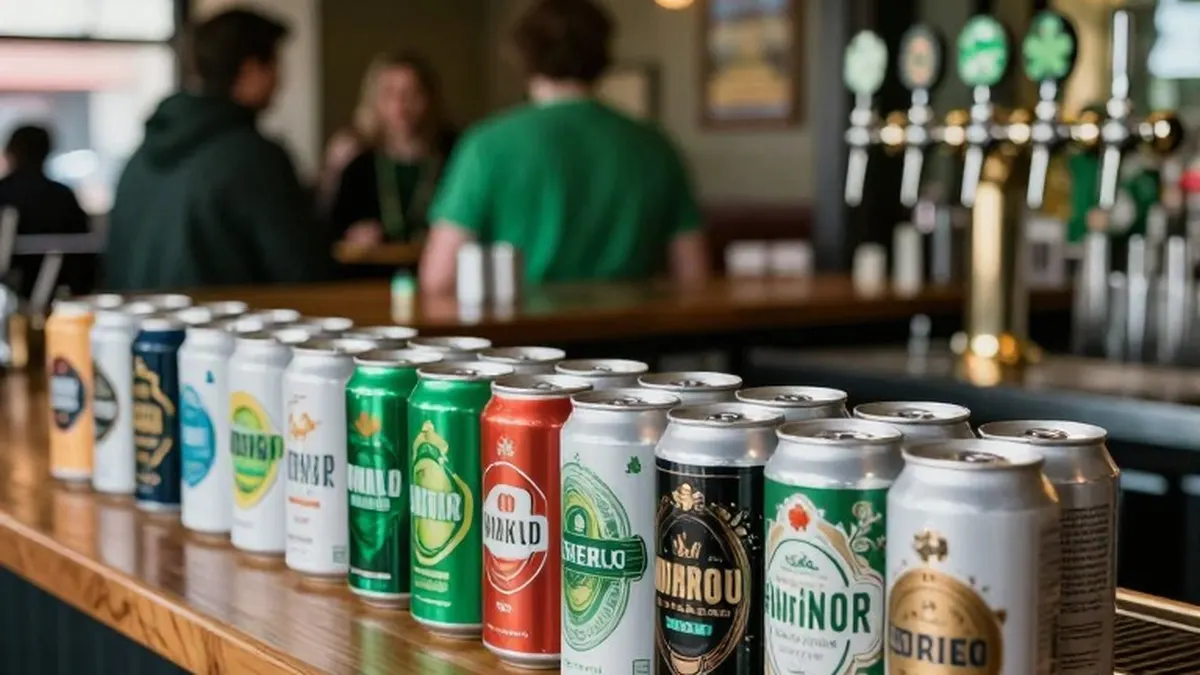
The company's lagers, porters, session ales and IPAs came in colorful cans showing Hendrik Heerschop's 17th-century painting "The African King Caspar," which depicts one of the three wise kings who bring gifts to the baby Jesus in the Bible. Co-owner Jamhal Johnson said the artwork is meant to teach. "It's a conversation piece. It's unapologetic," he said.
That emphasis on cultural celebration is one way Moor's and Funkytown Brewery, the city's two Black-owned breweries, stand apart in a volatile industry. Brewery closings are rising nationwide, and in Chicago at least five have shuttered or announced closures this year, driven by higher operating and production costs and a decline in the U.S. drinking rate.
Moor's and Funkytown have held up in part through contract brewing, which means making their beer at other breweries instead of immediately opening their own locations. They have also built followings by pairing their products with cultural events and courting a diverse customer base. The owners hope the approach will carry them once they open their own spaces. "Our brew company is the anchor. But at the end of the day, we're a brand," Johnson said.
Black-owned breweries make up less than 1% of the national market, according to the National Black Brewers Association. Still, in 2023, Black-owned breweries producing fewer than 1,000 barrels grew 9% faster than similar-sized peers. In Chicago, Vice District closed its South Loop and Homewood taprooms in 2019, and Bronzeville's Turner Haus Brewery announced last year that it would pause regular taproom hours and shift to events only.
Moor's was founded in 2021 by Johnson, Damon Patton and Anthony Bell, and currently brews under contract with Homewood Brewing. Funkytown was founded five years ago by Rich Bloomfield, Greg Williams and Zack Day and has operated out of the beverage incubator Pilot Project Brewing in Logan Square. It plans to open its own Near West Side facility in 2027, helped in part by a $3.7 million Community Development Grant from the city.
The Brewers Association notes that contract brewing is often a necessity as Black-owned businesses struggle to reach capital, industry connections, distribution and marketing. "When it comes to getting loans or investment, it's always been significantly harder for Black people," Bloomfield said. He added that craft beer has never been marketed to make his community feel included. "It's about community and creating a sense of belonging," he said.
Others are building bridges. Mickey Bryant, founder of the nonprofit Black and Brew Chicago, runs events such as a recent bus tour on Black contributions to craft beer. Terrance Owens partnered with five others in 2025 to launch Brutalist Brewing, advertised as Chicago's first worker-cooperative brewery, also based at Pilot Project. He said many closed breweries overreached, and that he wants "steady, reliable growth."
Black Horizon Brewing Company, a brick-and-mortar Black-owned brewery in Willowbrook, has managed by sourcing materials domestically and tailoring events and beers to local tastes, co-owner Charles St. Clair said. The local brewers also put one another's beers on tap. "The interest is there," St. Clair said of Black-owned taprooms. "It's just not financially feasible right now."