An unexpected cabin leak warning came close to upsetting NASA's Artemis II mission just before the crew was due to leave Earth orbit for the moon, pilot Victor Glover has said.
Speaking on Oct. 18 in a conversation with former Canadian astronaut Chris Hadfield at the Starmus VIII festival in Tenerife, Glover described how narrow the window was. "If it had happened five minutes later, we may not have been able to have that burn," he said.
The episode took place on April 2, the second day of the flight. Orion had been looping through a highly elliptical orbit around Earth, reaching about 38,000 miles (61,000 kilometers) out, a phase that let the crew and mission control check the capsule's systems before committing to the lunar journey. The spacecraft was then heading back toward its closest approach to Earth, roughly 100 miles (160 km) above the surface, ahead of the translunar injection (TLI) burn.
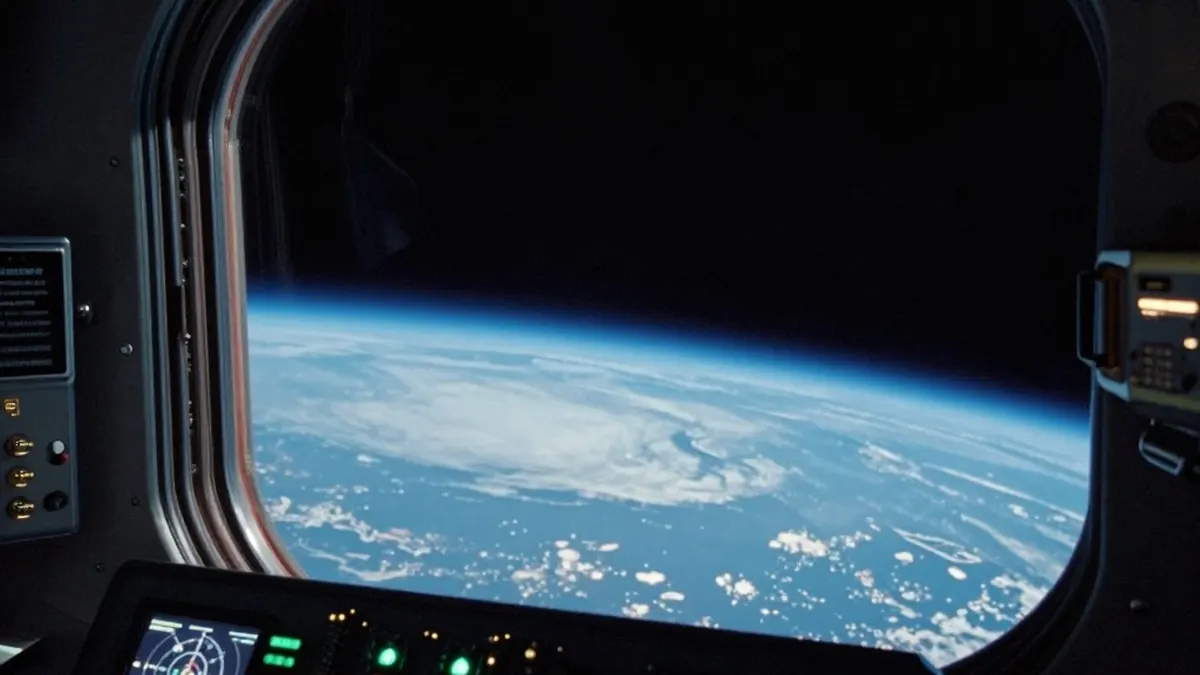
Glover said the low altitude was striking even to the crew. He recalled that mission specialist Jeremy Hansen of the Canadian Space Agency looked out the window and remarked, "I think we're going to run smack dab into the middle of Earth." The approach also took Orion through a region with orbital debris and satellites. "The density of things is going up from where we are, and also an increase in radiation," Glover explained.
About 15 minutes before the burn, Orion issued a warning indicating a possible cabin leak. "So, determining whether it was real or not was a big deal," Glover said. The crew and controllers had to decide whether to continue toward the moon or abandon the maneuver and end the mission early. "Are we going to do a TLI and burn to go to the moon, or are we putting on our spacesuits to prepare to come back to Earth right now?" he recalled.
The stakes were high because the TLI burn was meant to send Orion out of Earth orbit and onto its path around the moon, the first time astronauts had set out for the lunar neighborhood since the Apollo era. NASA flight director Judd Frieling said at an April 2 media briefing that the warning had been a false alarm.
With that settled, the mission received a go-ahead. Orion fired its main engine for about five minutes and 50 seconds, placing the four astronauts on course for the moon. Glover described watching the timer count down as velocities climbed and "the magenta and green numbers" converged. "Everything is tracking. It's looking good," he said.
Soon afterward the crew had escaped Earth's gravitational hold and was traveling toward the moon at about 24,500 mph (39,430 kph).
Artemis II went on to set a record. Commander Reid Wiseman, Glover, mission specialist Christina Koch and Hansen traveled farther from Earth than any humans before them, reaching a maximum distance of 252,756 miles (406,771 km) during their loop around the moon. The crew returned on April 10, splashing down in the Pacific Ocean off the coast of San Diego after nearly 10 days in space.