Mexican authorities announced on Sunday that eight suspected members of a criminal group led by Fausto Isidro Meza Flores have been arrested. The arrests followed a wave of violence that swept through the state of Sinaloa after the drug kingpin, known as Chapo Isidro, was captured in a joint operation with U.S. intelligence.
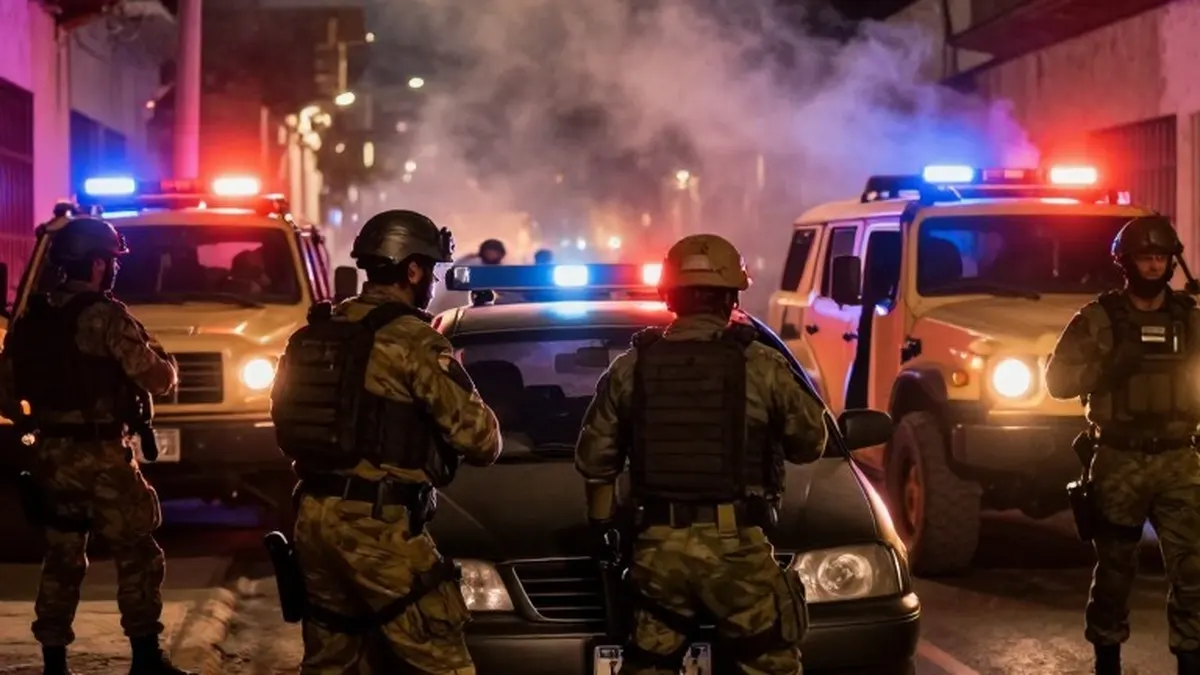
The defense ministry stated that the new arrests occurred during a special forces patrol. According to a post on the ministry's X account, the troops were fired upon by members of the Beltran Leyva criminal organization linked to Meza Flores. The ministry shared a video showing the nighttime apprehension of the suspects, noting that one of the eight was a minor who had participated in setting up roadblocks on November 20.
In addition to the arrests, military forces seized several high-caliber weapons and six vehicles. Officials reported that two of the captured vehicles featured improvised armor and turrets designed for mounting machine guns. This seizure highlights the level of preparation by the gang members who resisted the initial raid.
The military operation that led to Meza Flores' capture caused significant panic in the city of Guasave. Civilians fled from intense gunfire, while suspected gang members elsewhere in the state erected improvised roadblocks to hinder security forces. Defense Secretary Ricardo Trevilla confirmed on Monday that 16 cartel suspects have been killed in clashes since the operation began. Four soldiers also lost their lives during the confrontation.
Fausto Isidro Meza Flores, 44, led a drug trafficking organization affiliated with the Beltran Leyva gang. U.S. and Mexican authorities described him as a senior leader of the Sinaloa cartel. He had allied himself with one of two rival factions within the powerful cartel structure. He faced criminal charges in both countries and had been listed by the FBI as one of its ten most wanted fugitives.
The U.S. State Department had previously offered a reward of up to $5 million for information leading to his arrest. On Saturday, the U.S. Justice Department characterized Meza Flores as a key figure in the Sinaloa cartel, describing the organization as one of the most prolific and dangerous drug cartels in Mexico due to its widespread use of corruption and violence.
U.S. Ambassador to Mexico Ronald Johnson stated on social media that strategic intelligence sharing between the two nations helped make the operation possible. U.S. Attorney General Todd Blanche noted that the capture resulted from an operation by the Mexican government supported by a coordinated interagency effort, including the U.S. Homeland Security Task Force.
The timing of the capture was notable as it occurred just days after Mexican President Claudia Sheinbaum met with President Trump on the sidelines of a summit in Asia. President Trump, who has urged Mexico to take more action against drug gangs, said on Friday that the two leaders discussed trade and security matters.
Mexican officials have recently targeted several cartel leaders. The most prominent recent example is the death of El Mencho, considered Mexico's most powerful cartel leader, who was killed in February. That operation also resulted in a burst of violence and burning cars, similar to the events following Meza Flores' capture.
Mexican Security Secretary Omar García Harfuch wrote on X on Saturday morning that armed forces would remain deployed in Sinaloa to protect civilians. The continued military presence aims to stabilize the region and prevent further clashes as the aftermath of the major operation continues.