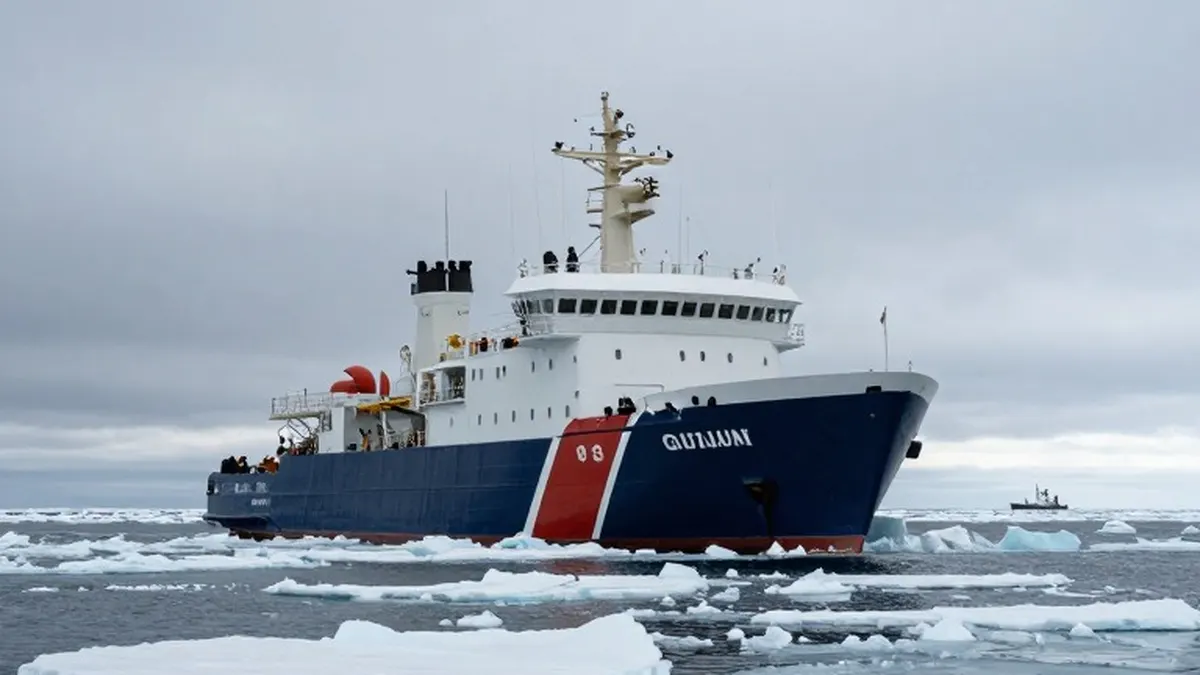
A single mechanical failure this summer cut the Coast Guard's icebreaking capability in the Arctic in half, highlighting how thin America's presence in the region remains. The breakdown came as Chinese vessels expanded their activity around Alaska.
Rear Adm. Bob Little, commander of the Coast Guard's Arctic District, told Fox News Digital that the failure aboard Coast Guard Cutter Healy left him with just one of two icebreakers that had been slated to operate in the ice. At the same time, four Chinese research vessels were working in the region. "Healy's unexpected mechanical failure cut in half my capability to operate up in the ice," Little said.
The shortfall arrives as the United States faces growing pressure to maintain a presence in waters that can take days to reach. Chinese research vessels are gaining Arctic experience and collecting data that can also serve military purposes, including submarine operations. Russia, meanwhile, has a much larger icebreaker fleet, which gives Moscow a greater ability to move ships and supplies through the area.
The Coast Guard is working to add ships, aircraft and surveillance capabilities as shrinking sea ice opens more of the Arctic to navigation. Its next generation of icebreakers, however, is still years away. Little said nearly $25 billion in recent funding will support 11 new Arctic Security Cutters, with the first expected in the region as early as 2028. "I can't get those icebreakers soon enough, given the operational environment," he said.
Little said the Coast Guard's operating area is effectively growing, because declining sea ice is opening more navigable water around Alaska. That is drawing more commercial and military activity into areas once harder to reach, and creating a need for additional Coast Guard missions.
China has become a more regular presence there. According to Little, Chinese research activity has grown from as few as one vessel appearing episodically to five last year, with four operating in the Arctic this year. The vessels are not necessarily breaking international rules. Coast Guard Cutter Munro recently returned from a 112-day Arctic patrol that included monitoring Chinese research ships, and Little said the crew saw no surface activity outside customary law or international norms.
The concern, he said, is what China can learn simply by operating there. Research can support scientific work or economic studies tied to future exploitation of critical minerals and scarce resources, Little said. It can also help military efforts, such as mapping seabed floors and navigating subsurface assets.
Troy Bouffard, director of the Center for Arctic Security and Resilience at the University of Alaska Fairbanks, said the activity gives Beijing experience in an environment where it has historically had little. "They're pretty desperate to gain operational experience and knowledge in terms of their growing military capabilities," he said. He added that the data collected is legitimate science but can also be useful for submarine warfare planning.
Bouffard said the challenge goes beyond icebreaker numbers. Unlike the North Atlantic, where the U.S. and its allies have decades of infrastructure and experience, the North Pacific side of the Arctic has far less to support a sustained presence. Reaching the Bering Sea from Kodiak, Anchorage or Seattle can take several days. "If we can't have presence, surface presence in an area, it's very difficult to manage issues that may escalate," he said.
The Coast Guard is also watching cooperation between Moscow and Beijing, Little said. It has observed joint Russian-Chinese military surface groups, cooperation between their coast guard forces, and Chinese research vessels collaborating with Russia and "likely sharing information." "Either of them alone are worth paying attention to," Little said, but when they work together, the Coast Guard watches closely for any threat to homeland security or military risk to the United States.