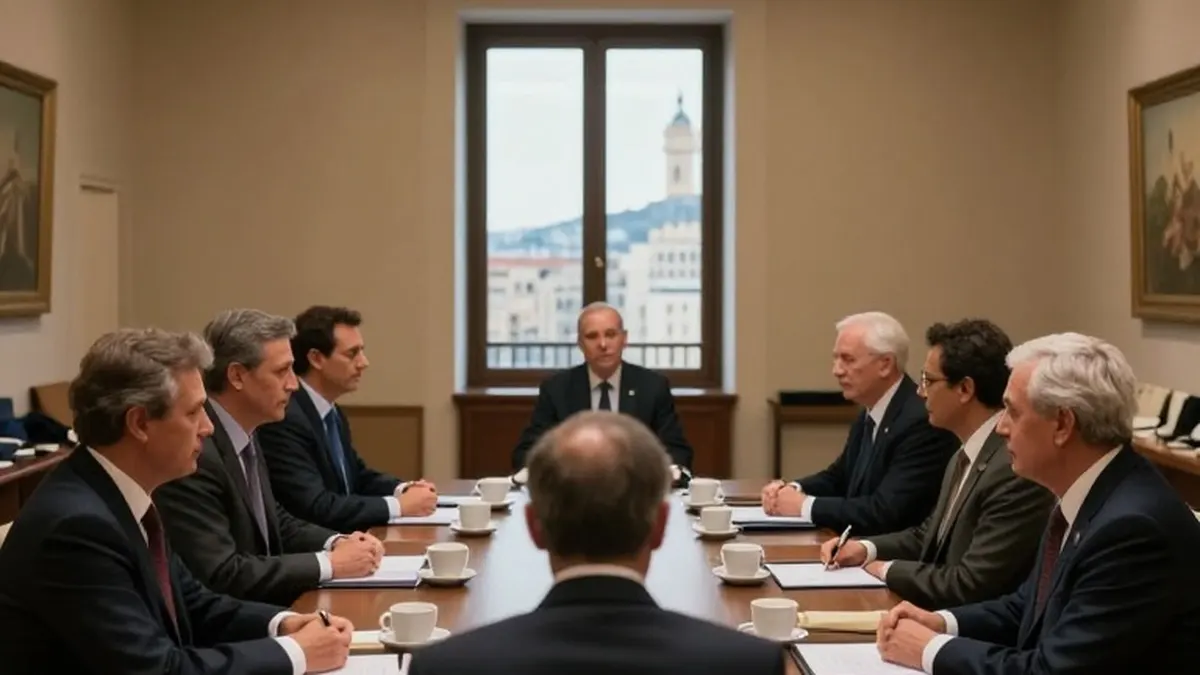
Leaders from the United States, China, and Russia have agreed on a joint peace statement following a historic trilateral meeting. The declaration, released on Thursday, focuses on strategic stability and diplomatic norms but does not reference the ongoing wars in Ukraine and Iran, two conflicts directly involving two of the participating nations.
The summit took place during the Asia-Pacific Economic Cooperation (Apec) event, which China hosted this week. President Donald Trump, President Xi Jinping, and President Vladimir Putin convened for approximately one hour and twenty minutes. Trump described the session as a moment of making history, emphasizing that peace is forged through engagement. Putin later characterized the talks as a free discussion that resulted in mutual understanding.
A central theme of the declaration was nuclear security. The leaders reaffirmed the principle that a nuclear war cannot be won and must not be fought. While this language mirrors previous statements by the five permanent members of the UN Security Council, Xi Jinping called for nuclear weapons to be eventually prohibited and destroyed. Experts noted that China’s willingness to engage in these discussions is significant, even if the text did not establish a new framework for denuclearization.
The statement also prioritized the reform of the United Nations to make it more responsive to global challenges. Analysts suggested this reflects Beijing’s desire to flex its diplomatic influence and set the agenda for international deliverables. Additionally, the leaders committed to protecting diplomatic immunity and stated that international courts, including the ICC, should avoid abusing their jurisdiction. This clause has been interpreted as favorable to Putin, who is currently subject to an ICC arrest warrant.
Despite the high-profile nature of the meeting, some geopolitical experts argue that the summit was more about symbolism than substantive outcomes. Prof William Hurst of the University of Cambridge suggested the event served to demonstrate Russia’s continued relevance. Putin rejected the idea that it was merely a photo opportunity, describing it as serious collaborative work.
The declaration included a commitment to increase the production and supply of refined petroleum products for the benefit of all nations. This economic provision is viewed as important by researchers, though its success may depend on whether the US lifts sanctions on Russia. The three leaders also expressed intent to maintain strategic stability and international security.
Bilateral meetings accompanied the trilateral session. Trump and Putin held their first meeting since August 2025, with the US president referring to the Russian leader as a friend. Subsequently, Trump and Xi met for the third time this year. Xi described the US-China relationship as generally stable and positive, though he urged Washington to handle the issue of Taiwan carefully to avoid setbacks.
Technology was also on the agenda, with Xi suggesting that the US and China should enhance coordination to manage security risks in artificial intelligence. He emphasized the need to ensure that AI remains under human control. The lack of detailed findings on AI and other complex issues may suit China, which prefers the role of convener to that of a direct broker in resolving the Ukraine and Iran conflicts.
For much of the day, Apec-specific business matters took a back seat to the high-level diplomatic discussions. Xi addressed Apec leaders in the morning, using a metaphor about passengers on the same ship to appeal for regional harmony. Despite the camaraderie displayed, the relationships remain complex, with Russia under US sanctions and the US and China having recently emerged from a significant trade war.