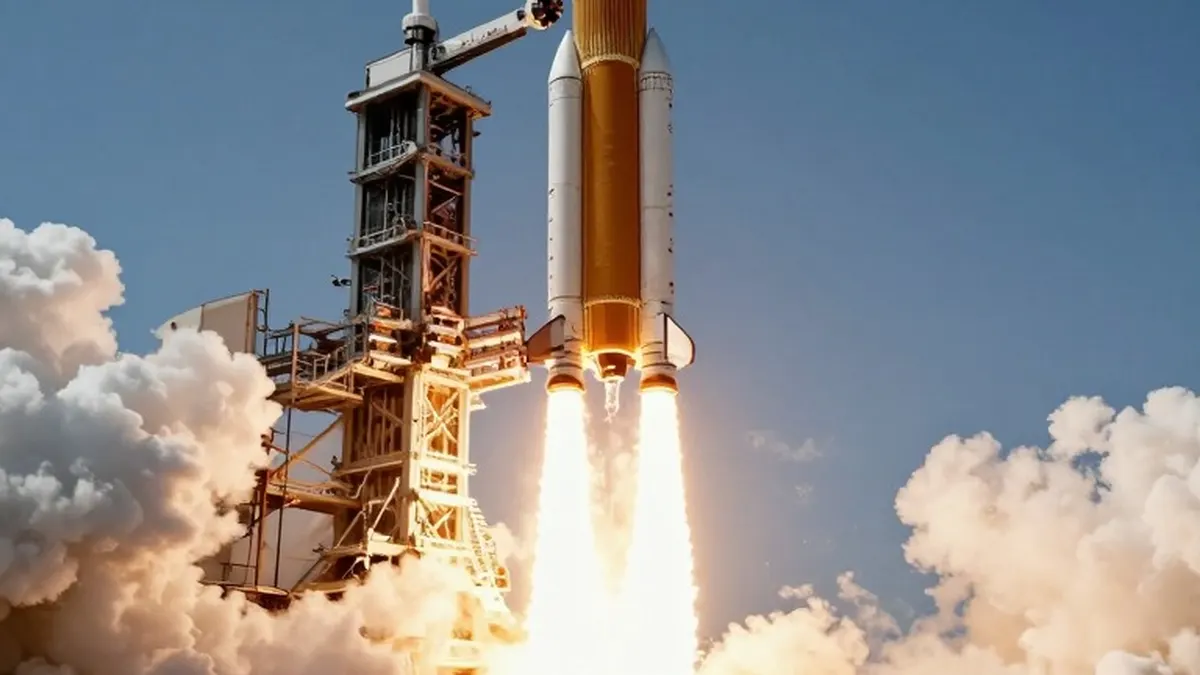
China successfully launched the Shenzhou 24 spacecraft on Wednesday morning, marking a significant milestone in the nation's space program. The mission carried a three-person crew consisting of two Chinese astronauts and one Pakistani astronaut. This flight represents the first joint mission involving both Chinese and foreign astronauts in the history of China's manned space efforts.
The spacecraft lifted off from the Jiuquan Satellite Launch Center in northwestern China. After separating from its rocket, the craft successfully entered its predetermined orbit. The launch was preceded by a send-off ceremony where large crowds gathered, many using their mobile phones to record the event.
The crew members are Tang Hongbo, 51, Wu Yi, 39, and Muhammad Zeeshan Ali, 40. Tang and Wu are Chinese astronauts, while Ali is the first Pakistani to travel to space. This joint flight is the result of an agreement signed between China and Pakistan in February 2025, which paved the way for increased collaboration in the space sector.
According to reports from the official Chinese news agency Xinhua, the crew is scheduled to perform over 90 scientific experiments and technology tests during their time in orbit. Ali will participate in a short-term mission, during which he is set to conduct an experiment involving photosynthetic cyanobacteria. He will eventually return to Earth aboard the Shenzhou 23 spacecraft.
This is a veteran mission for Tang, who has flown on two previous spaceflights. National broadcaster CCTV noted that this flight will make him the first astronaut to board the Tiangong space station for a third time. In contrast, this marks the first spaceflight for both Wu and Ali.
Pakistani Prime Minister Shehbaz Sharif extended his best wishes to the crew before the launch. On Tuesday, he posted on the social media platform X, stating that the friendship between Pakistan and China is surpassing the heights of the Himalayas in its journey to outer space.
At a press conference held on Tuesday, Tang discussed the challenges of working with an international partner. He acknowledged that differences in language, culture, and psychology made the preparation process more difficult. However, he expressed satisfaction that the efforts of both sides were yielding positive results.
During the same event, Ali demonstrated his proficiency in Mandarin. He recited a line of Chinese poetry regarding climbing to higher elevations to see more distant views. He described this as akin to his daily training, where he reaches new heights day after day.
Speaking in English, Ali expressed hope for the future of space cooperation between the two nations. He envisioned a progression from a single astronaut on one flight to multiple joint missions, with ultimate goals including the moon, Mars, and beyond.
China has been actively expanding its space presence in recent months. In May, the country launched another mission carrying three astronauts, one of whom was slated to remain in space for approximately one year. The nation has also set a target for its first crewed lunar landing by 2030, a goal that positions it as a primary rival to the United States, where NASA aims to return humans to the lunar surface by 2028.