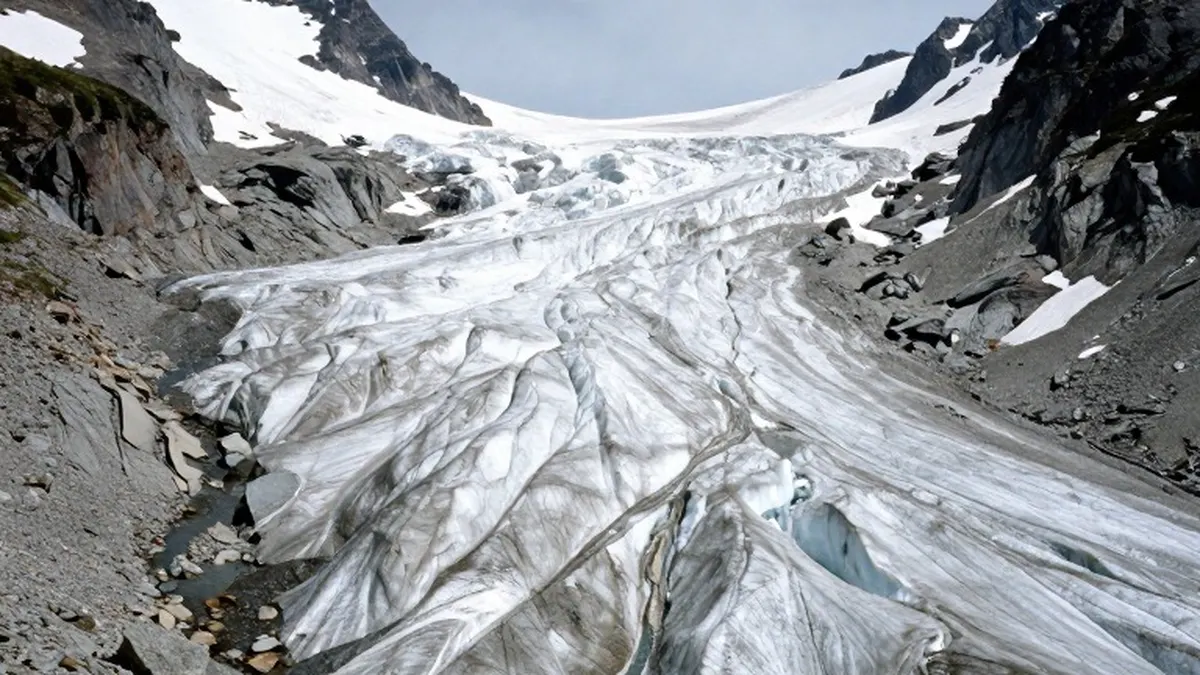
The most prominent glaciers in Colorado thinned dramatically over the past year, according to new research, after record low mountain snow was followed by record warm temperatures.
Glaciologist Dan McGrath of Colorado State University set out to examine 2026 specifically, even though scientists usually track glacier change over much longer periods. He said the year stood out because the state's worst snowpack on record, followed by record summer heat, left the year-round ice masses of the Rocky Mountains exposed.
The Andrews Glacier thinned by more than 12 feet (3.7 meters) in this single year. The Arapaho Glacier lost nearly 10 feet (3 meters), and the Isabelle Glacier lost about 6.5 feet (2 meters). McGrath said those figures double the rate of thinning seen over the prior five years. In the decade before that, thinning measured a foot or less per year. St. Mary's Glacier, a perennial snowfield popular with hikers and skiers, melted completely in September.
"What we're witnessing is the loss of that part of Colorado's identity. And it's not just Colorado," said McGrath, who specializes in glacier dynamics. He pointed to similar patterns in other western U.S. ranges, the European Alps and elsewhere, calling them "very clear, consistent patterns."
The losses fit a wider global trend. Research shows more than 7 trillion tons of ice (6.5 trillion metric tons) has vanished worldwide since 2000. That slow-motion disaster can turn sudden: in August, more than 1,300 people were killed after a massive section of rock and overlying glacier collapsed near Nepal's border with China. Swiss glaciers lost 5.5% of their ice volume this year, the second-biggest percentage drop on record, according to the GLAMOS monitoring service and the Swiss Academy of Sciences, which said alpine glaciers have no chance of surviving long-term under such conditions.
In Washington state, the North Cascade Glacier Climate Project surveyed six glaciers on Mount Baker and found the fastest average retreat since 1950, along with the collapse of several large ice caves. Director Mauri Pelto said such caves form as warm air circulates in retreating glaciers.
Brian Menounos, an earth sciences professor at the University of Northern British Columbia, co-authored a new study on glaciers in the contiguous United States. They average just 0.16 square miles (0.41 square kilometers) and sit at high elevations. Since the mid-1900s, about one-quarter have disappeared, and the remnants have lost a third of their area and volume. Menounos said their runoff supplies high alpine and downstream ecosystems across the West, which may become more vulnerable to extreme drought as the ice disappears. He added that wildfires deliver a "one-two punch" by darkening glacier surfaces with soot and dust, so they absorb more sunlight.
Glaciers could re-form if carbon pollution falls substantially and temperatures drop enough for snow to build up year-round and compress into ice, but Menounos said that may take several hundred years. McGrath said Colorado's remaining glaciers could vanish much sooner. The Andrews Glacier has already lost half its ice since 2017, and he said they are thinning at a rate that "could lead to their demise in the next 20 years."
Harlan Ulmer, 20, a Colorado State University student who has photographed the glaciers annually since 2022 and volunteers on McGrath's project, called the decline sad but important to record. "Being Gen Z, I came in too late to ever see the glaciers at their largest," he said, adding that he hopes to document the changes for future generations.