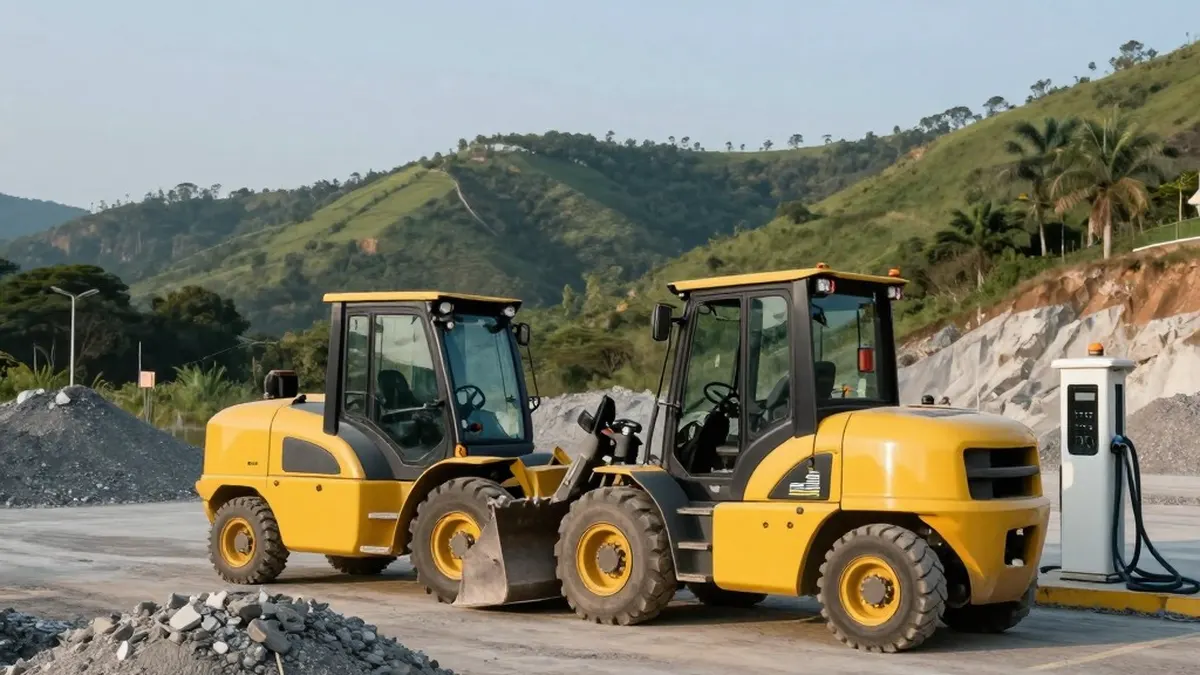
SDLG Brasil has closed its first sale in Brazil, supplying six heavy-duty electric wheel loaders to Grupo Base, a Brazilian company active in mining, construction and infrastructure. The first of the machines are reportedly already on site, moving material without the noise of a conventional diesel engine.
Grupo Base placed the order in June. It covers four 27-ton L972 HEV loaders and two 12.5-ton L938 HEV loaders, all built by Shandong Lingong Construction Machinery Co., Ltd., the Chinese manufacturer behind the SDLG brand. The name is drawn from the company's own: "SD" stands for Shandong and "LG" for Lingong.
Carlos Renato Machado, executive director of Tracbel, SDLG's Brazilian distributor, described the contract as "a historic milestone." He said it arrives as the distributor has taken on commercial responsibility for SDLG across 60% of Brazil. Machado added that the company hopes to broaden the use of electric mining and construction equipment across the wider region.
On the technical side, the two models use lithium iron phosphate (LFP) battery packs of different sizes. The larger L972 carries a 423 kWh pack and sends power to a 230 kW electric motor, equivalent to roughly 305 horsepower. The smaller L938 has a 180 kWh pack and a 180 kW motor, or about 240 horsepower.
Both configurations are said to support a full day of continuous operation, with fast DC charging available between shifts.
The buyer operates at considerable scale. Grupo Base runs a fleet of 450 heavy equipment assets across more than 30 concrete and mortar batching plants and 20 sites producing crushed stone and fracking sand. The company employs more than 2,000 people.
Electrifying machinery on that scale would offer a significant environmental benefit in an ecologically sensitive region, a point that Grupo Base's leadership appears to recognize. Edson Pechio, the company's president and CEO, said: "We are driving a major transformation across our operations." He added that the company wants to adopt solutions that allow it to operate more efficiently while progressively reducing greenhouse gas emissions.