
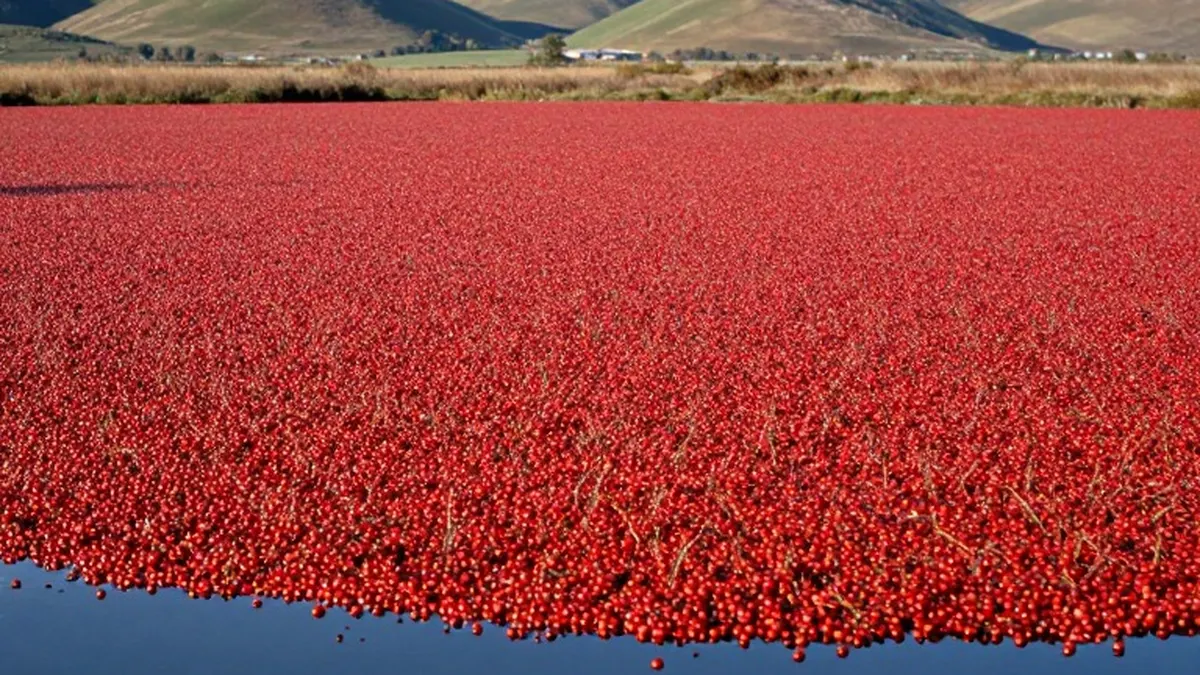
The autumn landscape in rural Wisconsin is currently defined by a vibrant red hue as the state's most prominent crop reaches harvest. Wisconsin remains a dominant force in the industry, producing over 60 percent of the nation's cranberry supply. Nicole Hansen, who has cultivated these berries for nearly thirty years, guides visitors through the marshes where the harvest takes place. The process involves wading into flooded beds to corral the buoyant fruit that has been shaken loose from the vines by specialized machinery.
While cranberries are native to North America, their growth cycle is often misunderstood. They do not grow submerged in water but instead thrive on low-lying vines in dry soil. It is only during the harvest that the beds are flooded to allow the berries to float. This highly choreographed process combines mechanical precision with manual labor, yet it remains entirely dependent on atmospheric conditions. Hansen notes that growers monitor the weather frequently, sometimes checking forecasts five to ten times a day, because every step of the operation is governed by meteorological factors.
Across the United States, weather patterns are becoming increasingly erratic, a trend largely attributed to the climate crisis. In producing states such as Massachusetts and New Jersey, record-breaking summer heatwaves have begun to cause fruit scalding. This phenomenon causes berries to bake on the vine before they can be collected. Additionally, rising humidity and heavy rainfall during the growing season create stagnant, moisture-rich environments. These conditions invite fungal pathogens that can lead to devastating crop rot.
In Wisconsin, the primary climate threats often manifest after the harvest has concluded. To shield the plants from winter cold and damaging winds, growers spray water over the vines. This water freezes to form a thick layer of ice that acts as a natural thermal blanket. Amaya Atucha, a fruit scientist at the University of Wisconsin-Madison, explains that without this protection, the vines are susceptible to significant cold damage.
Data from Climate Central indicates that winters in the upper Midwest are warming faster than in many other parts of the country. Cranberry-growing regions now experience an average of 14 more warm winter days than they did in 1970. These shifts trigger erratic cycles of thawing and freezing. Atucha points to recent years where unusually warm temperatures in February melted protective ice sheets prematurely. This left vulnerable vines exposed to sudden deep freezes, highlighting the unpredictability of the new climate patterns.
To ensure this seasonal staple remains on holiday tables, scientists and growers are racing to adapt. Researchers are utilizing artificial intelligence to identify and breed new crop varieties that are more resilient to extreme weather and disease. In the field, growers are integrating advanced technology into their daily operations. Drones are now used to apply fertilizers with precision and to monitor temperatures across vast marshes and bogs.
The transition to new methods is a necessary response to changing conditions. Atucha describes the situation as a game where the rules have suddenly changed, requiring immediate adjustment. For modern farmers, adapting to these shifts is an integral part of the job. Despite the challenges, the harvest continues to be a source of pride and livelihood for those who work the land.
On a clear autumn morning, surrounded by the glassy water and floating red berries, Hansen reflects on the enduring appeal of the work. She describes the experience as amazing and a great way to raise a family, acknowledging the pull of the crimson tide that defines the region's agricultural identity.





