Production designer Uli Hanisch initially believed that filming the highly anticipated 'Hunger Games: Sunrise on the Reaping' in the remote town of Asturias, Spain, would protect the project from leaks. The chosen location was a desolate valley that required hours of travel to reach, with limited nearby accommodations and restaurants. Despite these precautions, dedicated fans managed to locate the set. Hanisch recalls that after only a few days of building the arena pieces, images surfaced online from enthusiasts who had found the crew in the secluded landscape.
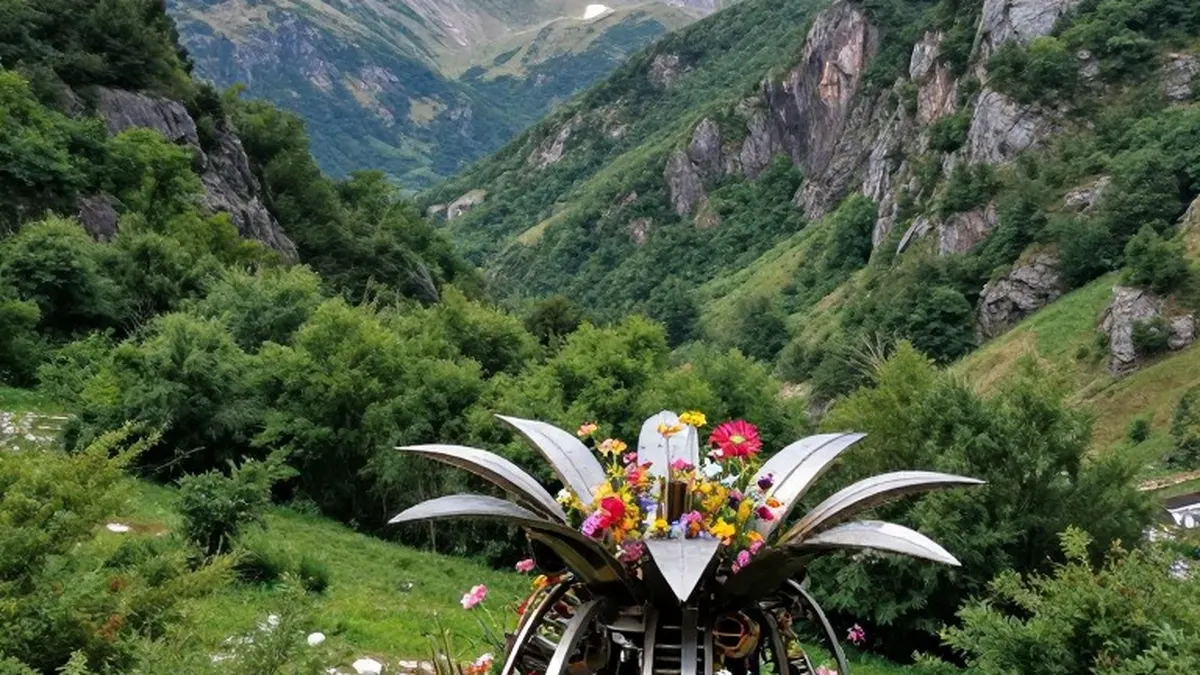
Although the location was remote, Hanisch was convinced it was the perfect setting for the Second Quarter Quell arena upon seeing the contrast between the lush greenery and the jagged mountains. He shared an image of the valley with director Francis Lawrence, who confirmed that the production would proceed there regardless of the logistical challenges. The team then began the complex task of designing the Cornucopia, the central structure of the games. This element is intended to distinguish each iteration of the franchise while balancing aesthetic beauty with underlying danger.
The design featured a blossom with metal spikes serving as petals, surrounded by thick beds of wildflowers arranged by color to mark the positions of the tributes. Hanisch described the result as elegant yet deadly, noting that the opening scene with caped tributes resembled a strange cult. Once the games commenced, the tributes moved into a flourishing woodland environment where the foliage was both extravagant and lethal. A small team of six worked for three weeks to dress the arena, using up to 600,000 artificial flowers for the arrangements around the Cornucopia alone. Hanisch noted that the visual experience in the film was further enhanced by visual effects.
The production also required the invention of deceptively beautiful mechanical devices, such as the berms. These structures served as mechanical bushes that acted as portals for mutts to enter and exit the arena, while also providing a conduit for the character Haymitch to destroy the mechanism. Hanisch described the process of creating these elements as long, tiring, and complex, as the team had to devise sensible explanations for their function within the story.
Recreating District 12 offered a different experience, described by Hanisch as coming home. The cast and crew returned to the same abandoned steel mill factory in Germany used for the 2023 prequel 'The Ballad of Songbirds and Snakes'. This location near Hanisch's hometown of Nuremberg allowed the team to capture the dreary atmosphere of the downtrodden district. The production team agreed that District 12 should remain unchanged from the previous film, a choice Hanisch appreciated deeply.
In contrast, recreating the Capitol of Panem presented a familiar but distinct challenge. The 2023 prequel established a Capitol based on post-World War II Berlin, but 'Sunrise on the Reaping' jumps twenty years forward into a 1970s aesthetic. The filmmakers sought to portray the capital at the peak of its power, wealth, and arrogance. They returned to Berlin for its unique architecture and ability to capture these power dynamics. The International Congress Center in Berlin was selected as a key location, with Hanisch comparing it to a Star Wars spaceship that had landed in the middle of the city.
The choice to use a 1970s style was rooted in the same principle as the arena design: beauty masking danger. Hanisch explained that while the 1970s are often remembered as a progressive era of youth rebellion, they were also the peak of Western wealth. Society was proud and untouchable, making it an interesting twist to show this opulence in Panem. This imagery was derived from the filmmakers' interpretation of Suzanne Collins' novel and the subsequent screenplay by Billy Ray and Michael Lesslie.
Translating the book into a film remains a significant challenge, as every reader creates their own mental world. Hanisch acknowledged that it is impossible to satisfy every interpretation, so the team focused on the writer's intention and their own vision. This approach helps ground the production when dealing with such a massive and devoted fan base. Hanisch emphasized that the primary goal is to make fans happy, a mission he takes seriously and finds fascinating.
The production team has invested considerable thought into the experience of the audience, recognizing the deep emotional connection many people have with the franchise. While it is Hanisch's job and a source of professional pride, he views the work as a service to the fans. He believes that by staying true to the source material and the creative vision, the team can ensure that the audience leaves satisfied with the final product.