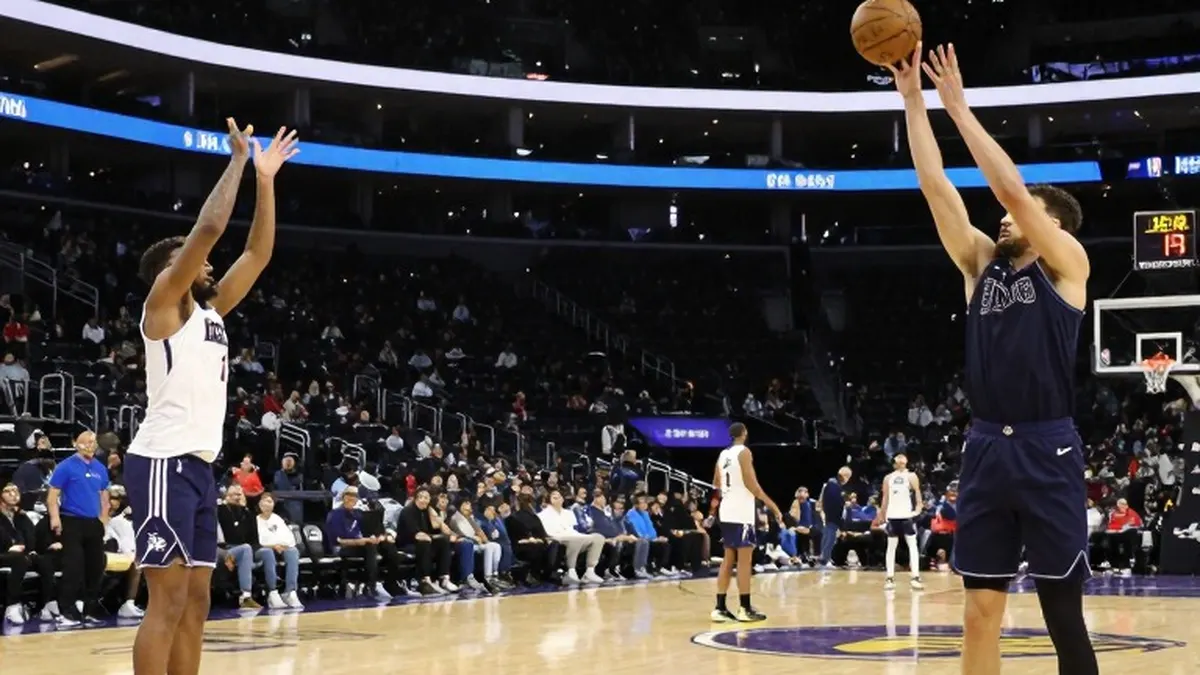
The United Center in Chicago hosted a decisive victory for the No. 5 Michigan State Spartans over the No. 2 Duke Blue Devils in a Champions Classic matchup. The final score was 79-73, a result that left Duke head coach Jon Scheyer visibly frustrated as he rushed to the podium in the lower levels of the arena. Scheyer was candid in his assessment, stating plainly that the performance was not representative of the standard Duke basketball.
The Duke coach, known for his steady and process-oriented demeanor, offered a critical review of his team's efforts. He pointed to specific deficiencies in guard play, team connectivity, and overall toughness. It is difficult to contest his observations, as the Blue Devils displayed bad habits and poor shot selection that had previously appeared in shorter bursts against Army but were prominent throughout this contest. While Duke remains a contender for the NCAA Tournament, this game highlighted that the team is not currently at its peak performance level.
Michigan State dominated the flow of the game, largely due to the control exerted by national player of the year frontrunner Jeremy Fears Jr. The Spartans appeared well-connected, whereas the Duke offense struggled significantly. The Blue Devils managed only 0.75 points per possession during a 25-point first-half segment. Long-standing tenets of Scheyer’s offensive philosophy, such as unselfishness and effective cutting, were notably absent for much of the night.
Scheyer described the experience as an out-of-body moment, noting that his team failed to play through resistance or progress to the next action. He observed that Duke frequently resorted to one-on-one plays against set defenses, leading to blocked shots and turnovers. Scheyer acknowledged that Michigan State’s defense was a major factor in creating separation, but he expressed disappointment in his team’s ability to fight for better shots and control the rim.
The defensive prowess of the Spartans was a central theme of the game, particularly the performance of sophomore wing Jordan Scott. Scott demonstrated a significant leap in his second year, recording nine rebounds and six blocks. Michigan State forward Cam Ward identified Scott as the X factor on defense, praising his constant presence and impact on the court.
This victory aligns with Michigan State’s historical identity, relying on physicality, high-level point guard play, and toughness. The Spartans executed their standard script of defending, rebounding, and running. With a capable group and the potential for increased shot-making from freshmen Carlos Medlock Jr. and Jasiah Jervis, Michigan State is positioned to make a serious run in March.
Duke’s guard play was a significant point of contrast. Cayden Boozer and Caleb Foster struggled to influence the game, with Boozer playing only nine minutes in the second half. Foster shot 2 of 10 from the field, including some contested attempts. Wisconsin transfer John Blackwell finished with a team-high 17 points, largely due to a late-game flurry when the outcome was already decided. Scheyer admitted that the perimeter game was underwhelming and that his guards need to improve.
The performance of 17-year-old freshman Joaquim Boumtje Boumtje also drew attention. Despite preseason hype as a top prospect, Boumtje Boumtje was quiet in this game, scoring just five points and grabbing four rebounds. Scheyer noted that while the young player is wired for high-level moments, the team must find better ways to get him into position. He emphasized that Boumtje Boumtje must continue to learn how to impact the game through defense and rebounding when not shooting.
The result sends Duke back to the drawing board as Scheyer searches for a team that plays collective rather than individual basketball. He aims to find lineups with better balance and shooting. For now, the Blue Devils face a period of recalibration as they work to address the issues exposed by the Spartans.