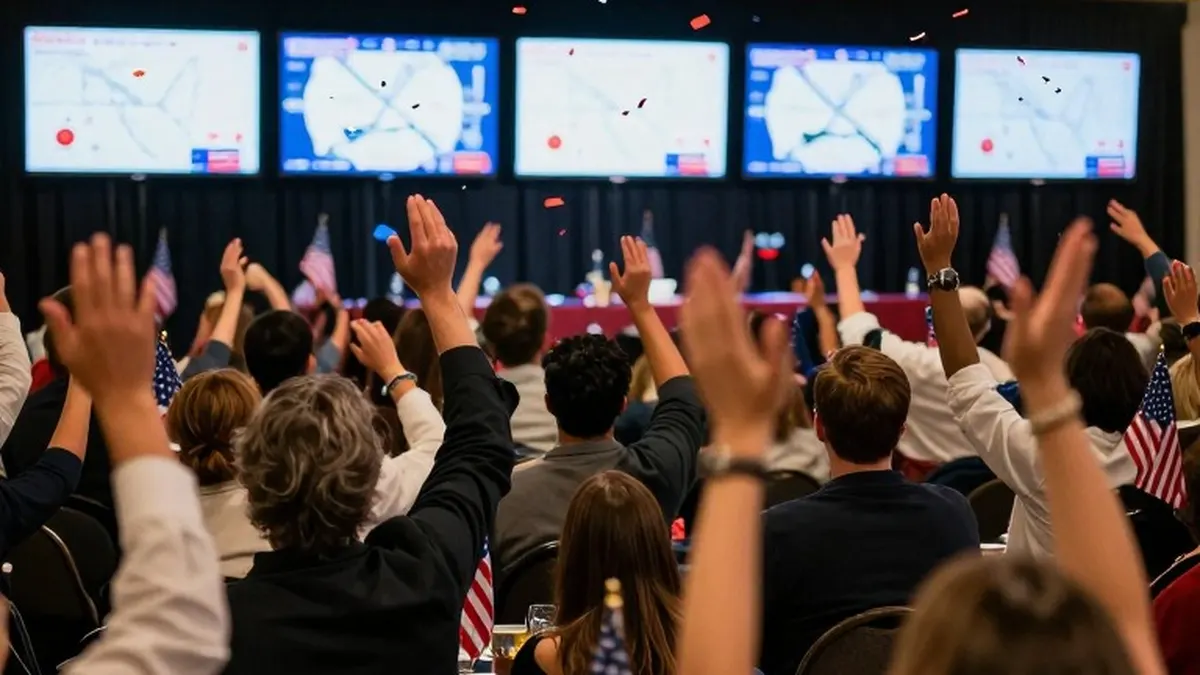
Democrats and their supporters in Hollywood celebrated a historic election on Tuesday night, and some of the people who helped orchestrate the wins are now trying to draw lessons from the results. Among them is Jane Kleeb, a vice chair of the Democratic National Committee under Ken Martin who also leads the Association of State Democratic Committees, which represents the party in each state and territory. The native Nebraskan and longtime activist was in a giddy but pragmatic mood on Wednesday as she broke down the outcome in a phone interview.
Kleeb said she had expected Democrats to retake the House and the Senate, win some governors' races and break Republican supermajorities at the state legislative level, given the quality of the candidates and the infrastructure the party had built. What surprised her was the scale. In some races the margins were not one or two percentage points but five or six or more, which she called a resounding victory rather than simply a vote against President Trump.
She pushed back on pundits who framed the night as only a rebuke to Trump, crediting Democratic organizers and candidates who looked and sounded like their communities and were fighters. She said candidates this cycle acted as if they had nothing to lose because they viewed Trump as such a threat to democracy, and that the effort played out across the country rather than only in targeted battleground states.
Asked whether the party needed to hit rock bottom after its 2024 defeat, Kleeb pointed to a major reality check in 2024 and even in 2016, noting that the 2020 win was not enough to carry Democrats and that divisions over keeping Joe Biden as the nominee or switching candidates 100 days out showed a party that could not find its voice or footing. "We had to hit the bottom," she said. She added that Black, young and Latino voters the party had frankly taken for granted saw Trump as a change agent who would break up the status quo, and when he did not deliver, Democrats repositioned themselves as the party fighting for change to level the playing field.
Kleeb acknowledged that the pattern did not hold everywhere, including California, where a proposed billionaires' tax appeared headed for a bad defeat. She offered several possible explanations, saying people may simply not like taxes and that the ballot layout was confusing, with a billionaire tax and a ban on a billionaire tax sitting next to each other and both resembling a property tax. She said she still believes voters are deeply frustrated with the billionaire class and want accountability, suggesting alternatives such as stopping giveaways at the federal level.
Unlike past Democratic sweeps, such as 2008 with Barack Obama, this one had no central charismatic figure. Kleeb described the difference as "the story of a team instead of a lead actor," arguing the party shines when it does not rely on one person. She noted that Democrats lost 1,500 local seats over Obama's eight years because the party was not investing in state and local infrastructure, a lesson she said was learned the hard way.
Her biggest surprise of the night was Mississippi. Kleeb said Symone Sanders, a fellow Nebraskan, had been talking up the state, prompting a visit, though Kleeb initially doubted anything could happen there this cycle. She cited Brandon Presley's near miss in the 2023 governor's race without enough resources, and said Scott Colom, who was leading incumbent Cindy Hyde-Smith by a few dozen votes with 44,000 ballots outstanding, had gotten there on sheer grit. Colom's viral "pick another protein, pick another Senator" ad, mocking a Hyde-Smith debate line, drew particular praise. "Damn, we should have known," Kleeb said.
On resources, Kleeb rejected the premise that money is limited, saying the amount raised this cycle shows there is plenty of money in the political system. She said she, Chair Martin and others across the party's 57 states and territories believe Democrats should maintain permanent infrastructure everywhere, year-round, with no exceptions. She dismissed the idea that states like Florida are beyond hope, noting Colorado and Georgia were red not long ago and that Florida, where she grew up, was once a swing state. She predicted significant shifts in places like Florida and Nebraska, where an independent Senate candidate came close to defeating a Republican this cycle, heading into 2028.
Looking ahead to governing, Kleeb said having moderates, progressives and far-left activists in the same caucus is an advantage rather than a risk, because it will produce durable, long-lasting policies that all kinds of Americans will embrace. The American people, she said, hold all those different views too.