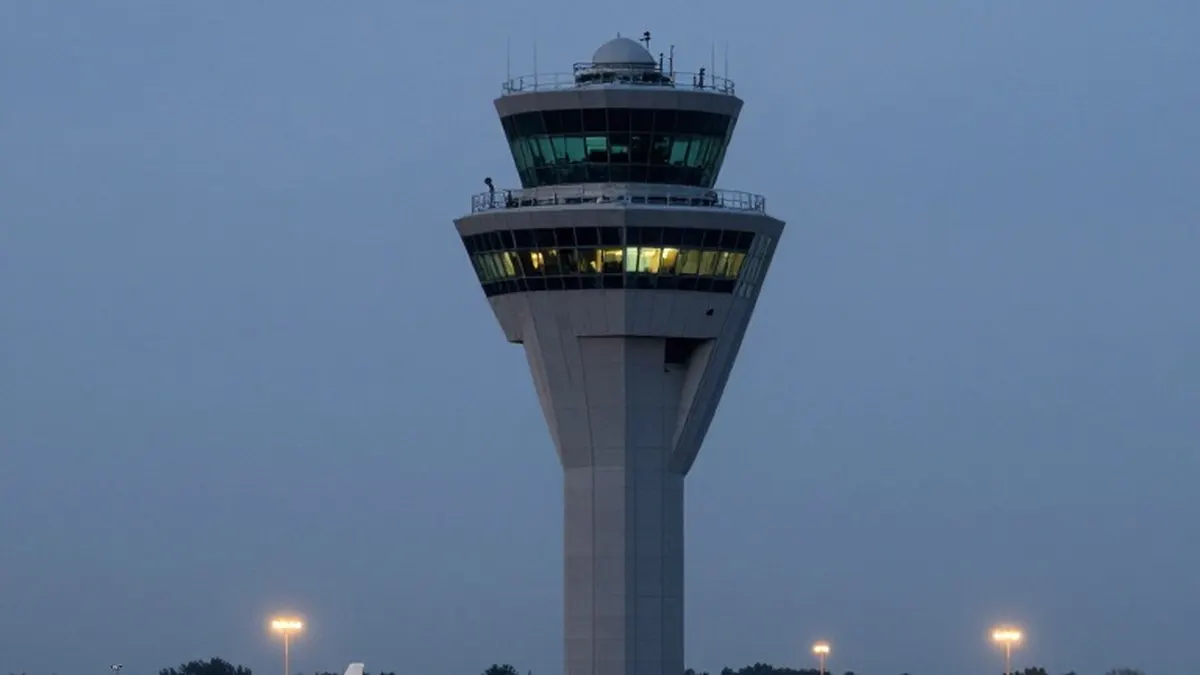
Senate Republicans voiced skepticism Tuesday after Transportation Secretary Sean Duffy made the case for tens of billions of additional dollars for the Federal Aviation Administration, days after a system failure triggered a ground stop that scrambled air travel across the country.
Overloaded routers prompted the FAA to order the ground stop on Friday, leading to thousands of canceled flights and leaving travelers stranded. Duffy is seeking $50 billion to overhaul the agency's systems, some of which still run on technology that is decades old. While lawmakers across the conference agree the problem is serious, GOP senators questioned both the size of the request and the legislative path to approve it.
Speaking at a news conference after a closed-door lunch meeting with Duffy, Senate Majority Leader John Thune said the secretary "fielded a lot of questions" about the funding and how it would be used. "How we deal with that issue remains to be seen," Thune said. "There are ways in which we could do it with Republicans only, there are also ways in which we could do it with Democrats."
Republicans have been weighing another reconciliation bill, a maneuver that would let them advance the money without Democratic votes, though the process is complicated and time-consuming. Thune said discussions would continue into Wednesday and acknowledged that "the clock is ticking" toward the end of the current Congress. He also noted that Congress allocated $12.5 billion for the FAA in the One Big Beautiful Bill Act just last year. "We did that then, there's more that's required," Thune said. "How that gets done is still an open question."
Thune suggested some senators are uneasy with the $50 billion figure. He said the administration's initial request before the ground stop, $30 billion, covered "not just the immediate needs" but also "a number of other things that they want to do," some of which he believes should move through the regular government funding process rather than reconciliation. Asked about the $20 billion increase, Duffy told CBS News he "decided to put everything on the table." "There's been a historic underinvestment in aviation," he said. "I hope we get the full investment."
Sen. John Kennedy of Louisiana told reporters he was "furious when they went from $30 billion to $50 billion," adding, "I mean, I'm not Bambi's baby brother." Sen. Rick Scott of Florida thanked Duffy in a post on X but backed a far smaller package. "We absolutely need to update our air traffic control system, which would cost about $10 billion," Scott wrote, stressing that "the airlines need to put up money and have skin in this game too."
Other Republicans embraced the pitch. Sen. Eric Schmitt of Missouri, who has been working with the administration on proposed aviation infrastructure funding, said "the needs are pretty broad and pretty deep" for technology upgrades. "So my position is: Let's go fix this on behalf of the American people," he said. Schmitt urged approving the funds through reconciliation and said that while he does not want to "make this partisan," some Democrats "are taking a different tack." "I can't think of anything more important than the safety of the millions of Americans that fly," he said.
After the meeting, Duffy called the engagement from Republicans "fantastic" and said the GOP would "work through what they think is the right approach, the right funding levels" to address the needs of American airspace. He said the country needs a new network that is "resilient," along with investment in air traffic control towers, new runways and airports more broadly. Asked whether he would accept a piecemeal approach, Duffy said he will take what he can get, but warned that under the status quo, "I will replace every single tower in America in 300 years." "So we have to do something different," he said.