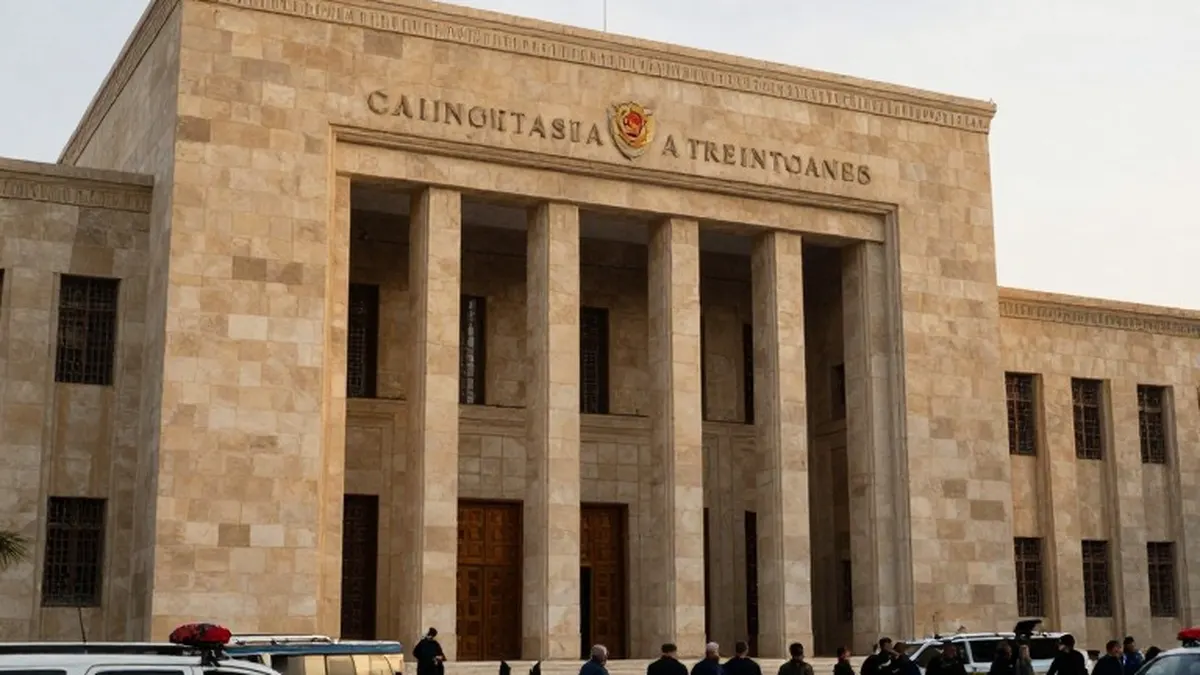
Security personnel lifted Egyptian journalist Lina Attalah off the ground and carried her out of a Cairo courtroom on Tuesday, moments after a judge convicted her of running an unlicensed website and ordered the independent outlet she leads, Mada Masr, closed. The outlet said Attalah remained in custody at the courthouse on Tuesday afternoon.
The ninth circuit of the New Cairo Misdemeanour Court, presided over by Judge Mohamed Mubarak, handed down the maximum penalty. It consists of a fine of 3m Egyptian pounds (around $53,500), the closure of the Mada Masr website and the confiscation of its property. The ruling is the harshest outcome so far in six years of legal cases against the outlet, one of the few independent news organisations still working in Egypt under President Abdel Fattah el-Sisi.
Hossam Bahgat, executive director of the Egyptian Initiative for Personal Rights, attended the hearing and described it to Mada Masr. He said the judge cleared the courtroom of everyone except Attalah and her lawyers after deliberations. Plainclothes officers and guards then filled the room, including a National Security Agency officer, he said.
According to Bahgat, the judge, joined by a representative of the Supreme State Security Prosecution, upheld his rejection of all defence procedural requests, among them submitting documents and hearing witnesses. The defence declined to enter a plea while those requests went unanswered. The judge then appointed a lawyer unknown to the defence team to represent Attalah, "in a move that astonished all those present", Bahgat said. Her eight lawyers objected, and Attalah told the court she did not accept the appointment, but the judge refused to record her objection in the minutes. Bahgat said the judge then began writing down requests attributed to the court-appointed lawyer, who had not spoken, before the verdict was read over shouts from the defence.
The Committee to Protect Journalists condemned the detention. Regional Director Sara Qudah called the conviction and closure order "a devastating blow to press freedom in Egypt" and a message aimed at dismantling independent media. "If Egypt can put in custody one of its most respected editors and shut down her newsroom, no independent journalist in the country is safe," she said, adding that Attalah must be released immediately.
Attalah was referred for trial on 22 October in Case No. 9072/2026, a day after more than six hours of questioning. Prosecutors also questioned her on publishing false news, including over a Mada Masr report on protests at prisons across the country, but that accusation was dropped from the charge sheet. She had been released on bail of LE100,000 ($1,053).
Attalah founded Mada Masr in 2013, and it has been blocked inside Egypt since May 2017. The outlet has applied for a licence several times since a new media law was passed in 2018, and said it only learned in 2022 that the regulator had rejected its application, when Attalah was shown the decision during questioning in another case. The Journalists' Syndicate, headed by Khaled al-Balshy, argued that the proper route was a challenge before the administrative courts rather than criminal prosecution.
This is the sixth case brought against Mada Masr, its journalists and editors in six years. In August 2025, prosecutors questioned Attalah over "false news" and operating without a licence after the outlet reported alleged abuses at Badr 3 prison. In 2022, she and three Mada Masr journalists faced trial for "offending" pro-government lawmakers, and in November 2019 security forces raided the Cairo office and briefly detained Attalah and several colleagues.
The verdict follows the arrest of six journalists from the investigative platform Matsadaash on 28 and 29 September. Attalah's summons came hours after Mada Masr joined seven other Arab outlets in launching a joint newsroom to fill the gap left by those arrests. Before the ruling, 119 rights organisations and media institutions condemned an "unprecedented attack on press freedom", and Human Rights Watch raised concerns that licensing rules were being used to restrict independent media. Egypt ranks 169th of 180 countries in Reporters Without Borders' 2026 index, which says it remains one of the world's biggest jailers of journalists despite high-profile releases, including that of writer Alaa Abd el-Fattah.