President Donald Trump held two distinct geopolitical gatherings during his recent trip to Asia, illustrating the varied approaches of his administration to a changing global landscape. In Manila, the Philippine capital, the U.S. leader met with the heads of state from Japan, India, and Australia to reinforce the Quadrilateral Security Dialogue, commonly known as the Quad. This group of democracies is positioned to counterbalance China's influence in the region.
Just two days after the Manila meeting, Trump engaged in an unprecedented trilateral summit with Chinese President Xi Jinping and Russian President Vladimir Putin in Shenzhen. Although Trump described all the leaders as friends, the contrast between the two events highlighted different diplomatic strategies. The Quad represents the post-World War II international order based on democratic principles, while the trilateral summit suggests a potential shift toward a system where major powers manage their own spheres of influence.
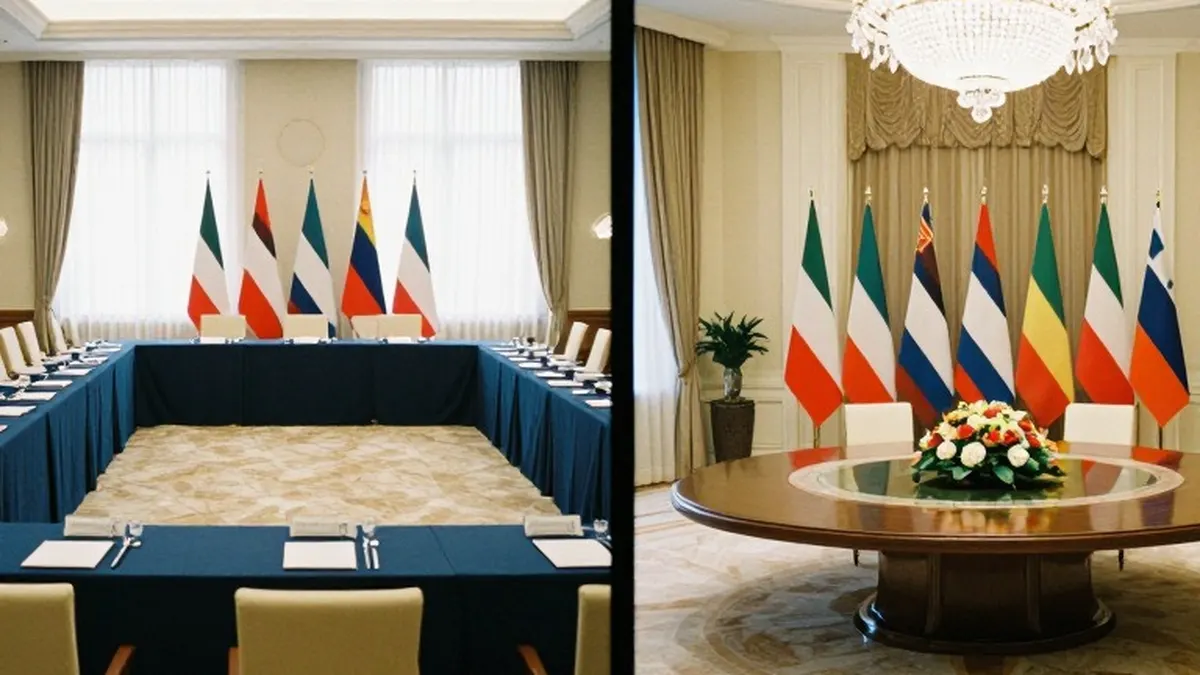
The atmosphere in Manila was characterized by informality. In a modest hotel conference room, the four leaders sat around quadrilateral-shaped tables covered in blue cloth. The setting lacked decoration aside from national flags. Before the formal session, the leaders posed for photographs, and Trump engaged in light banter with his counterparts. He patted Australian Prime Minister Anthony Albanese on the back and joked about the strength of Indian Prime Minister Narendra Modi and Japanese Prime Minister Sanae Takaichi, noting that Takaichi might be even tougher.
During the press conference in Manila, Trump emphasized the personal nature of these alliances. He stated that his phone and the Oval Office are always open to his counterparts from Japan, Australia, and India. The joint statement from the Quad described the group as a force for good and outlined cooperation in areas such as artificial intelligence, cybersecurity, and maritime surveillance.
The scene in Shenzhen was markedly different. The trilateral meeting took place in a state-owned resort with marble floors, crystal chandeliers, and jade sculptures. The three leaders sat at a large ring-shaped table, separated by significant distance. Xi Jinping read from a prepared script with minimal expression, while Putin reviewed documents. Trump sat at the opposite end with a slight smile, creating a more formal and less spontaneous atmosphere than the Manila gathering.
In Shenzhen, Trump argued that differences between nations should not prevent dialogue. He noted that past leaders often avoided talking to countries with which they had disagreements, but his administration takes the opposite view. The Chinese, U.S., and Russian governments issued a statement committing to reform the United Nations, increase petroleum supplies, and affirm opposition to nuclear wars. While the Quad statement was substantive, the trilateral statement was largely symbolic, though it included more detail than many analysts had anticipated.
The interactions between the leaders during the trilateral event were notable. At the airport in Shenzhen, Trump received a rare greeting and an unusual hug from Xi Jinping. Later, during a welcoming ceremony for the Asia-Pacific Economic Cooperation grouping, Putin and Trump shook hands and held each other by the arm while Xi looked on with a smile. Trump addressed both Xi and Putin as friends, mirroring the language he used with the Quad leaders.
Experts note that the trilateral summit raises the prospect of a different world order. Ken Moriyasu, a senior fellow at the Hudson Institute, explained that the Quad upholds the rule of law, whereas the trilateral format implies three great powers recognizing each other's core interests. Edgard Kagan, a former U.S. ambassador to Malaysia, described the language regarding nuclear weapons and future dialogue in the trilateral statement as a major concession by China. These events collectively showcase the U.S. president's flexible approach to managing relationships with both traditional allies and rival powers.
The dual nature of these meetings reflects a broader shift in global diplomacy. By engaging with both the democratic Quad and the rival trilateral group, Trump is navigating a complex international environment. The specific outcomes of these summits, including commitments to cooperation and dialogue, will likely shape future interactions in the Asia-Pacific region and beyond.