
Israel announced on Monday that it will permit the partial repair of two major sewage treatment plants in the Gaza Strip. The decision comes after months of delay, despite an agreement reached in June to facilitate the maintenance work. The announcement was issued by the Defense Ministry’s Coordinator of Government Activities in the Territories, known as COGAT, at a time when international frustration with Jerusalem’s pace of action has been growing.
The move follows a meeting between COGAT chief Yoram Halevy and representatives from the United Nations and the Board of Peace. During the session, officials discussed preparations for the winter season in the territory. Halevy presented a newly approved package that includes pumps, generators, water tankers, and medical equipment. The package also outlines specific solutions for the wastewater facilities in Sheikh Ajlin and Sheikh Radwan.
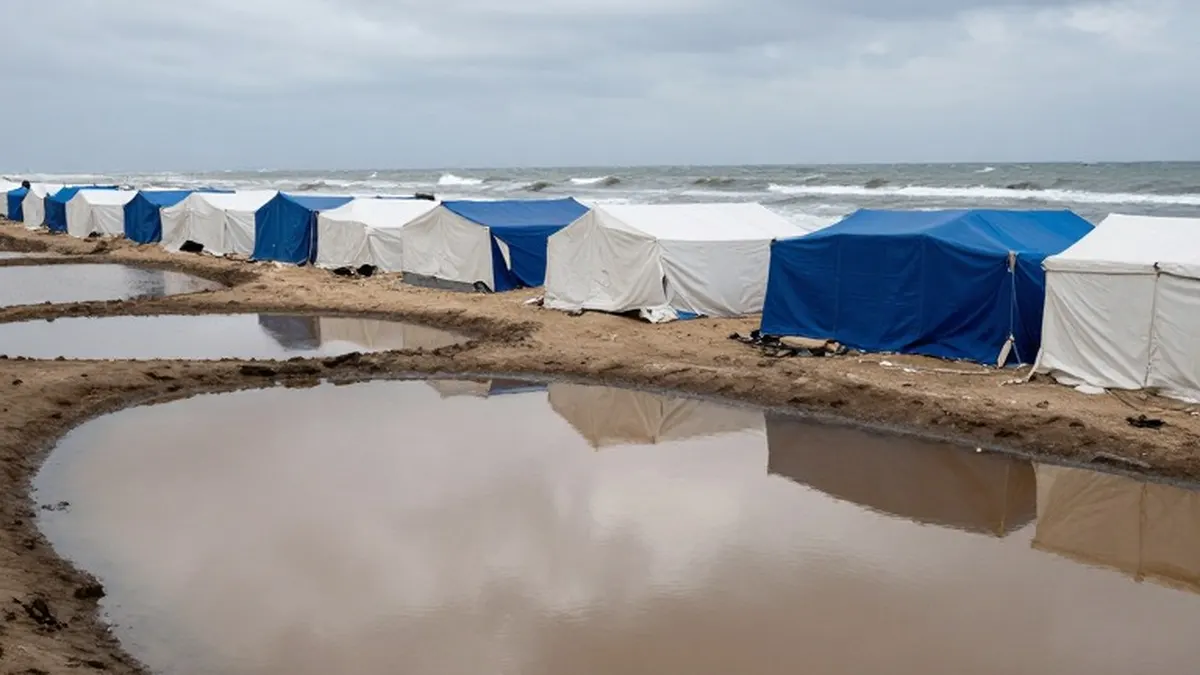
COGAT stated in a release that it recognizes the challenges winter brings to Gaza’s residents. The agency said it is working to provide a dedicated humanitarian response. This statement came just two weeks after severe storms caused flooding that destroyed or damaged approximately 23,000 tents in the Strip. Most Gazans currently live in temporary shelters, and recent footage has shown these tents inundated with sewage. Untreated wastewater continues to flow into the Mediterranean Sea on a daily basis.
The announcement coincided with the release of a new report by the humanitarian organization Oxfam. The report claimed that Israeli military operations have turned Gaza into a toxic wasteland. It cited the excessive use of explosive weapons as a cause of a humanitarian and environmental catastrophe. In response, Israel’s Foreign Ministry described the report as shameful and scandalous, arguing that Oxfam had traded its credibility for campaigning.
An Israeli official clarified that the repairs to the Sheikh Ajlin and Sheikh Radwan plants are intended as temporary fixes for damaged infrastructure. COGAT placed responsibility for the lack of long-term solutions on Hamas. The agency stated that as long as Hamas refuses to disarm and uses equipment intended for residents for military buildup, it bears direct responsibility for the inability to improve living conditions.
The broader context involves a stalled disarmament proposal. Hamas agreed to the Board of Peace’s plan in July, but progress has been halted largely by Israeli opposition to the gradual framework for weapons handover. Prime Minister Benjamin Netanyahu’s government has refused to operationalize the governing and security bodies designed to replace Hamas. This stance has angered the US-controlled Board of Peace, which was mandated by the UN Security Council last year to oversee postwar rehabilitation.
Israel has shown more willingness to cooperate on humanitarian issues recently. Following a meeting with US special envoy Jared Kushner in August, Netanyahu announced a working group to address water, sanitation, and hygiene issues. However, an official familiar with the matter said little progress has been made through this group since its inception. The European Union had previously noted in July that Israel agreed to allow repairs during a meeting between Foreign Minister Gideon Sa’ar and EU Commissioner Dubravka Šuica.
The repairs are to be funded by one billion dollars in donations from EU countries. A key obstacle has been Israel’s concern over the entry of tools and equipment that could serve dual purposes for both repair and military use. COGAT stressed that all equipment entering Gaza for these repairs will be closely monitored. The official familiar with the matter noted that while some concerns about dual-use items are principled, others appear motivated by Netanyahu’s desire to limit recovery projects before the October 27 election.
The situation regarding winter supplies remains tense. Earlier this month, UN Humanitarian Coordinator Ramiz Alakbarov stated that 150,000 tents were waiting outside Gaza for entry permission. COGAT responded by saying it had already allowed nearly 100,000 tents into the territory. The agency added that requests for over 67,000 additional tents and other winter supplies have been approved but remain unfulfilled.





