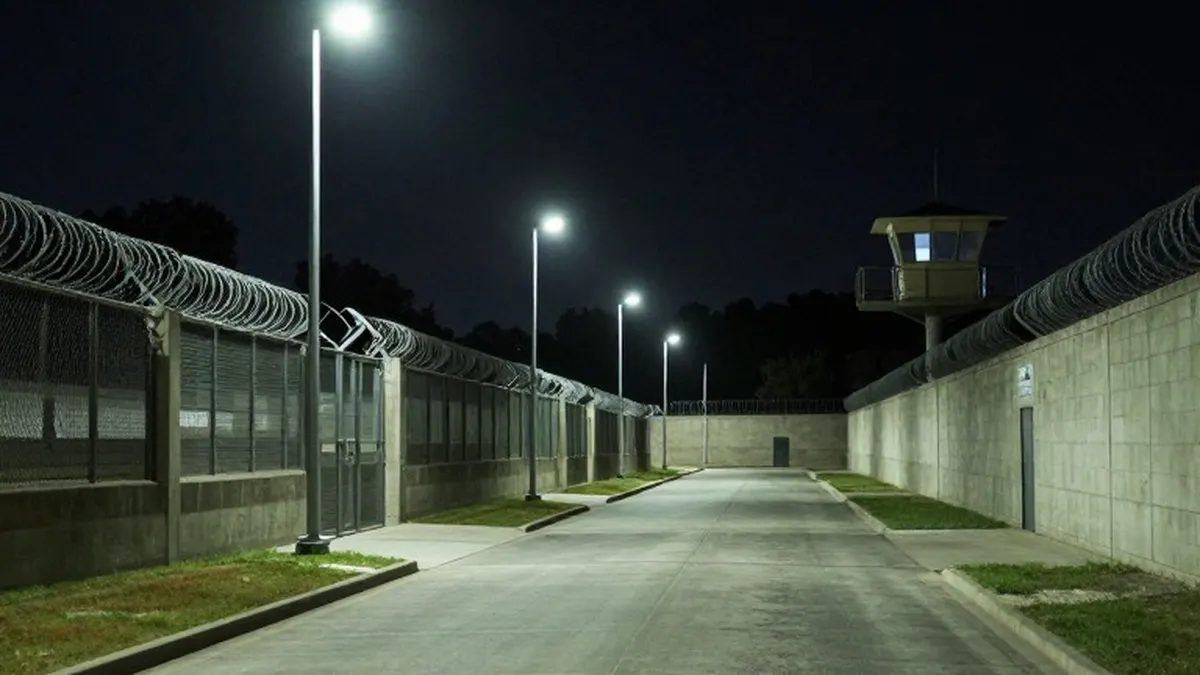
Indiana executed a man who admitted to killing his girlfriend's two young children early Thursday, the first of three lethal injections scheduled to take place across the United States on the same day. Jeffrey Weisheit was pronounced dead at 12:45 a.m. at the Indiana State Prison in Michigan City after the lethal injection began just after midnight, according to Noelle Russell, chief communications officer for the Indiana Department of Correction.
Weisheit, 50, was convicted of killing the children, ages 8 and 5, by setting fire to his girlfriend's house in the Evansville area in 2010. Russell said his final meal was barbecue ribs and that he offered no final words.
In the lead-up to the execution, Weisheit's lawyers pressed Indiana Republican Gov. Mike Braun to allow him to undergo brain scans, arguing the testing would support their case that he had a history of head injuries and mental health problems. Braun rejected that request and also refused to commute the sentence to life in prison.
Weisheit's final legal challenge focused on Indiana's plan to use lethal drugs bought from a pharmacy that faces a disciplinary hearing next week before the Indiana Pharmacy Board. The Department of Correction said it was confident "in our ability to humanely carry out" the execution.
Afterward, Braun released a brief statement noting that state and federal courts had reviewed the case many times. "These reviews have never resulted in an overturned sentence," he said. "Today, Weisheit's sentence has been carried out as ordered by the court." Indiana Attorney General Todd Rokita said the execution delivered "long-awaited justice for Alyssa Lynch and her brother Caleb, two innocent children whose lives were stolen in an act of unspeakable cruelty."
Executions were also scheduled Thursday in Florida and Alabama, which would mark the second time this year that three people in the U.S. were put to death on the same day. It was Indiana's first execution this year, while Florida's would be its 19th under Republican Gov. Ron DeSantis. Capital punishment has drawn renewed scrutiny since a botched execution in Tennessee in September in which a woman survived two lethal doses of pentobarbital, though courts have declined to halt other executions. In a statement dictated to her lawyers a month later, the woman, Pike, said she had been in pain every moment since waking up confused in a hospital. "I had not contemplated life beyond that night," she said.
In Florida, Jesse Guardado, 64, was set to die for fatally stabbing a 75-year-old woman inside her Walton County home in 2004 before stealing her jewelry box, $80 and other valuables to support his drug habit. The victim had helped him find a job and housing. Guardado confessed and quickly pleaded guilty, and a federal appeals court in 2024 found he had received a "full and fair" hearing during the death penalty phase of his case.
Florida has accounted for more than half of the 32 executions carried out in the U.S. so far this year. DeSantis, who leaves office in January, has said his goal is to bring justice to families who have waited decades for death sentences to be carried out.
In Alabama, Michael Taylor, 54, faced execution 35 years after fatally beating an older couple with a metal bar during a robbery in their Gadsden home. Police arrested Taylor, then 19, an hour away in Birmingham with the victims' Cadillac. It would be Alabama's third execution this year.
Death penalty opponents had urged Republican Gov. Kay Ivey to reduce Taylor's sentence to life in prison, pointing to his age and immaturity at the time of the killings, but she declined. "If the state kills Michael, it is not the 19-year-old who made the worst mistake of his life who it kills. But the mature, well-respected, God-fearing man sitting in that cell today," said Esther Brown of Project Hope to Abolish the Death Penalty. The state planned to execute Taylor by lethal injection after a switch in method; his attorneys objected because he had selected nitrogen gas several years ago, but a judge ruled against him.