
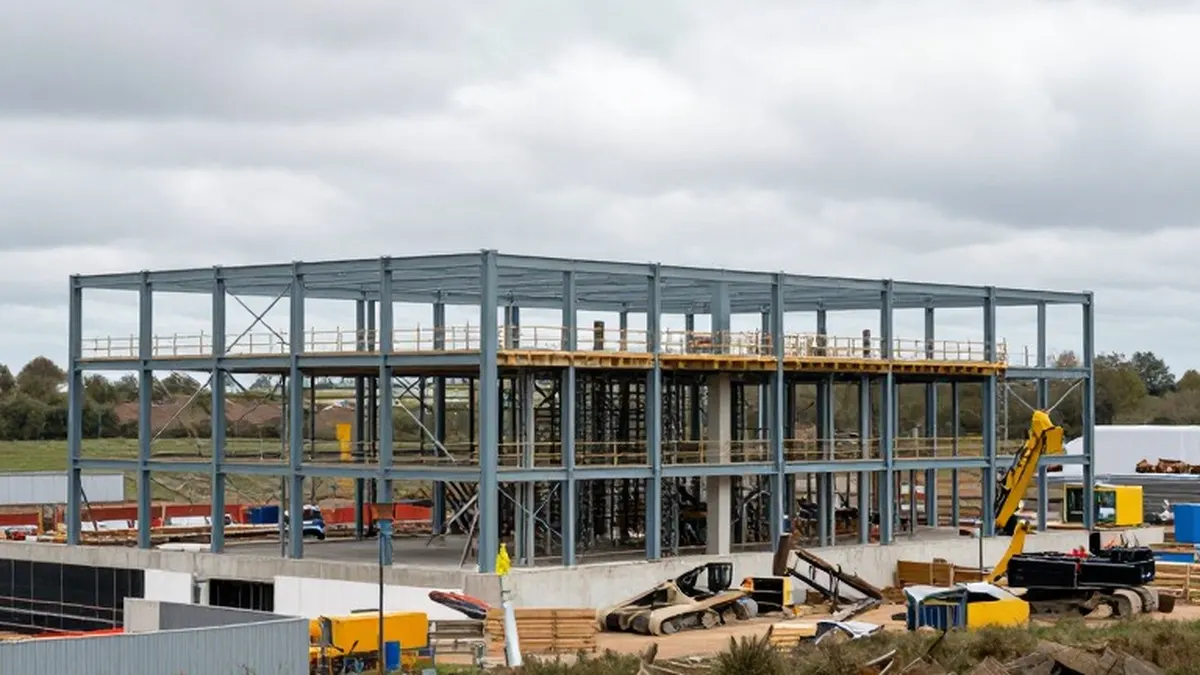
A major electric vehicle battery project in the United Kingdom is facing significant disruption after its second construction contractor in five months decided to leave the site. This development has intensified scrutiny over the timeline for Jaguar Land Rover vehicles to utilize British-manufactured batteries.
The facility in Bridgwater, Somerset, is valued at 5.2 billion pounds and is being developed by Agratas to supply its sister company, Jaguar Land Rover. Both entities are part of the Indian conglomerate Tata Group. The UK government has committed 380 million pounds in financial support for the plant, viewing it as essential for the long-term viability of the domestic car industry.
According to three sources, the construction specialist TSL, formally known as the Tonroe Group, is exiting the project due to an inability to agree on terms with Agratas. Two sources indicated that the disagreements centered on the project's timeline and associated costs. TSL is expected to depart the site within the next two to three months, leaving the project without a lead build contractor for the time being.
The dispute mirrors issues that led to the departure of the previous contractor, Sir Robert McAlpine, in June. One source noted that discussions regarding the terms of SRM's exit are still ongoing. With no immediate replacement named, industry observers believe NG Bailey, the current mechanical and electrical contractor, may be a potential candidate to assume the entire build.
Agratas announced the gigafactory in 2023 with an initial goal to begin production in 2026, employing up to 4,200 people. That target was later revised to 2027, and the latest target is now January 2028. While the company has not officially pushed back the start date, the repeated changes in leadership on site have raised doubts about whether this new deadline can be met.
A spokesperson for Agratas stated that the company remains on track to meet customer requirements. The representative described the Somerset site as a large and complex industrialization project and noted that all supplier partners are supporting the preparation for the launch phase.
The company’s internal morale has also been affected by a decision to relocate some staff from a shared building in Coventry to Somerset. Some employees are expected to take redundancy rather than move their families 120 miles away. If this occurs, it will continue a recent trend of senior staff leaving the business.
The broader context for UK battery production is challenging. The only other operating gigafactory in the country, located in Sunderland, has faced its own difficulties as carmakers scale back electric vehicle plans and governments delay bans on petrol and diesel cars. In August, it was revealed that the Sunderland operator had shelved expansion plans after failing to reach a separate supply deal with Jaguar Land Rover.
Jaguar Land Rover has secured batteries from other suppliers, meaning its immediate sales plans for new electric models are not directly impacted. However, the initial vehicles will not feature British-made batteries. The company could potentially use European-made batteries to avoid certain tariffs under specific rules of origin.
Despite the setbacks, Agratas has made progress at the Somerset site, where the building shell is largely complete and National Grid has begun work on the necessary electricity substation. Some managers have traveled to India this week to share experiences with counterparts at the Sanand site. Industry insiders suggest the project could still succeed, avoiding the fate of the collapsed Britishvolt project, which is now being converted into a data center.





