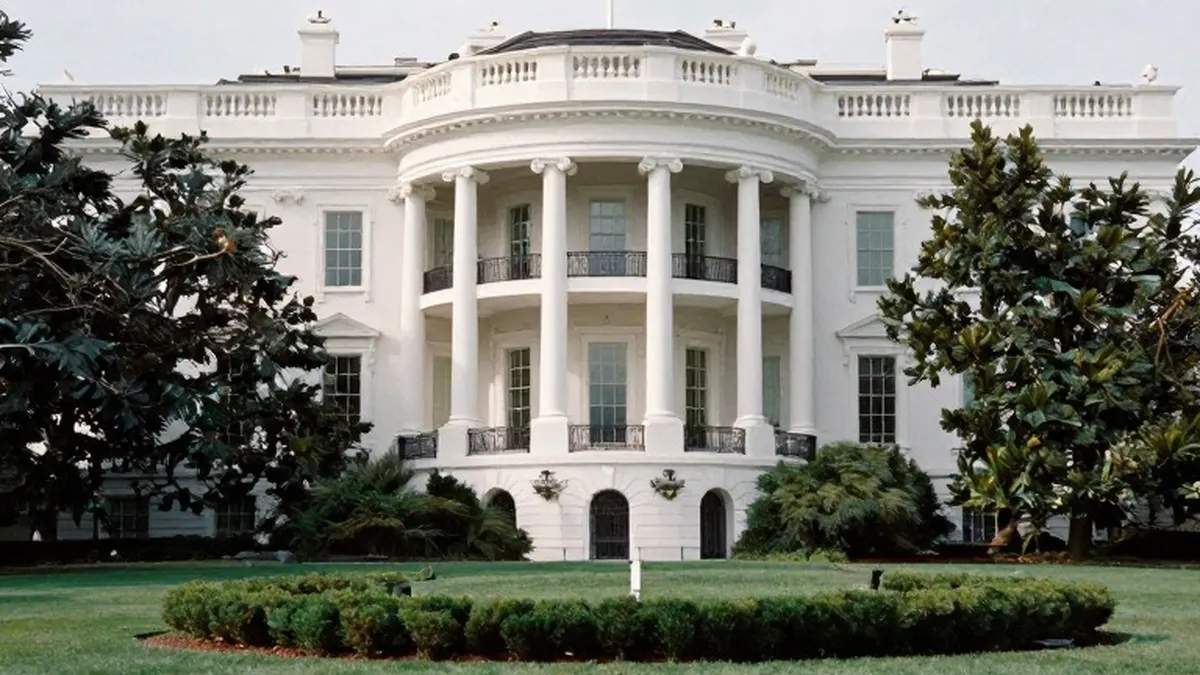
US First Lady Melania Trump is set to host representatives from Russia and Ukraine at the White House on November 5. Both nations have confirmed their participation in the meeting, which focuses on a localized cease-fire in the southern Kherson region. This bilateral engagement occurs as a new round of US-mediated peace talks is scheduled to begin next week.
The upcoming discussions follow a six-day pause in fighting around the Russian-occupied city of Oleshky. Melania Trump stated that she helped broker this arrangement to facilitate the delivery of humanitarian aid and the evacuation of vulnerable civilians. The temporary truce lasted from October 27 to November 2, providing a critical window for relief efforts in the war-torn area.
Ukraine will be represented at the White House by David Arakhamia, head of President Volodymyr Zelenskyy's parliamentary faction, and Dmytro Lubinets, the country's human rights ombudsman. The Russian delegation is expected to include Kirill Dmitriev, head of the Russian Direct Investment Fund and a Kremlin envoy, along with Yana Lantratova, Russia's human rights commissioner.
The announcement comes amidst a surge in diplomatic activity. On November 3, Russia confirmed that trilateral talks involving Moscow, Kyiv, and Washington will take place in Abu Dhabi from November 10 to 11. Kremlin spokesman Dmitry Peskov indicated that Vladimir Medinsky, a longtime aide to President Vladimir Putin, would lead the Russian delegation. The talks are expected to address the end of the nearly five-year full-scale war, postwar security arrangements, and de-escalation strategies.
The humanitarian situation in Oleshky had become desperate prior to the cease-fire. Ukrainian Foreign Minister Andriy Sybiha reported in September that residents were forced to eat grass and weeds due to shortages of food, medicine, clean water, and electricity. The city, located on the eastern bank of the Dnieper River, had a prewar population of approximately 24,000, though only a fraction of residents remained after displacement. The recent initiative enabled the evacuation of nearly 800 people to Ukrainian-controlled territory.
Despite the humanitarian progress, Ukraine accused Russian forces of using the temporary pause to reinforce military positions. Eugene Goncharov of the American Coalition for Ukraine welcomed the cease-fire as proof that Russia can agree to localized pauses when it chooses. However, he cautioned against expecting a broader breakthrough, noting that Russia could end the war at any time but has repeatedly chosen not to engage in serious cease-fire efforts.
Matthew Boyse, a senior fellow at the Hudson Institute, suggested that Russia might use this initiative to seek further localized cease-fires in exchange for major Ukrainian concessions. He noted that while postwar security is on the agenda, the gap between Moscow and Kyiv remains too wide for an immediate agreement. Boyse added that Russia believes time is on its side in the negotiations.
William Taylor, a former US ambassador to Ukraine, described the Oleshky arrangement as a potential starting point. He emphasized that a meaningful breakthrough would depend on Putin agreeing to a broader cease-fire. Taylor argued that once a political agreement is reached, military experts can easily work out technical details such as monitoring mechanisms using drones and sensors. The difficult part, he stated, is securing Putin's agreement to stop the fighting.
International efforts to advance the peace process continue alongside these bilateral meetings. The European Commission is scheduled to host US, Ukrainian, and European representatives in Brussels on November 4. Delegations from France, Germany, Britain, and NATO, along with the World Bank, are also expected to attend.
Further diplomatic gatherings are planned for the coming weeks. The Coalition of the Willing, a group of Ukraine's closest allies, will meet on November 19. Additionally, US Secretary of State Marco Rubio is expected to attend a Group of Seven foreign ministers' meeting in Marseille, France, from November 9 to 10, where Ukraine will be a central topic.