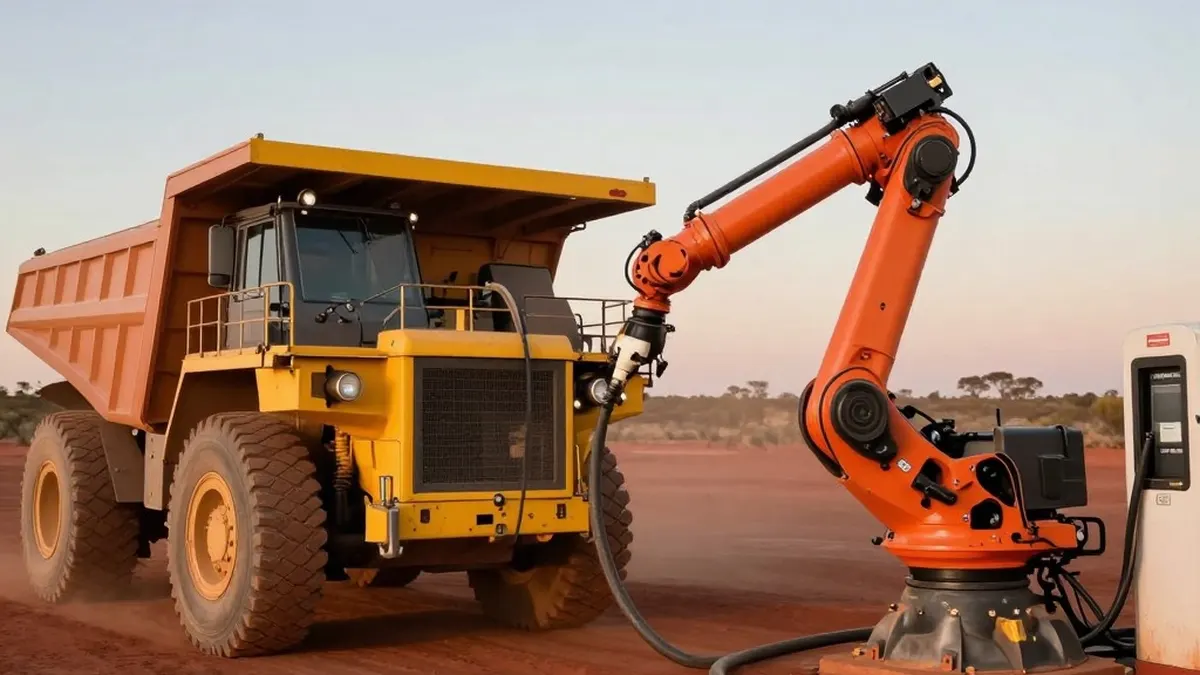
Humanoid robots are not yet up to the job of charging the enormous electric haul trucks Fortescue is deploying in Australia's Pilbara region. Instead, the mining company has turned to modified industrial robots from KUKA, machines of the kind normally found welding cars on assembly lines, to handle the cables that feed 6 MW of power into the trucks' batteries.
Chinese automakers with 2 MW "flash charging" systems have drawn much of the recent attention, but Fortescue and Liebherr have been quietly working since 2024 on a 6 MW charging system for ultra heavy-duty mining vehicles. Few details about how it operates had been made public until Fortescue released a new video earlier this month.
The video shows how the company delivers such a large jolt of electricity to the battery of its Liebherr T264E, a 264 (short) ton electric haul truck developed specially for the operation. The liquid-cooled copper cables involved are too large, heavy and dangerous for a person to handle, which is why robots do the work.
"The challenge with a six megawatt charger is that nobody makes these, and therefore nobody makes a lot of the components, either," a Fortescue representative says in the video. The company has therefore had to borrow systems and subsystems from other industries, including industrial robots that would ordinarily be used for welding in a car factory.
Fortescue developed and refined the KUKA robots with support from a $10 million (AUD) grant from the Australian Renewable Energy Agency (ARENA). The funding was earmarked for a 6 MW fast-charger test unit and for the company's goal of reaching net zero operations by 2030.
When the grant was announced in 2024, Ellie Coates, then Fortescue Zero's chief executive, said the company was drawing on its battery and charging expertise from motorsport. "Equipped with robotic connection options, they will be able to power Fortescue's future 240-tonne Liebherr T 264 battery electric trucks in just 30 minutes," she said.
The scale of the battery helps explain the power requirement. The Liebherr T264E carries a 3.2 MWh (3,200 kWh) pack, which is roughly the capacity of about 40 road-going Tesla Model Y crossovers. Fortescue's target is to fill that pack in around half an hour.