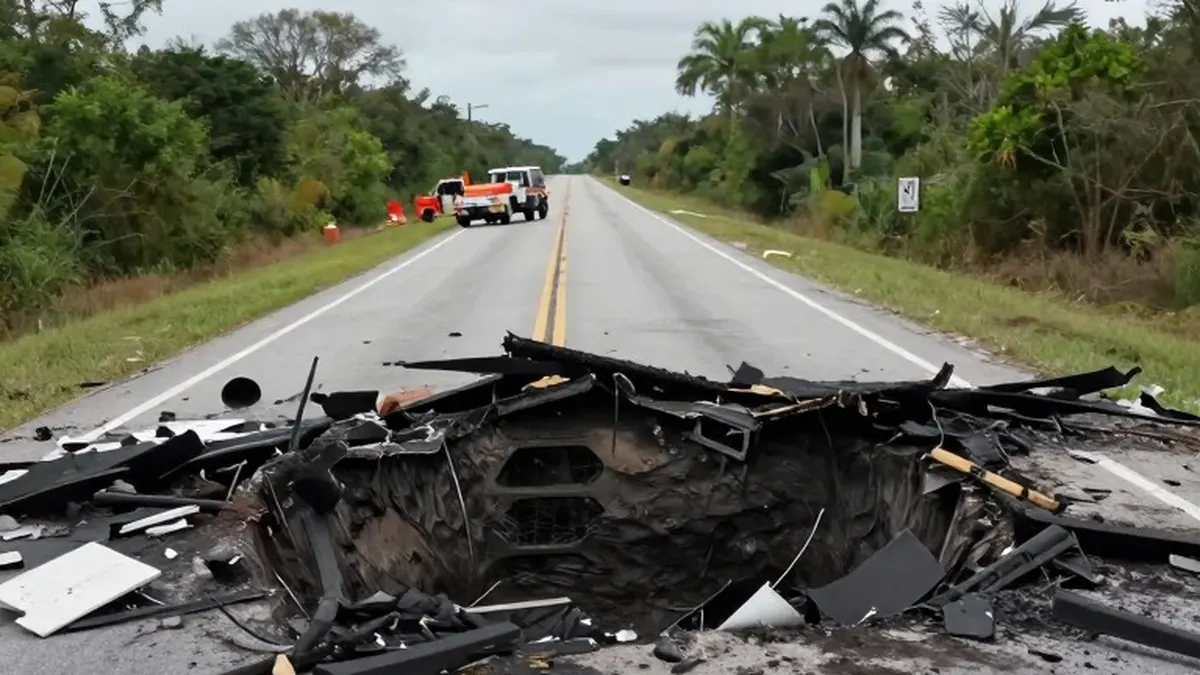
A longtime friend of the co-pilot who perished in a Florida aircraft accident on Sunday has described the recovered audio recordings as the most distressing sound she has ever encountered. The incident involved a Learjet 60 that crashed in Palm Beach County, resulting in the deaths of all nine individuals on board.
The co-pilot, 20-year-old Nathalia Filgueiras, was flying with 55-year-old captain Adam Robinson. The jet was en route from Austin, Texas, to the Bahamas at the time of the disaster. In the air traffic control audio, Filgueiras can be heard reporting that the aircraft was descending rapidly. She stated, "722 Bravo Delta, we're descending 8000 Mayday, Mayday, we're descending 10,000 ft per minute."
As the situation deteriorated, the communications became increasingly urgent. Filgueiras later declared an emergency, noting that the plane was in an overspeed condition and descending at 20,000 feet per minute. Mikaela Schluth, who has known Filgueiras since middle school, expressed pride in how her friend managed the crisis. Schluth noted that Filgueiras remained calm and continued to provide essential information until the very last moment.
The other seven victims were identified as Helen Sharp, who was traveling with Robinson, and their two young children, Emma, age four, and Charlie, age two. Also on board were Rachael Reed, Charmi Fehr, and Anita Maria Cetina. In a joint statement, the families of the victims described Adam and Helen as devoted parents. They characterized Charmi and Rachael as individuals full of joy and adventure, while noting that Anita Maria demonstrated a legacy of unconditional love and devotion.
Investigators are now examining two primary atmospheric scenarios that may have contributed to the crash. Robert Sumwalt, a former chair of the National Transportation Safety Board and a transportation safety expert, stated that both possibilities are related to weather conditions. He identified icing as one potential factor and thunderstorms with associated turbulence as the other. Weather data indicates that the aircraft entered a rapidly intensifying thunderstorm cell shortly before the pilots reported significant turbulence and icing.
Pilots typically use weather radar, standard on aircraft like the Learjet 60, to identify and avoid thunderstorms and the turbulence they generate. A key priority for the NTSB is the recovery of the cockpit voice recorder. The contents of this device are expected to provide critical insights into the sequence of events leading up to the impact.
Timothy Monville, the NTSB investigator in charge, highlighted the challenge of recovering major wreckage from the impact crater on the roadway. He described this task as the biggest obstacle facing the team at the crash site. Despite these difficulties, Sumwalt expressed strong confidence that investigators will determine the cause of the crash and develop recommendations to prevent similar accidents in the future.