
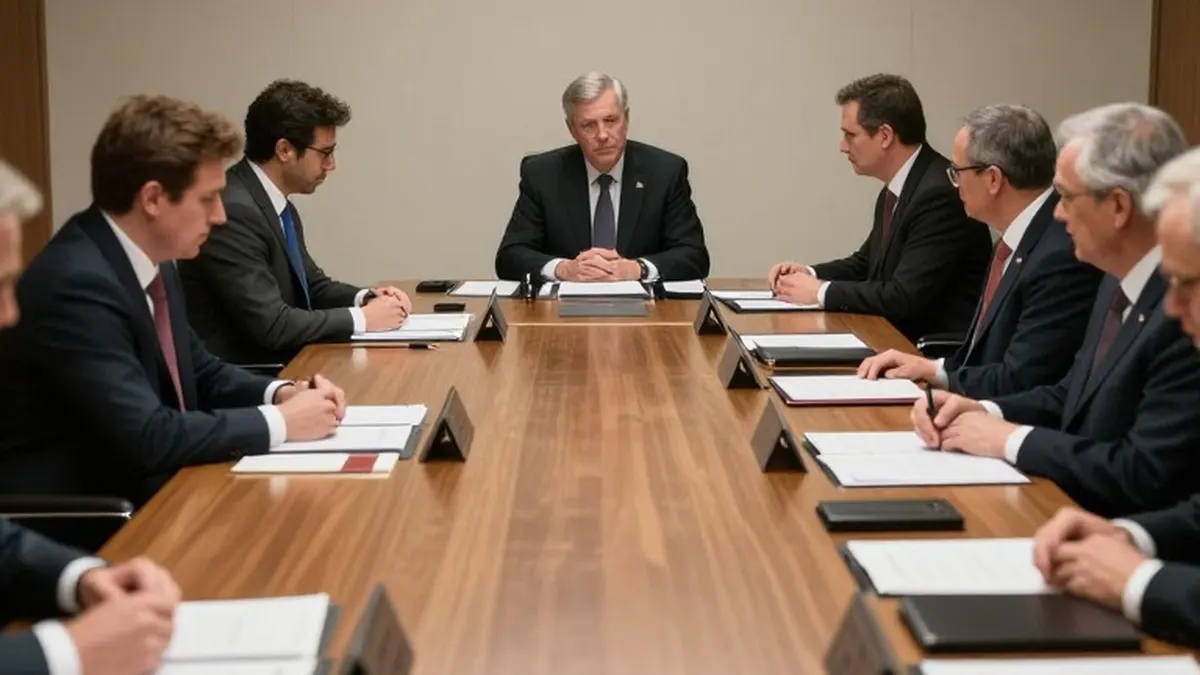
Negotiating teams from the Yashar party, led by Gadi Eisenkot, and Prime Minister Benjamin Netanyahu’s Likud party met on Monday evening to continue discussions regarding a potential unity government. This gathering marks the third round of talks between the two political blocs within the past two weeks. On the preceding Sunday, representatives from both sides engaged in approximately four hours of dialogue, covering a wide range of topics, though they did not address the central issue of establishing a government through a rotation agreement.
Prime Minister Netanyahu has consistently advocated for a unity government since his bloc lost its parliamentary majority to the Eisenkot-led coalition following the October 27 election. Ahead of Monday’s meeting, Eisenkot stated that his party was entering the negotiations in good faith. He emphasized the goal of achieving genuine unity based on shared values rather than a mere political arrangement.
Netanyahu expressed his belief that most Israelis view a unity government as the optimal path forward. Speaking at the Knesset, he noted a collective desire to end division among the populace. The prime minister stressed the need for flexibility from both sides, citing the issue of drafting ultra-Orthodox men for military service as an example. He asserted that the ultra-Orthodox communities must be included in any unity government and declared that he possessed the genuine will to reach an agreement.
The Yashar party described the ongoing marathon of talks on Saturday as part of efforts to exhaust every possible avenue for forming a new government. A party statement indicated that the negotiating team would work to enable bold moves and achieve a breakthrough. Previously, Eisenkot had drawn a red line against serving in a government headed by Netanyahu, outlining four key principles that members of the Knesset must accept to join his coalition.
On November 8, Eisenkot received the presidential mandate to form the next government. He was given 28 days to complete this task, with the option to request an additional 14-day extension. Party leaders within the Eisenkot-led bloc, including Naftali Bennett of B’Yachad, Avigdor Liberman of Yisrael Beytenu, and Yair Golan of the Democrats, all stated last week that Netanyahu must be ousted from power. However, these leaders hold differing views on how to structure the government following the post-election deadlock.
Liberman and Golan have both drawn a red line against joining a unity government led by Netanyahu. Golan has called for a minority government and advocated for serious examination of cooperation with Arab parties, specifically Ra’am and the Joint List. He argued that the possibility of working with these parties should not be ruled out in advance for what he described as ulterior motives. In contrast, Liberman has opposed partnering with Arab parties and forming a minority government, arguing that such an arrangement would be unstable and likely lead to further elections. He has instead called for a partnership with the ultra-Orthodox parties.
Liberman’s current stance has attracted criticism, as he had taken a hardline position against partnering with ultra-Orthodox parties before the elections, demanding legislation for universal military draft. Although leaders in the Eisenkot bloc have recently opened the door to negotiations with the ultra-Orthodox parties Shas and United Torah Judaism, these groups have been key partners in Netanyahu’s coalition. This history makes it unclear whether they would agree to join a government led by Eisenkot.
Meanwhile, Bennett openly backed the formation of a unity government with Likud on Saturday, provided it was led by Eisenkot. He stated his commitment to not joining Netanyahu’s bloc under any circumstances and expressed support for a rotation agreement where Eisenkot would serve as prime minister first. The B’Yachad party warned on Monday that Netanyahu would bear the consequences if he were found to be deliberately wasting time rather than pursuing a unity government led by Eisenkot.
Bennett stated after a faction meeting in the Knesset that his party was turning over every stone to establish a Zionist government to replace the outgoing administration. He added that if Netanyahu sought to waste time, he would face repercussions. Last week, Bennett held a meeting in Netanyahu’s Knesset office without Eisenkot’s prior knowledge, which sparked speculation regarding his intentions. Bennett had remained silent on his stance immediately following that encounter.
The October 27 election results indicated that the bloc seeking to replace Netanyahu won 67 seats, including 19 held by Arab parties, while Netanyahu’s bloc secured 53 seats. No government has been formed yet, as most party leaders have drawn a red line against partnering with Arab parties. Nevertheless, support from these parties has allowed the opposition bloc to advance key legislation in the Knesset while Netanyahu heads a caretaker government.





