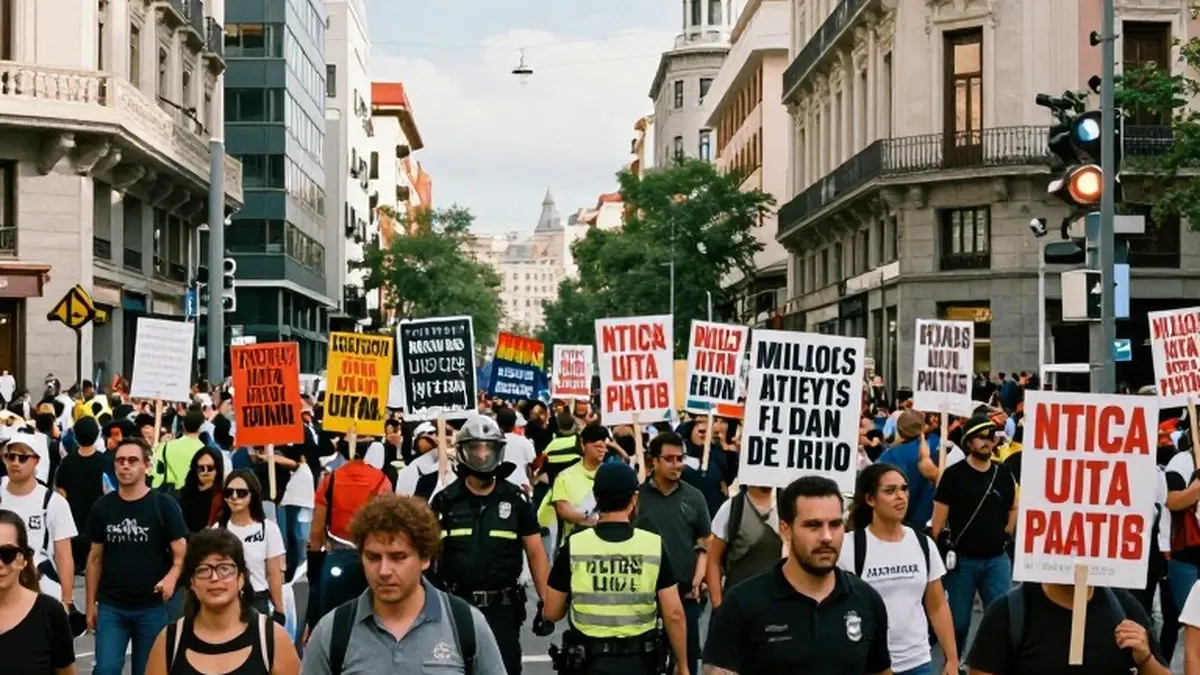
Spain experienced its first general strike in 14 years on Wednesday, with millions of workers expected to participate in a 24-hour walkout. The labor action comes at a critical moment, occurring less than three weeks before a general election that will determine the country's political direction. The primary catalyst for the protests is widespread frustration over soaring rents and the rising cost of living.
In the early hours of the strike, tensions flared in the capital as demonstrators clashed with police at a wholesale market in Madrid. Roadblocks were also reported across the country as workers began to disengage from their duties. The disruption is expected to be significant, affecting public transport networks, flight schedules, and halting operations in various shops, businesses, and factories.
Housing remains the central grievance for many participants. Rents in Spain have nearly doubled over the past decade, leaving many households feeling financially squeezed and homeownership out of reach. The Bank of Spain estimates that the country currently faces a shortage of 750,000 homes, a deficit that could grow to one million units within the next two years.
The strike was called by CCOO and UGT, the two largest trade unions in the country. They are demanding greater government intervention in the housing market, including an end to tourist rentals and automatic lease renewals. Additionally, the unions are seeking a new agreement on minimum wages. UGT Secretary-General Pepe Álvarez urged members to join the protests, stating that there is no salary capable of coping with the current price of housing.
This labor action follows weeks of social unrest, triggered partly by the eviction and subsequent death of an 87-year-old woman in Madrid. The incident sparked national outrage, especially after the left-wing government's attempts to pass tenant protection measures were blocked by the opposition. In response, Prime Minister Pedro Sánchez called for an election on November 29, aiming to secure another four years in power.
However, the political landscape has shifted following a high-speed train collision that killed 69 people, the second such disaster this year. This tragedy has redirected public debate toward public safety and accusations of government mismanagement. While the government has not officially endorsed the strike, left-wing parties view it as a chance to center the election campaign on housing. The slogan for the day is "Salaries. Housing. Prices."
Political analysts suggest that a strong and peaceful turnout could help the left regain control of the narrative. Sánchez has taken to social media to defend existing social policies, warning voters that a right-wing government would likely introduce austerity measures. He reminded citizens that achievements like public healthcare and the 40-hour workweek were collective efforts that must be protected.
Conversely, the conservative Popular Party and the far-right Vox party accuse the unions of using the strike to maintain the current government's hold on power. Miguel Tellado, a spokesperson for the Popular Party, described the event as an election strike rather than a general one. Both parties oppose deep intervention in the housing market, a stance that contrasts with the unions' demands.
Recent opinion polls indicate a shift to the right. A survey published on November 9 shows the Popular Party leading with 31.9% of the vote, followed by Sánchez's Socialist Party at 29.9% and Vox at 18%. This polling suggests the right could form a governing majority, which would bring the far right into national government for the first time since the end of Francisco Franco's dictatorship in 1975.
The outcome of the strike will be closely watched. While a high turnout could bolster the government, any violence could backfire, potentially strengthening the far right's argument for order and security. Experts advise looking beyond the immediate spectacle to assess which sectors and regions stopped work and whether housing truly becomes the focal point of the campaign.