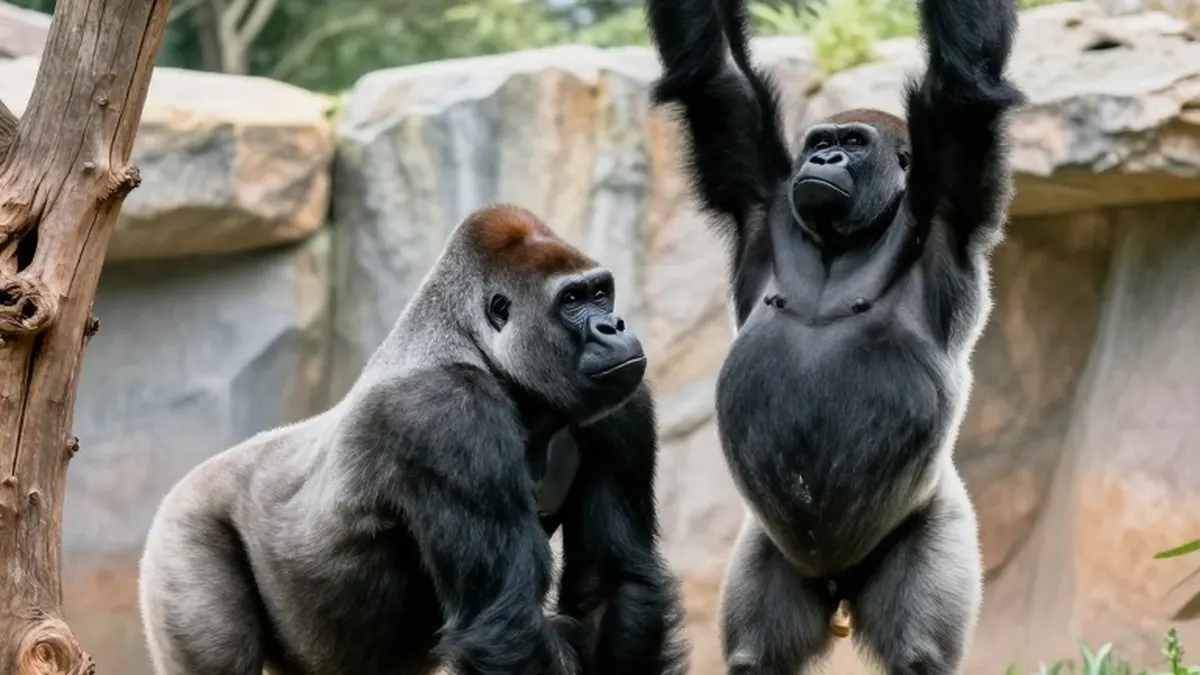
Researchers in Israel have documented a rare case of spontaneous cooperation between adult gorillas, after two females at the Ramat Gan Safari were caught on camera climbing on one another to reach vegetation that would otherwise have been out of reach.
The findings, described in the journal Primates by Tel Aviv University researchers, draw on three separate events recorded in 2021, 2024 and 2025. Each time, a female western lowland gorilla named Lisha provided a stable platform for her half-sister Amelia to climb on. The behavior was spontaneous, as neither gorilla had been trained to perform it.
The most extensively documented event took place in September 2024, after keepers noticed the two females peacefully eating bark and leaves from a large branch that had previously been beyond their reach. To work out how they had obtained the food, staff reviewed security camera footage.
The video showed a coordinated sequence of actions. Amelia walked over and climbed onto a rock beneath a particular tree, and Lisha then joined her, standing firmly on all fours on the rock. Amelia climbed onto Lisha's back, stood upright and stretched upward to grasp and break off a branch roughly 4.5 meters, or nearly 15 feet, above the ground. An electric barrier around the tree trunk prevented the pair from climbing it directly.
A video from June 2025 offered an especially telling detail: Lisha approached Amelia and positioned herself with her back toward her, ready to support the climb. Amelia was not observed using force or trying to move Lisha into position, and Lisha's participation appeared voluntary. The researchers interpreted the pattern as cooperation, because the two gorillas' actions depended on one another and appeared directed toward the same immediate goal: reaching the branch and bringing it down.
Teamwork did not always lead to shared food. While keepers reported peaceful, shared feeding after the 2024 event, in the sequence observed in 2025 only Amelia ate the vegetation. To the researchers, that difference indicated that cooperating to obtain a resource and sharing it afterward are separate aspects of social behavior.
The partnership struck the team as particularly notable because the half-sisters do not usually spend much time together: they sleep in separate quarters at night and rarely groom one another. The researchers also cautioned that the study involves only two individuals and three documented events, and that the footage does not show whether the gorillas communicated through vocalizations or subtle gestures, or whether they planned their actions in advance.
"The study's great importance lies in providing scientific documentation and analysis for observations and behaviors we encounter in our daily work, allowing us to enhance our knowledge of gorillas, their social world, and their cognitive abilities," Yehonatan Samocha, who heads the Ramat Gan Safari's primate section, said in a press release on Monday.
Prof. Israel Hershkovitz of Tel Aviv University's Anatomy and Anthropology Department, who took part in the research, said the observations could help partially explain how early humans survived in the savanna, through social support and a high level of cooperation that could take place even without language or preplanning.
Michael Levitzky, a graduate student in biological anthropology at Tel Aviv University who initiated and led the study, said: "When I first watched the footage, it was clear to me that this was something extraordinary." He said Lisha did more than simply serve as a step, appearing to participate actively and willingly in solving the problem by approaching on her own initiative and positioning herself in exactly the right place. That, he said, is the difference between using another individual as a tool and true cooperation, in which both individuals work together toward the same goal.