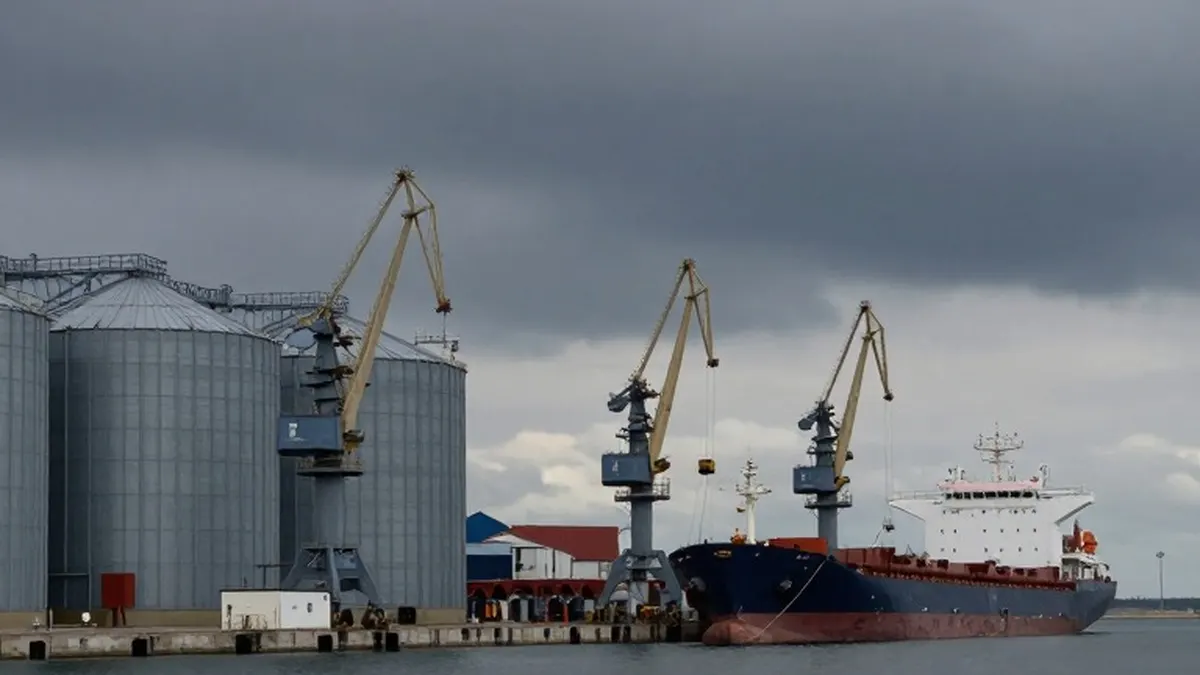
A surge of attacks on Black Sea shipping and Ukrainian ports is disrupting grain exports, with consequences for countries that depend on the region’s supplies. At least 30 sailors have died or disappeared in the recent attacks, according to Bulgarian and Romanian authorities and maritime tracking services. Ukraine’s farmers also face mounting difficulties getting their harvests to overseas buyers.
On October 28, three naval drones and aerial drones attacked the Liberian-flagged Contship Jet Monrovia off Bulgaria’s coast. The freighter, carrying more than 400 containers from Haifa in Israel to Romania, sank after explosions. Bulgarian authorities said all 18 crew members were rescued. Footage and images of the daytime attack were captured by crew members, nearby vessels and a French surveillance aircraft.
Kyiv attributed the drones to Russia and accused Moscow of seeking to obstruct civilian navigation and undermine Ukraine’s grain trade. President Volodymyr Zelenskyy said Ukrainian forces had carried out no operations in that area. The alleged Russian campaign follows Ukrainian attacks on Russian freighters and oil tankers in the Black Sea and Sea of Azov, which intensified in July. Bremen University researcher Nikolay Mitrokhin told Al Jazeera that Ukraine had broken an informal understanding against attacking each other’s cargo vessels.
The disruption affects a major route for international food supplies. Before Russia’s full-scale invasion in 2022, roughly one-third of global grain exports moved through the Black Sea. Ukraine supplied 10 percent of world wheat exports and 15 percent of corn exports, with customers including countries in the Middle East and North Africa. Russian grain exporters, who normally ship more than two-thirds of their harvests through the Black Sea, are testing routes through the Arctic port of Murmansk, despite the additional transport costs.
Wheat prices have increased by about 20 percent over the past year. Chicago wheat futures rose from $5.03 a bushel in October 2025 to $6.03 in October 2026. The US-Israel war on Iran, global warming and drought in South Africa have also contributed to the increase.
Russian drone and missile strikes have halted operations at Odesa, Ukraine’s largest maritime hub. Viktor Honcharenko, president of the Association of Farmers and Private Land Owners of Ukraine, told Al Jazeera that land routes could accommodate barely more than half of grain exports. He said wheat was being left unharvested and warned of lost jobs, falling tax revenue and financial hardship for farmers and medium-sized businesses. Smaller farms would suffer most, he said, because industrial producers would secure access to rail and truck transport first.
Kyiv-based analyst Aleksey Kushch said Ukraine had harvested up to 60 million tonnes of grain this year, but could export only half because its rail network was overloaded. He suggested expanding domestic processing or shifting towards legumes and oil crops sought by EU buyers. Such a shift would reduce farmers’ profits, he said, arguing that the government should have negotiated EU subsidies estimated at one billion euros.
European Commission spokeswoman Paula Ritter-Moschutz told Al Jazeera that Europe’s food security was not threatened, while reaffirming support for Ukraine’s access to international markets. She said the EU was assessing the effects on agriculture, the economy and global food security, and supported initiatives for a moratorium on Black Sea attacks.