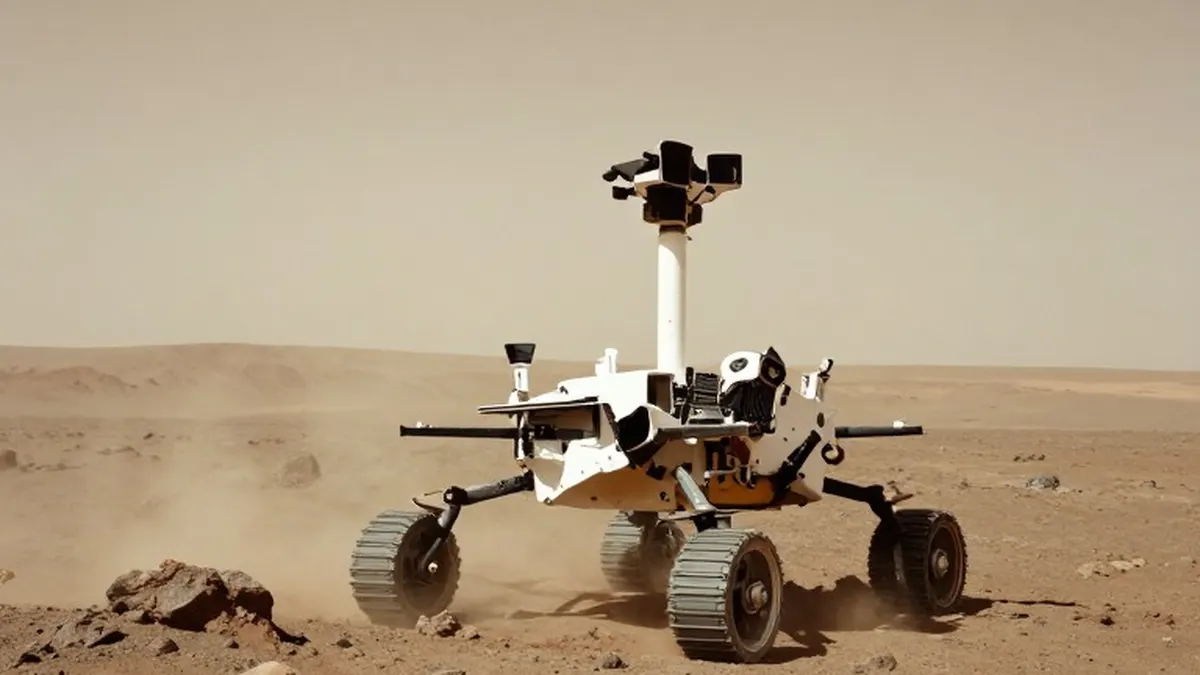
Two of the four NASA missions currently active at Mars have temporarily halted their primary science operations following the discovery of distinct technical problems. The affected spacecraft are the Perseverance rover and the Odyssey orbiter, both of which are functioning well beyond their original design life expectancies. This development represents a significant pause in data collection for a portion of the agency's current planetary exploration fleet.
The Perseverance rover, which has been exploring the Martian surface for six years, is currently tasked with collecting rock and soil samples for a future return to Earth. The vehicle is presently investigating the rim of a crater that once held an ancient lake of liquid water. The issue affecting the rover stems from its communication systems, which are critical for transmitting data back to Earth.
Perseverance is equipped with two redundant ultra-high frequency radios designed for high-rate communications with relay orbiters. It also possesses a separate X-band system capable of direct communication with Earth, though at a lower data rate. On October 30, one of the primary UHF radios failed to respond during a power-up sequence. This malfunction triggered an automatic switch to the backup radio and placed the rover into a safe mode.
Ground teams at NASA’s Jet Propulsion Laboratory in California subsequently identified a secondary issue. They found that the backup UHF radio was transmitting at approximately half of its expected power output. NASA confirmed these findings in a statement released last week, highlighting the dual nature of the communication failure.
In response to the findings, the engineering team has ceased using both UHF radios. This precautionary measure allows engineers to evaluate the potential causes of the issues and determine when one or both systems can be safely resumed. The decision aims to prevent further damage or data loss while a thorough diagnostic is conducted.
Until the high-rate radio systems are restored, Perseverance is transmitting signals directly to Earth using its X-band system. This direct connection provides a significantly lower data rate compared to the standard method of relaying signals through orbiters. The reduced bandwidth limits the amount of scientific data that can be transmitted from the rover’s instruments.
Mission managers have paused science operations out of an abundance of caution while the radio problem is investigated. The primary focus of the engineering effort is to get the backup UHF radio running at full capacity. Once that system is stabilized, the team will turn its attention to recovering the primary radio unit.
The Odyssey orbiter, which arrived in Mars orbit in 2001, is also affected by a separate technical issue. As the longest-lived Mars mission in history, Odyssey continues to play a crucial role in the network of spacecraft supporting surface operations. The simultaneous technical challenges facing both the rover and the orbiter underscore the complexities of maintaining hardware that has operated for many years in the harsh environment of deep space.
While the outages are currently described as temporary, they highlight the vulnerabilities inherent in long-duration space missions. NASA’s engineers are working to resolve the communication faults on Perseverance and the issues affecting Odyssey, with the goal of restoring full science operations to both platforms as soon as it is safe to do so.