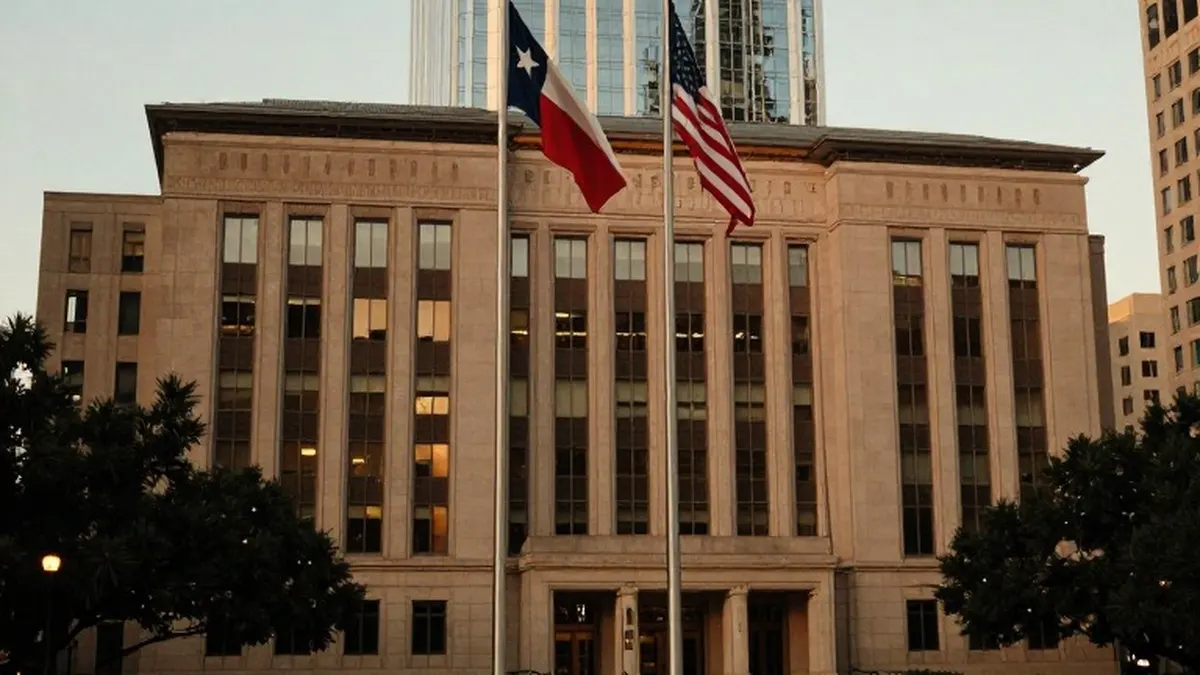
Houston will scale back cooperation between its police and federal immigration authorities, Mayor John Whitmire announced on Friday, describing the shift as "a new model" of immigration enforcement after Democrats won power in Texas for the first time in decades.
Whitmire said the city would go after immigrants "that pose a danger, not those that are going about their family business, work and education". A routine traffic stop, he said, will not set immigration enforcement in motion. "You write a citation or you warn them and they go about their way. No contact with [Immigration and Customs Enforcement] over nonviolent, non-jailable offenses. It reduces the fear and anxiety."
The move by the nation's fourth-largest city is among the first steps to curb the powers of Immigration and Customs Enforcement, or ICE, since Tuesday's midterm elections.
Under the mayor's new directive, Houston police should contact ICE only if a person they stop is arrested on a charge that carries jail time, or if ICE issues an administrative warrant, an order signed by a senior ICE official indicating that the person is wanted by immigration officials.
"The fact that a person is, or is suspected to be, subject to immigration enforcement shall not, by itself, be a basis to contact ICE, to prolong any detention, or to take any person into or hold any person in custody," the two-page order states. Spokespersons for ICE did not immediately respond to an email seeking comment on the announcement.
The policy follows a series of violent encounters involving ICE in Houston. In July, agents shot and killed Lorenzo Salgado Araujo during a traffic stop while reportedly looking for other individuals. The shooting rattled residents of the city's Magnolia Park neighborhood and was another blow to the embattled housing construction industry in Texas, which has been losing skilled, experienced workers at high volume and high rates.
"We feel it on a level we can't even describe," a neighbor who declined to share his name for fear of retaliation told the Guardian in July. "Everybody knows that what happened is wrong. How will we not stand with our people, stand behind them, especially when something so vicious and ugly happened?"
In October, an ICE agent struck an individual with a vehicle during a pursuit of a different suspect whose family noted he had died years ago. A grand jury indicted ICE officer Mario Alberto Morales on a charge of aggravated assault with a deadly weapon. Prosecutors say Morales intentionally rammed his car into Miguel Parra Hernandez, whose leg was broken. ICE has asserted that Parra Hernandez ran in front of the vehicle, an account that prosecutors say is contradicted by video.
Despite a one-time $75bn infusion from Congress, ICE remains heavily dependent on local police to find people subject to deportation and turn them over, partly through about 2,600 agreements, many of them in Texas, to deputize local police and other state and local agencies to enforce immigration laws. Texas has been a primary target for ICE arrests. Governor Greg Abbott, who closely aligned the state with the Trump administration to collaborate on enforcing federal immigration laws, lost his bid for a fourth term to Democrat Gina Hinojosa.
Fiel, an immigrant-rights group in Houston that has been working with the Parra Hernandez family, planned to hold a press conference on Friday afternoon in light of the announcement. "Today Houston won. The Houston city council had already decided this months ago," said Cesar Espinosa, executive director of Fiel Houston, adding that it was time to follow through.