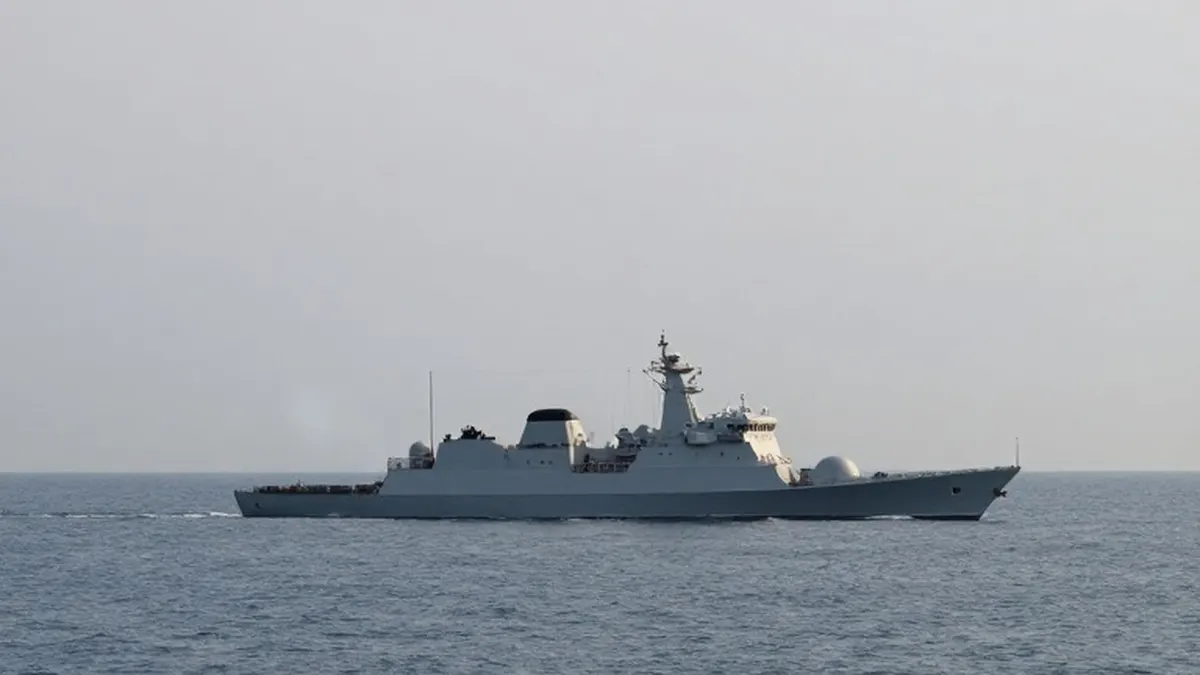
The Black Sea has emerged as a volatile new front in the Russia-Ukraine conflict, posing a direct threat to the security of NATO and the United States. Although the war is primarily fought on land, the maritime dimension is increasingly visible to the alliance, with incidents occurring right at NATO’s borders and occasionally spilling into its waters.
NATO military spokesperson Colonel Martin O’Donell reported to CBS News that the frequency of dangerous events in the region has exploded. While there were fewer than fifty incidents involving drones, mines, and commercial vessels in 2025, the number has surged to between four hundred and five hundred this year. This roughly tenfold increase has made the waterway more hazardous than other global flashpoints.
The danger is quantifiable in human terms. According to the International Transport Workers' Federation, at least forty sailors have been killed in the Black Sea this year. By comparison, the International Maritime Organization reported twenty-five sailor deaths in the Strait of Hormuz, a key chokepoint in the U.S.-Iran tensions. O’Donell noted that the Black Sea is arguably more critical for global trade, as any disruption to fuel and food supplies can have worldwide economic implications for America and other nations.
The conflict is not limited to the Black Sea basin. Over the weekend, Ukrainian forces struck an advanced Russian warship and a cargo vessel, which subsequently drifted into the waters of Finland, a NATO member, while on fire. Additionally, Ukraine announced on Sunday that it had sunk a Russian warship docked in Libya. These actions highlight the expanding geographic reach of the maritime conflict.
Three of the six nations bordering the Black Sea are NATO members: Romania, Bulgaria, and Turkey. Defending these maritime borders presents unique challenges compared to land defense, explained Romanian Navy Captain Mihai Iordache. He emphasized that there is no physical fence to mark the boundary, making the defense of the open sea more complex and fluid.
To address the growing threat, the Romanian Navy is deploying specialized divers and underwater drones to search for unexploded ordnance. However, the strain on resources is evident. Captain Iordache stated that the navy is stretched thin, lacking sufficient personnel and equipment to handle the volume of commercial traffic and drones. He noted that four years ago, the force was prepared for a single drifting mine, whereas now they must be ready for tens of drifting drones.
Pressure on the alliance is mounting from multiple directions. On Friday, Poland accused Russia of intentional provocation after Russian cruise missiles landed in the country’s southeast. Since the full-scale invasion began on February 24, 2022, drones have repeatedly entered the airspace of Poland and other NATO countries, mostly near Ukraine but not exclusively.
The NATO founding charter includes the Article 5 collective defense clause, which dictates that an attack on one member is considered an attack on all thirty-two members. When asked about the alliance's readiness, Colonel O’Donell stated there should be no doubt regarding NATO’s willingness and ability to act if necessary.
Looking ahead, Captain Iordache expressed uncertainty about the future trajectory of the conflict. He acknowledged that the situation could become either more intense or more stable. His final assessment was a hope for peace, acknowledging that the navy must remain adaptable to whatever the future brings.