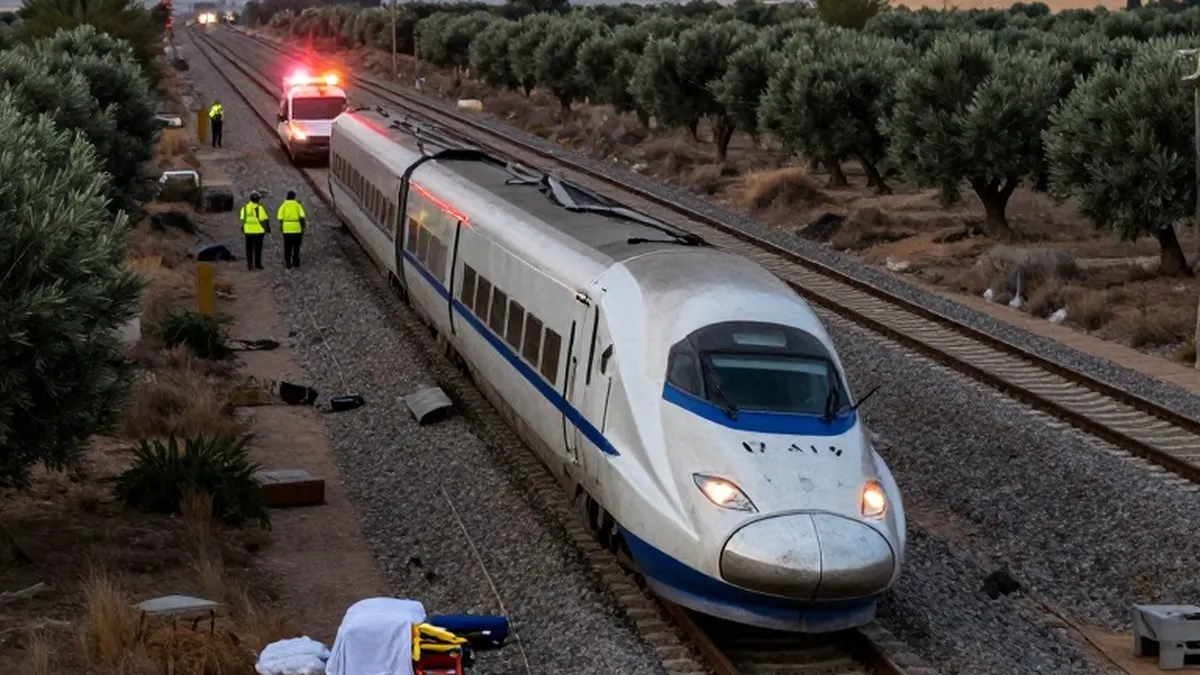
Spain is in three days of national mourning after two trains collided on a high-speed line in the central part of the country on Wednesday, killing at least 68 people and injuring 77 others. Prime Minister Pedro Sanchez declared the mourning period, saying: "All of Spain is mourning."
The crash happened just before 9am between Urda and Los Yebenes, two small towns south of Toledo. A Renfe high-speed train traveling from Madrid to Seville, carrying about 500 passengers, smashed into a stationary train operated by the Italian consortium Iryo. Rescuers searched for survivors in the wreckage of three carriages at the front of the Renfe train.
Passenger Joaquim Torres told Al Jazeera he tried to help the injured. Fighting back tears, he said: "I held this woman in my arms and tried to comfort her, but she stopped breathing. She died, she died." Sebastian Herrero, a 46-year-old doctor on board, described "a twisted mass of metal" and said it was "as if a bomb had gone off." Another passenger, Fernando Seco, told state broadcaster TVE that the train had just resumed its journey after a brief stop. "People were thrown through the air, seats were flying through the air," he said.
Transport Minister Oscar Puente said the Renfe train had been authorised to continue despite an active red signal, which was triggered by a computer communications failure that automatically halted traffic. He described the order from the central command centre to proceed as "inexplicable" and said the train engineers were not to blame. Renfe has opened an investigation, and a judicial inquiry is expected to begin shortly.
Volunteers rushed to the scene. Jose Maria Rabadan, a resident of Urda, the nearest town, said he and others brought food, water and blankets and offered transport to those affected. Meanwhile, relatives waited at Seville station holding photographs of loved ones who never arrived.
The disaster comes nine months after another crash on the same line at Adamuz, near Cordoba, in which 46 people died. A preliminary investigation attributed that accident to a rail fracture, though a police investigation has not concluded. Sanchez said it is "not acceptable for a country like Spain" to suffer two major train disasters in one year.
Politics has quickly entered the picture, with a general election due on November 29. Opposition leader Alberto Nunez Feijoo of the People's Party, the favourite to win, called for "a complete and independent review of the entire rail network." The union Solidarity, which is linked to the far-right Vox party, demonstrated in Madrid on Wednesday night demanding Puente's resignation, and riot police were deployed. Rail unions had already planned a strike for Thursday over what they describe as a poor safety record.
European Commission data suggests investment has not kept pace with the rapid growth of high-speed travel. Between 2018 and 2022, Spain spent an average of about $1.67bn a year on high-speed lines, but only 16 percent went to maintenance or repairs. Italy, Germany and France spent between 33 and 39 percent of their budgets on maintenance. Spain's safety authority AESF counted 69 rail accidents in 2025, up from 45 in 2016.
Salvador Garcia-Ayllon, a civil engineering professor at the Universidad Politecnica in Cartagena, said the network has become popular because it is cheap and accessible, but that authorities "have not spent enough on its maintenance in recent years."