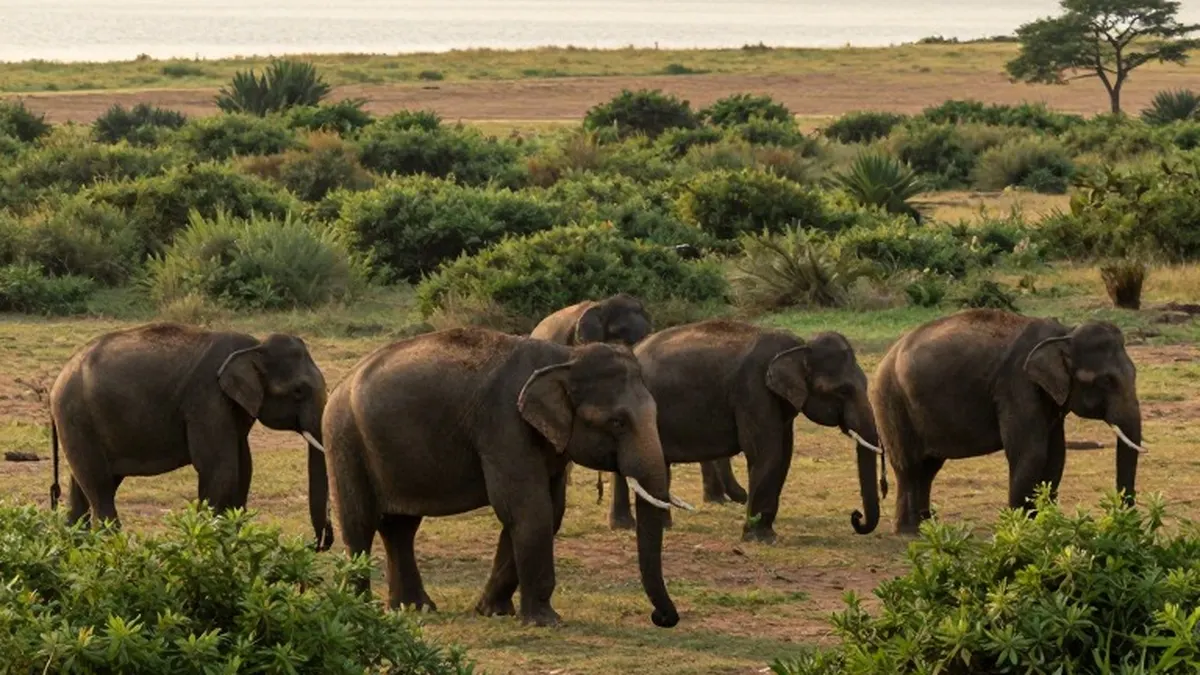
Elephants form some of the most complex and durable societies in the animal kingdom. Members die or drift away, calves mature and newcomers arrive, yet the wider community usually endures. Long-term research on African savanna elephants has shown that even after poaching or other sudden spikes in deaths, survivors gradually rebuild the social connections they lost. A new study, however, suggests that this resilience has a breaking point when losses accumulate steadily over time.
Anastasia Madsen, a behavioral ecologist at the University of California, San Diego, and her colleagues examined 12 years of observations of wild Asian elephants in Sri Lanka. Their conclusion: once deaths and departures began to exceed the number of newcomers joining the population, the elephants' society did not simply contract. It broke apart.
The research centered on Udawalawe National Park in southern Sri Lanka, which was established in the 1970s around a reservoir built on one of the country's four major rivers. "Before that, it was basically a tropical deciduous forest," said Shermin de Silva, an ecologist at UC San Diego and senior author of the study. De Silva founded the Udawalawe Elephant Research Project in 2006.
The reservoir drew farming and settlers to the area, and some of them lived inside what would later become the park. When those residents were relocated, the fields they had cleared for crops grew into grassland that, in de Silva's words, looks very much like an African savanna. Because this open landscape offered far more food than the original forest, the park became renowned for its large elephant herds.
That savanna, though, turned out to be only one stage in the forest's recovery. Without fires or clearing to hold vegetation back, invasive plants such as lantana spread across the park. "In some places, they're like an impenetrable thicket. Not even elephants really like to go there because there's no food for them," de Silva said.
That shift matters because elephants move toward where the grass grows. As forage disappears, the researchers say, the park stops drawing elephants in from surrounding areas, and at the same time fewer calves survive to adulthood because food is limited.
The findings add a cautionary note to the idea that elephant communities can absorb almost any blow. A population can recover from a sudden catastrophe, but a slow, persistent decline in numbers, driven in this case by a changing landscape, can unravel the social fabric itself.