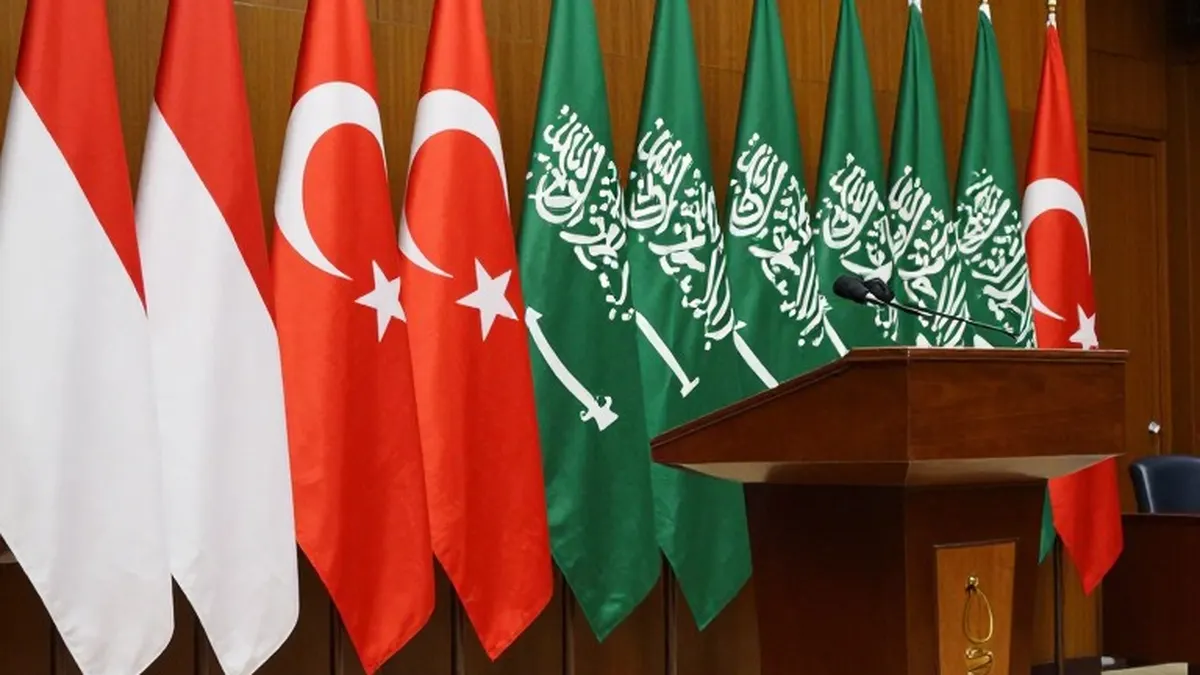
Indonesia is interested in joining the Mecca Pact and is examining its options, three Turkish officials told Middle East Eye. The pact, signed by Turkey, Saudi Arabia and Pakistan in August, has emerged as an attractive regional security initiative, with other countries, including Syria, also considering joining.
Potential Indonesian membership would carry particular weight because of the country's location in Southeast Asia, far from the Middle East and its regional conflicts. Two Turkish officials said Jakarta's interest was natural, pointing to the close partnership between Ankara and Jakarta, especially in defence industry cooperation.
Those ties have deepened quickly. Indonesia last year signed a deal worth more than $10bn to buy 48 Turkish Kaan fighter jets. It is also acquiring two Istanbul-class frigates under Turkey's national shipbuilding programme through a $1bn agreement signed in January between Turkish shipbuilder TAIS and Qatar's Barzan Holding.
Earlier this month, Turkey, Indonesia, Pakistan and Qatar signed a memorandum of understanding known as the Badr Pact. The agreement aims to streamline defence industry cooperation and deepen collaboration on the design, production and funding of military systems and platforms.
Official confirmation remains absent, however. A spokesperson for the Indonesian embassy said they could not confirm at this stage whether Indonesia was interested in joining the Mecca Pact. Several Turkish officials, including Foreign Minister Hakan Fidan in remarks on Tuesday, said the pact's founding members were prioritising its institutionalisation and were not seeking new members for the time being.
Adinda Khaerani Epstein, a Southeast Asia expert at Geopolitical Intelligence Services, said there was no official indication that Indonesia was considering membership. "In fact, President Prabowo reaffirmed Indonesia's longstanding commitment to its free and active foreign policy at the 11th Eastern Economic Forum in September 2026, reiterating that Indonesia has no intention of joining any military alliance," she said, adding that membership would represent a significant departure from the country's longstanding approach to maintaining its strategic independence.
Turkish and regional officials attribute the pact's emergence in part to Israeli military actions following the 7 October 2023 attack. Israel's military operations in Gaza, Syria and Lebanon, its air strikes targeting Hamas leaders in Doha, and the war with Iran have left countries across the region deeply concerned about the Israeli government's intentions.
Indonesia has taken a more nuanced position. While condemning Israel's genocide in Gaza and supporting international legal action against Israel, Jakarta said earlier this year that it could commit thousands of troops to Gaza as part of an international peacekeeping force. Israel welcomed the proposal at the time, but Indonesia announced in March that it had suspended the deployment.
Khaerani Epstein noted that although Indonesia has no formal diplomatic relations with Israel, Prabowo has reiterated that Jakarta would consider establishing ties only if Israel first recognises an independent Palestinian state. She said Indonesia's willingness to contribute troops to the proposed International Stabilization Force came with clear conditions, including a strictly humanitarian and non-combat mandate, and pointed to the Indonesian delegation's walkout during Prime Minister Benjamin Netanyahu's address to the UN General Assembly in September.
She described Prabowo's approach as a more multi-aligned foreign policy, reflected in Jakarta's engagement with Brics, its pursuit of OECD membership and its growing defence cooperation with partners including the United States and Turkey. The Badr Pact, she said, should be understood as a technical partnership rather than a collective defence agreement. "Multi-alignment better describes Indonesia's evolving foreign policy: expanding partnerships with different powers while maintaining its longstanding strategic independence."