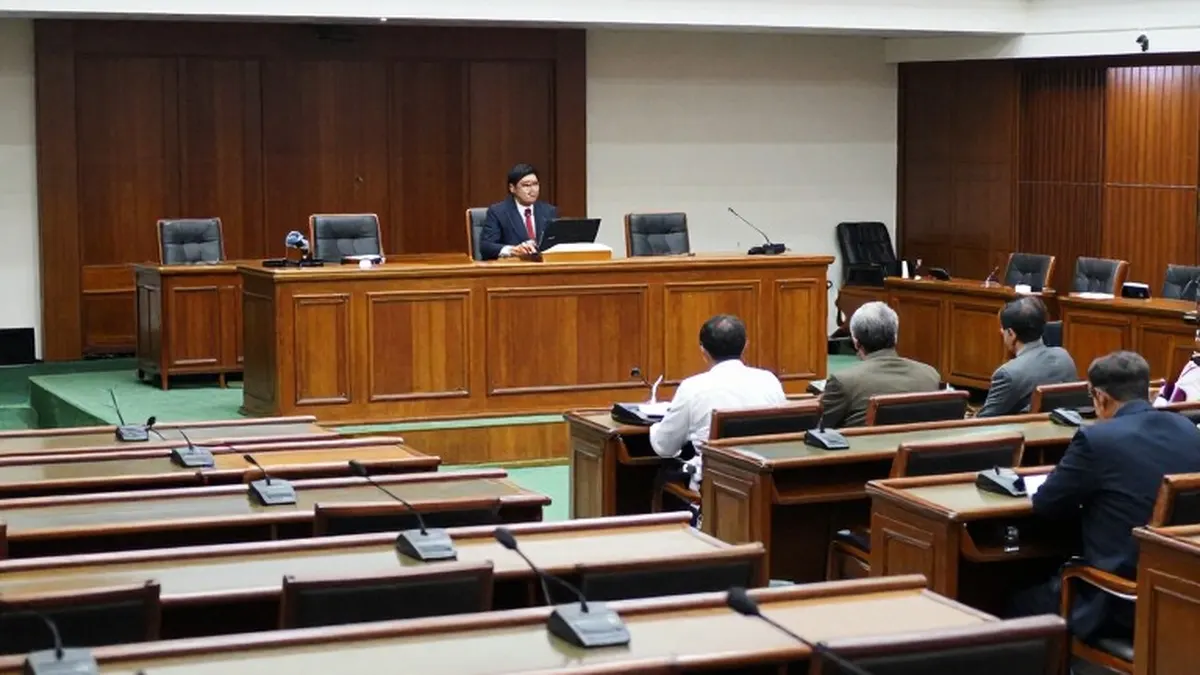
Indonesia’s vice president, Gibran Rakabuming Raka, formally resigned from his post on Thursday. The decision comes after a series of court rulings raised significant questions regarding his eligibility for the office. Specifically, legal authorities disputed the validity of the educational documents he had previously submitted to meet election requirements. Raka, the 39-year-old son of former President Joko Widodo, delivered his resignation to the leadership of the People's Consultative Assembly at the parliament building in Jakarta. He offered no public comments as he departed the meeting.
The resignation follows a period of intense political scrutiny. Raka had initially proposed stepping down on Tuesday during a meeting with President Prabowo Subianto. He stated that he wished to prevent the controversy from dragging on and consuming further political energy. The following day, he personally handed his resignation letter to the president. On Thursday afternoon, Prabowo addressed the nation from the presidential palace, flanked by Raka and top parliamentary leaders. In a televised statement, Prabowo described his acceptance of the resignation as coming with a heavy heart.
President Prabowo praised Raka for demonstrating courage, responsibility, and statesmanship by choosing to leave the office. He noted that Raka acted in the greater interest of the nation and the Indonesian people. Prabowo highlighted Raka’s contributions over the past two years, including visits to 35 provinces and 149 regencies and cities to inspect 303 government projects. The president emphasized that many of the administration’s achievements would not have been possible without Raka’s hard work and dedication. He also expressed his hope that Raka and his family would find strength during this challenging time.
Former President Joko Widodo, speaking from his hometown of Solo, described the situation as a normal part of political dynamics in public office. He mentioned that he had reminded his son that political positions are temporary. Widodo also stated that the family would continue to support President Prabowo’s government, particularly its programs that serve the broader public interest. The academic credential investigation appears to be distinct from other recent inquiries, including allegations that top police officials were involved in wiretapping targeting the president.
The legal dispute over Raka’s eligibility began last month when both the Constitutional Court and the Supreme Court ruled that his documents regarding overseas education did not satisfy election requirements. Indonesian election law mandates that presidential or vice-presidential candidates must have completed senior high school or an equivalent level of education. Because Raka completed his secondary education abroad, he was required to prove that his qualifications were equivalent to an Indonesian high school diploma. The courts found that the submitted documents failed to meet this standard.
The resignation also preempted a parliamentary impeachment process. On Wednesday, 120 lawmakers from eight political parties submitted a petition to the House leadership. This action initiated a procedure that could have led to Raka’s formal removal from office. The push for impeachment was driven by long-standing allegations that Raka’s candidacy was facilitated by a contentious Constitutional Court ruling in October 2023. Critics viewed that ruling as a conflict of interest and evidence of dynastic privilege, as it created an exception allowing regional leaders to run for vice president at a younger age than the standard 40-year requirement.
Raka did not meet the age requirement before the 2023 ruling, which allowed him to become Prabowo’s running mate in the 2024 election. He is the first vice president in Indonesia to resign before the end of a term since the democratic reforms that followed the fall of dictator Suharto in 1998. Under the Indonesian Constitution, a vacancy in the vice presidency does not trigger a new national election. Instead, the office remains empty until the People's Consultative Assembly elects a replacement. The president must nominate two candidates from which the assembly will choose, a process that must be completed within 60 days.
Parliamentary leaders are expected to convene immediately to begin selecting a successor. Speaker Ahmad Muzani told reporters that the assembly would move quickly to fill the vacancy. He asked for the prayers and support of all Indonesians, hoping that the democratic process would proceed smoothly. Muzani expressed a desire for this transition to serve as a constructive new precedent in the country’s constitutional system.