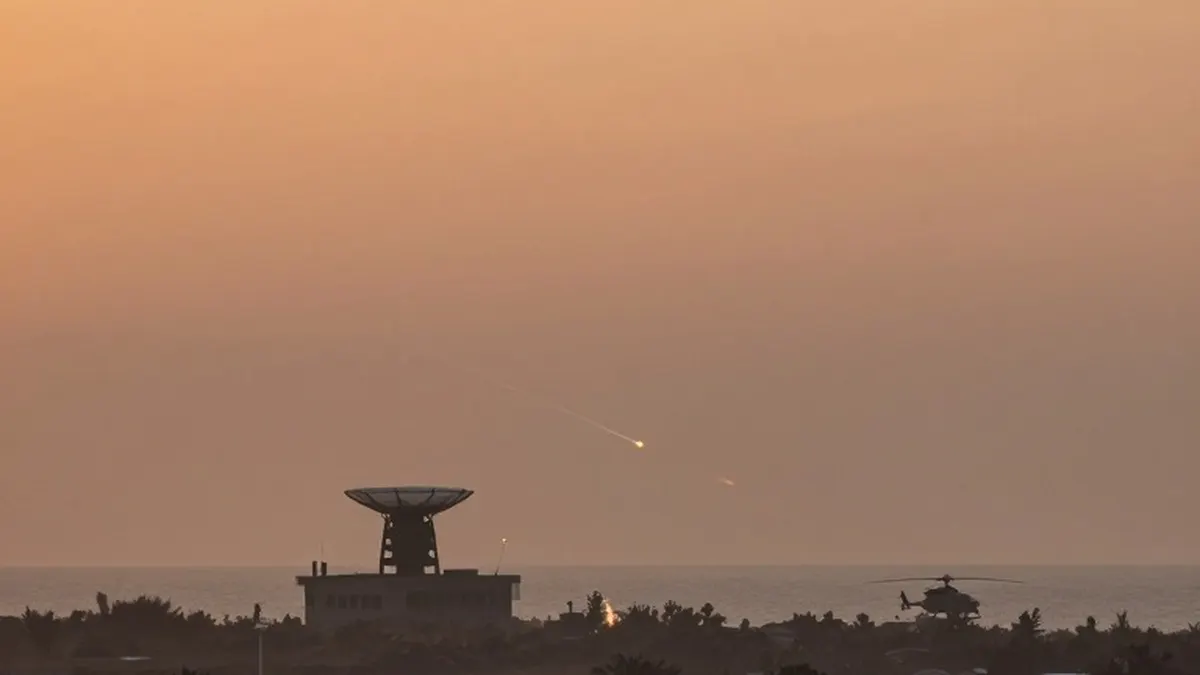
Iran carried out a drone attack against a US military base in Bahrain on Sunday, the second Iranian strike in three days, in retaliation for recent US attacks on Iranian territory. The assault further undermined already faltering peace efforts between Tehran and Washington and heightened fears of a broader escalation across the region.
Explosions were heard across the Gulf kingdom as Iran's Islamic Revolutionary Guards Corps said it launched six drones aimed at a US air defence radar at the Al-Rifaa helicopter base, describing the operation as a response to what it called hostile US actions. Bahraini authorities said the country's air defences intercepted the drones before they could reach their targets. The attack triggered sirens and official alerts urging residents to take shelter.
Speaking at a press conference in Tehran, foreign ministry spokesperson Esmaeil Baghaei said Iran would keep responding to any military aggression by the United States or other countries. Asked whether the latest strikes signalled a shift in Iranian policy now that negotiations with Washington have stalled, he said Iran was not waiting for anyone and remained focused on its own security.
US forces have conducted a series of strikes on Iranian targets in recent weeks, including on Qeshm Island in the strait of Hormuz. President Donald Trump last week described them as minor strikes and said Saudi Arabia and other Gulf states had warned him against large-scale combat operations. At the same time, Trump said Washington was no longer pursuing a deal with Iran and that he had directed Vice-President JD Vance to turn his attention to alleged corruption and fraud in Democrat-run cities and states. Vance, who blamed the Republicans' loss of Congress in the midterm elections on the Iran war, had previously requested a personal meeting with Iranian negotiators to discuss peace terms.
The conflict, which began with joint US and Israeli attacks on Iran in February, remains deadlocked, with the United States maintaining a naval blockade while Iran holds its grip on the strait of Hormuz. In a separate claim on Sunday, the Revolutionary Guards said two ships struck mines in the waterway and that one of them, an oil supertanker carrying 2m barrels of oil, sank after what the statement called massive explosions and fire. There was no immediate independent verification, and the US military recently said it had cleared all mines from the main routes through the strait.
The strikes on Bahrain suggested Tehran has settled on a tit-for-tat approach to US attacks. The kingdom hosts major US installations, including a forward base that has been home to the US Fifth Fleet and US Naval Forces Central Command, serving as a central support hub for American military operations in the Middle East. Iran repeatedly targeted the kingdom until a lull began in September. That pause ended on Friday, when Iran launched drones at a US radar facility; US Central Command said it shot down two drones without injury or damage.
"It's exactly what I was hoping wouldn't happen: Iranian attacks starting again, with all the worry and uncertainty that go with them," Hayat Ibrahim, a 65-year-old resident, told Agence France Presse.
Bahrain's foreign ministry denounced the resumption of attacks as heinous aggression and a flagrant violation of international law, rejecting what it called Tehran's flimsy pretexts and baseless claims. "The kingdom also rejects the transformation of its territory into an arena for settling scores and holds Iran fully responsible for these attacks and their consequences," it said. Jordan, Egypt, Saudi Arabia and Qatar condemned the attacks and voiced solidarity with Bahrain.
Meanwhile in Yemen, Saudi Arabia's campaign against the Iranian-aligned Houthi rebels suffered a setback when forces fighting for the Yemeni government pulled back from the Bab el-Mandeb strait to defend Aden on the southern coast. "The Southern Armed Forces announce the implementation of a redeployment operation for its forces from Dhubab Airport and the Bab el-Mandeb area, west of Taiz Governorate," the main pro-government force in the south said. The withdrawal appeared to mark the failure of a six-week counteroffensive aimed at driving the Houthis from the mouth of the Red Sea to secure a key oil route, while opening a potential path for the Houthis toward Aden. A Houthi missile strike near Aden killed people and wounded 12, AFP reported, citing military and government sources.