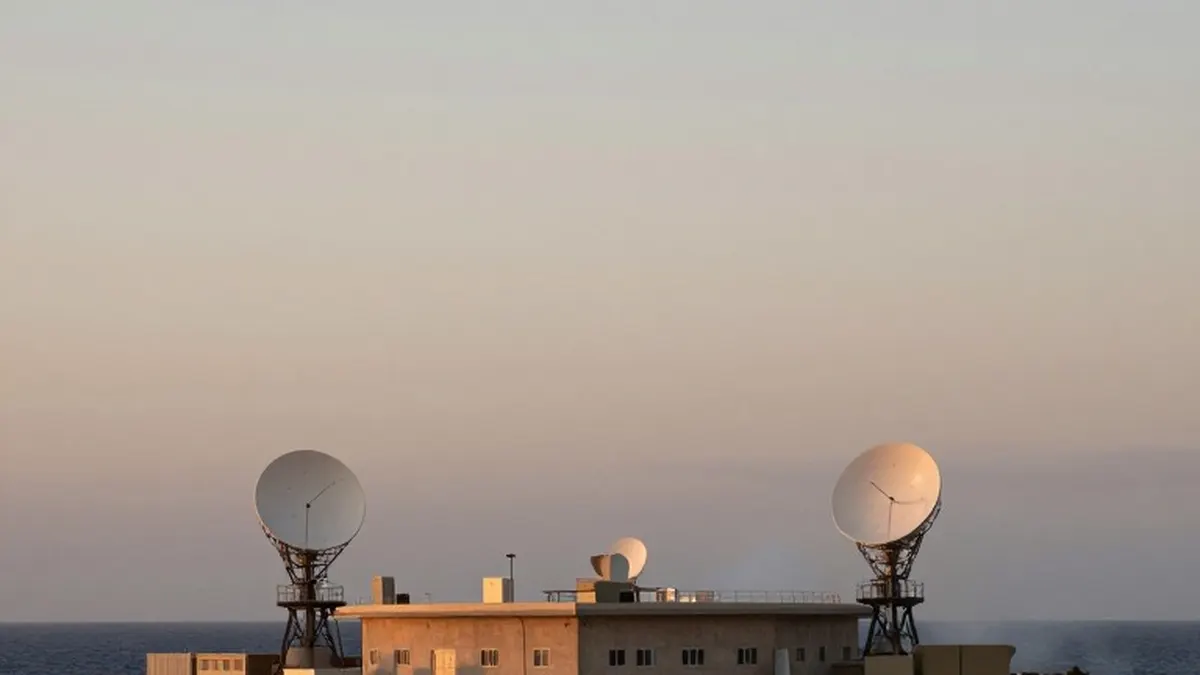
Iran launched its third wave of strikes against Bahrain on Tuesday, marking a significant resumption of hostilities after a two month pause in fighting. The Iranian military fired drones at a United States radar facility located in the small island nation, which serves as a critical hub for American military operations in the Persian Gulf.
Bahrain’s government announced that its air defense systems successfully intercepted the incoming aerial attacks, which officials described as treacherous. The United States military confirmed that no American personnel were injured and that no damage was sustained to U.S. equipment during the incident.
This latest round of strikes has drawn condemnation from several regional nations, including Egypt, Qatar, Saudi Arabia, and the United Arab Emirates. These countries cited the violation of Bahrain’s sovereignty and the threat to regional stability. Analysts suggest that Tehran’s actions are driven by increasing economic strain and the lack of progress in ongoing peace negotiations.
The conflict, which began on February 28, 2026, has now entered its eighth month. Despite initial predictions that the war would be short, U.S. President Donald Trump has remained cautious about the next steps. While he stated that new strikes were unlikely, he ordered the deployment of a third aircraft carrier and thousands of additional troops to the Middle East. He also indicated to Vice President JD Vance that immediate talks were not required.
A naval blockade enforced by the United States around the Strait of Hormuz has placed significant pressure on Iran’s economy by restricting the export of its crude oil. Conversely, oil tankers moving through the strait under U.S. military protection have helped restore Gulf oil shipments to levels near those seen before the war began. The blockade remains a central point of contention, with Tehran questioning whether escalating the conflict is less costly than accepting its continuation.
The arrival of the USS Theodore Roosevelt carrier strike group has expanded the U.S. naval presence in the region. Combined with the USS George H.W. Bush and the USS George Washington, the total U.S. naval assets in the Persian Gulf, Arabian Sea, Red Sea, and Mediterranean now exceed the forces deployed at the start of the war. This increased presence provides greater offensive firepower and missile interception capacity, according to an analysis by Israel’s Institute for National Security Studies.
Iran has framed its attacks as retaliation for U.S. strikes on its communications towers and ongoing drone surveillance operations. The Islamic Revolutionary Guard Corps stated that continued aggression against Iranian airspace and the use of regional bases for hostile acts would not go unanswered. Although previous attacks on U.S. radar systems in Bahrain appeared to cause little physical damage, they signal a potential shift in Iran’s strategy to target operational capabilities.
Diplomatic efforts to end the war have stalled despite intensified mediation by Qatar. A Qatari foreign ministry spokesman warned that continued attacks on Bahrain undermine diplomatic initiatives and pose a grave danger to the prospects of reaching an agreement. The current situation has been described by Iranian officials as a state of no war, no peace, with Tehran expressing both openness to a negotiated deal and readiness to escalate if economic pressures tighten further.
Shipping lanes continue to face threats as part of the broader conflict. The United Kingdom Maritime Trade Operations reported that a tanker was attacked twice north of Oman, resulting in a fire on board. Additionally, a cargo vessel off the coast of Yemen repelled an attempted boarding by armed men. In Yemen, Houthi rebels have solidified their control of the Bab el-Mandeb Strait, a critical route connecting the Gulf of Aden to the Red Sea, following a recent retreat by forces allied with the Saudi backed Yemeni government.