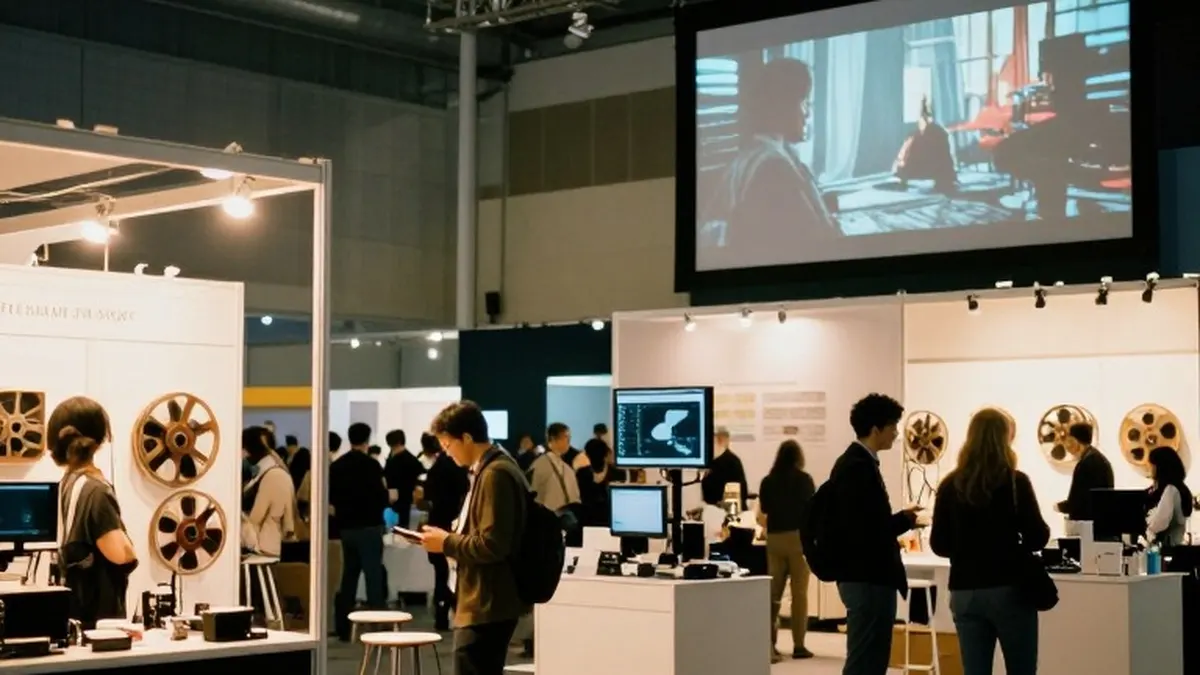
The fourth edition of the International Salon for Audiovisual Content of Abidjan, known as SICA, opened on November 26 with a clear focus on converting Africa's creative potential into tangible economic value. Running through November 28, the event centers on content economics and cultural diplomacy. This timing coincides with a new national strategy in Ivory Coast aimed at improving financing access for local producers, attracting international productions through fiscal incentives, and building the necessary infrastructure for a growing sector.
Ivorian Minister of Communication Amadou Coulibaly, who drives the annual event, stated that the salon has evolved from a simple networking gathering into a serious platform for economic cooperation. He noted that the goal is to give creative works real economic value beyond their cultural significance. To address the persistent challenge of funding, a memorandum of understanding is being signed between the public Media Support and Development Agency and NSIA Banque. This partnership aims to provide producers with grants or loans backed by state guarantees.
The financing initiative is supported by a pooled fund of approximately 2 billion CFA francs, or 3.34 million dollars, from the ministries of communication and culture. Additional funds of 500 million to 1 billion CFA francs are expected from the national youth employment agency. Coulibaly estimates that this leverage could generate between 5 billion and 6 billion CFA francs in guarantees. While the pilot phase is scheduled to begin in 2027, officials are already in discussions with the African Export-Import Bank to potentially extend this mechanism across the continent.
Legislative support is also strengthening the industry. The 2027 finance bill, which has passed the National Assembly and awaits Senate approval, includes tax and customs incentives for film equipment and new cinema construction. A tax credit to encourage filming within the country is also in development. Coulibaly drew a parallel to the country's status as a hub for Francophone music in the 1980s and 1990s, expressing a desire to regain that same dominant position in cinema and audiovisual media.
Previous editions of the salon have already produced significant results. Franco-American producer Alex Berger brought his series Eldorado to the country after attending SICA, employing a crew that was nearly 75 percent Ivorian. Additionally, American producer Larry Kasanoff, a keynote speaker at last year's event, is developing a production with a budget estimated between 30 million and 35 million dollars. The bulk of this filming is expected to take place in Ivory Coast.
Local productions are also seeing commercial success. The film Ebinto, an adaptation of Amadou Koné's novel, has recorded over 50,000 admissions in Ivory Coast, Senegal, and France, including a sold-out premiere at the Grand Rex in Paris. This project marks the first feature co-production for NCI Création, the production arm of Ivorian broadcaster NCI. The partnership originated from a meeting at SICA between the broadcaster and producer Charly Kodjo.
Infrastructure development remains a key priority. According to the European Audiovisual Observatory, the country had only 15 cinema screens in 2024 despite a population of 32 million. To address this, Mauritanian filmmaker Abderrahmane Sissako is developing the Treich Studio Academy, a complex featuring studios, incubators, and training facilities. Meanwhile, actor Isaach de Bankolé launched his acting school, Premier Continent, in October, with support from Cannes Film Festival head Thierry Frémaux.
The government is also working to improve distribution terms. Negotiations with local free-to-air television channels have reduced exclusivity periods from five years to three, allowing producers to sell their work to other broadcasters sooner. Furthermore, advanced discussions are underway with Meta to address digital monetization, with similar talks planned for YouTube. The goal is to ensure creators benefit from revenue generated when their works are streamed on these platforms.
Looking ahead, Coulibaly aims to transform SICA into a year-round platform with sessions dedicated to financing, co-production, and intellectual property. The Business Hub, launched last year, will be developed into a full audiovisual market over the next five years. International cooperation is also expanding, with new agreements planned with film festivals in Cameroon, Senegal, Cairo, and the Red Sea region.
The minister emphasized that the initiative has a pan-African vocation. He stated that it is crucial for the continent to take ownership of its own narratives, translate them into films, and share them with the world.