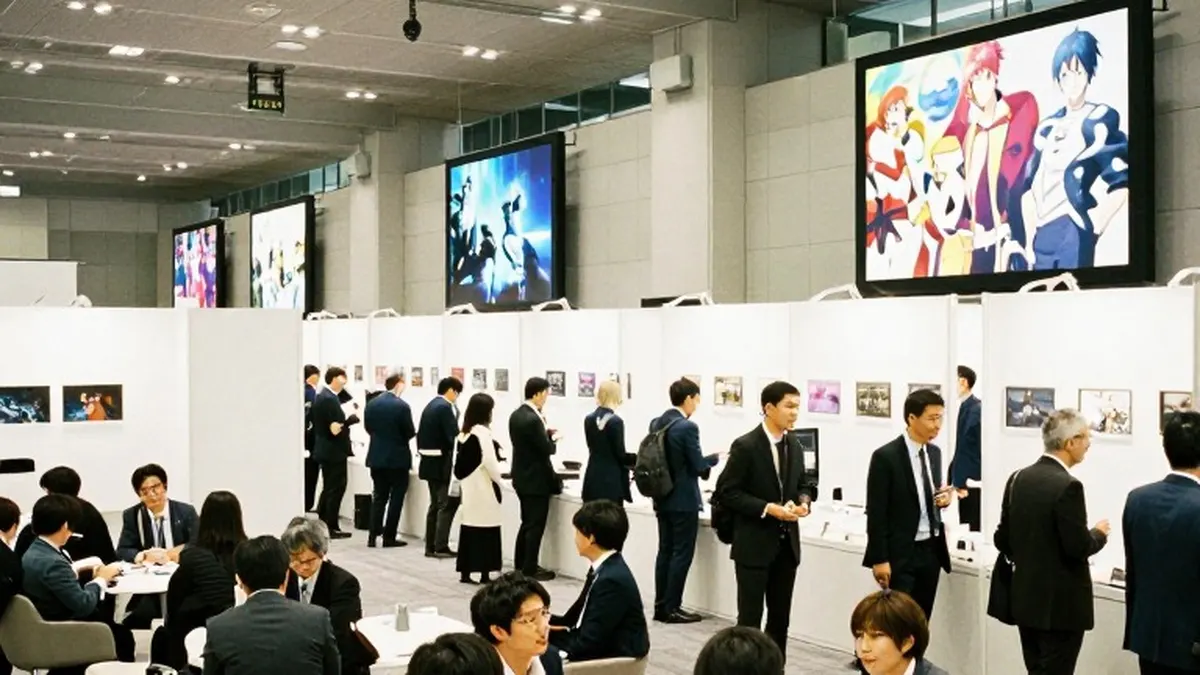
Exhibition space at TIFFCOM, the market arm of the Tokyo International Film Festival, has sold out early this year. Managing director Ikeda Kaori says a growing number of Japanese producers are using the event to find partners while their projects are still in development.
Last year's edition drew more than 4,600 industry professionals from 46 countries and regions, a 13% rise in attendance. Ikeda attributes part of that growth to worldwide interest in Japanese content. She told Variety that TIFFCOM has moved beyond the trade of finished content and become a platform for finding partners from the development stage, which has led to a significant increase in participation by Japanese producers.
She also points to Asia, now one of the world's largest markets, where governments are actively backing their content industries. Ikeda does not see a conflict between TIFFCOM's role as the main marketplace for Japanese content and its aim of becoming an Asian hub, and calls them two essential pillars. She notes that Southeast Asia is growing quickly in economic strength and production capability, and that demand for Japanese content there is rising.
The Tokyo IP Market now has 10 participating IP holders and has added new categories, including toys. Its pitch event has changed too, with each company giving a focused pitch on its flagship IP. The changes follow the market's expansion to the Cannes Film Market this year, where more than 700 people registered for pitches, panels and related programs, mostly from Europe and Hollywood. Ikeda says the IP holders there held a run of meetings with partners they rarely meet in person, and an initiative proposed by the Cannes market set up matchmaking with the XR sector.
Ikeda says overseas interest extends beyond established hits such as "One Piece" and "Super Mario." Japan, she says, still has many outstanding original works with strong potential for screen adaptation and remakes, and the Tokyo IP Market is meant to help buyers discover them.
The Tokyo Gap-Financing Market (TGFM) has 24 live-action and animation projects this year and has teamed with Canadian genre outfit Frontières. Ikeda says Japan, Thailand and Indonesia stand out in Asia for genre films such as horror and thrillers. TGFM hopes the genre focus will widen the mix of projects and filmmakers and give Asian projects a route into North America.
The market can already point to results. Two TGFM projects are at this year's festival, and "The Violinist," which took part in 2023, won the top prize at Annecy this year. Ikeda understands that the Italian financing on "The Violinist" and the Thai financing on "Four Seasons in Java" both stemmed from connections made at TIFFCOM.
Japanese broadcasters feature prominently in the conference program. TBS will present its partnership with Legendary Entertainment and the worldwide rollout of "Sasuke," known overseas as "Ninja Warrior." Nippon TV will discuss its global strategy, including a drama co-produced with South Korea, while TV Tokyo will present a case study on taking IP overseas through experiential exhibitions in a session run by the Broadcast Program Export Association of Japan.
For anime studios weighing international partnerships, Ikeda sees the biggest obstacle as a shortage of talent with international co-production experience, which leaves them without established networks. She says that also means there is immense room for growth, and TIFFCOM is hosting a conference on anime co-production covering project structuring and financing. Other sessions look at data-driven trends in Japanese content, with AGBO giving the keynote, as short-form drama and participation from AI and data analytics companies both grow.
Ikeda does not want to narrow TIFFCOM to a single next area, preferring that it keep adapting as trends and formats change and add partnerships with other markets and events. "The content industry five years from now holds so much potential that it cannot yet be defined, and that is precisely what makes it so exciting," she said.