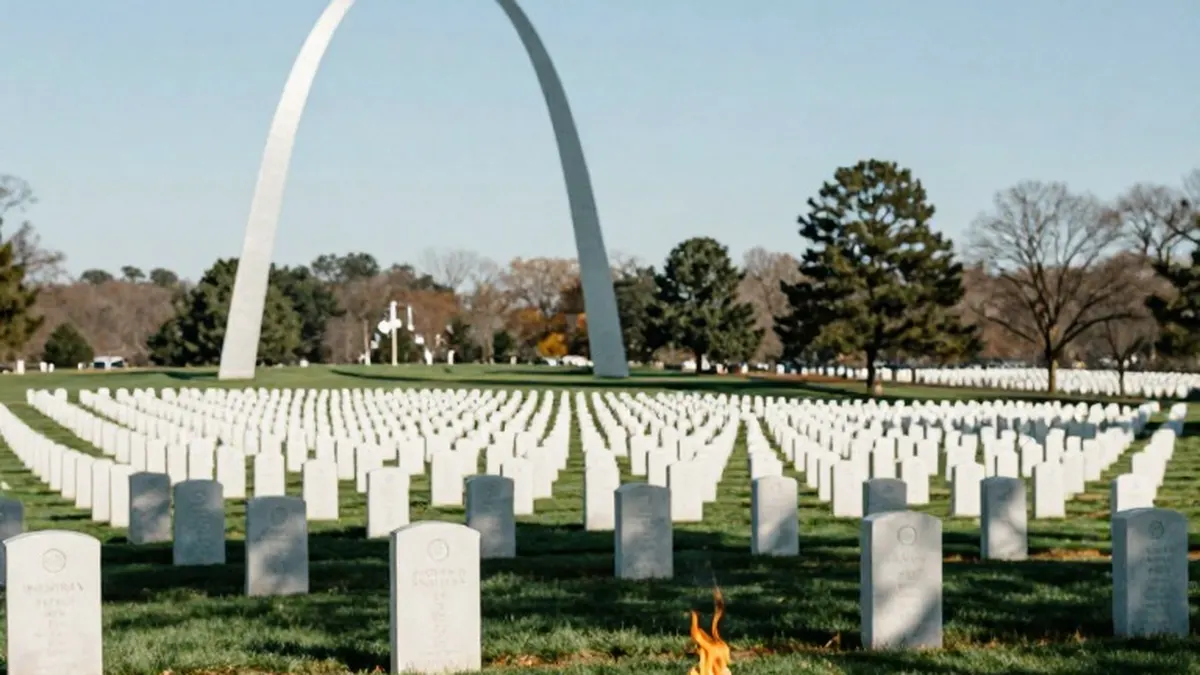
Members of the Kennedy family have entered the legal dispute over President Donald Trump's proposed arch in Washington, D.C. On November 10, nine relatives filed a motion in federal court to join an existing lawsuit aimed at halting construction of the 250-foot structure. The plaintiffs argue that the arch would obstruct views of their family members' gravesites at Arlington National Cemetery, including the eternal flame at the grave of President John F. Kennedy.
The motion was submitted by children of the late Senators Robert F. Kennedy and Edward M. Kennedy, as well as a son of Ethel Kennedy. All three deceased relatives are buried at the cemetery. Notably, Health and Human Services Secretary Robert F. Kennedy Jr. did not join his siblings in the lawsuit against his own administration. Rory Kennedy and Maxwell Kennedy stated that a towering arch casting shadows over their father, mother, and uncles would also undermine democratic principles and the safeguards established to protect the hallowed ground.
The Kennedy family's legal filing, which is 27 pages long, describes the arch as a permanent denigration of the family's final resting places. The plaintiffs assert that they would no longer be able to appreciate the sites as they have in the past. This new legal challenge adds a personal dimension to a fight that already includes Vietnam War veterans, an architectural historian, and the governments of Washington, D.C., and Virginia.
The Trump administration had recently secured final approval from the National Capital Planning Commission for the arch. Officials initially planned to break ground in Memorial Circle immediately after the late-night approval. However, District Court Judge Tanya Chutkan issued an order blocking construction for two weeks to allow for a review of the broader legal challenges. She previously questioned the administration's reliance on a century-old authorization for columns that were never built, writing that the argument revealed its own flaws.
A central issue in the case is whether the Kennedys have standing to sue. Legal experts suggest their involvement strengthens the plaintiffs' position. David Super, a law professor at Georgetown University, noted that judges may feel uncomfortable dismissing the family's concerns about their ancestors' graves. He also pointed out that the timing, which coincides with the administration's efforts to take control of the Kennedy Center, may make the President appear hostile to his revered predecessor.
The legal team cited a forensic analysis by The Washington Post indicating that the arch would cast shadows over tens of thousands of graves. The analysis suggests the structure would darken JFK's memorial on 50 days of the year and briefly block the eternal flame on nearly half of those occasions. The Kennedys frequently visit the graves in the morning, a time when the shadows would be most pronounced, fundamentally altering their experience of the site.
Arlington National Cemetery is a significant location for the Kennedy family, who chose it for JFK's burial to ensure public accessibility. The grave is aligned with a bridge connecting Arlington House to the Lincoln Memorial. The administration has acknowledged that the arch would disrupt the historic significance of nearby memorials but maintains that building it elsewhere would defeat its purpose. The White House characterized the project as a tribute to military heritage that would enhance the visitor experience.
Critics, including many veterans, argue the arch disrespects the solemnity of the cemetery. They contend that construction, which involves long workdays, would interfere with the numerous funeral services held there weekly. Veterans have also criticized the administration for cutting resources while proposing a monument to honor their service.
In a separate declaration filed this week, retired U.S. Army Brig. Gen. Steven Anderson argued that the arch could endanger national security. He warned that storing ammunition in a tourist attraction poses a tremendous risk and that launching drones nearby creates hazards for civilians. He suggested the structure is an unsuitable military facility that degrades security in the capital region.
As the legal battle continues, Democrats in Congress have vowed to use their majority to investigate potential wrongdoing and restrict funding. However, experts indicate that the ultimate decision on the arch's future may rest with the Supreme Court, given the President's veto power and the complex nature of the standing arguments.