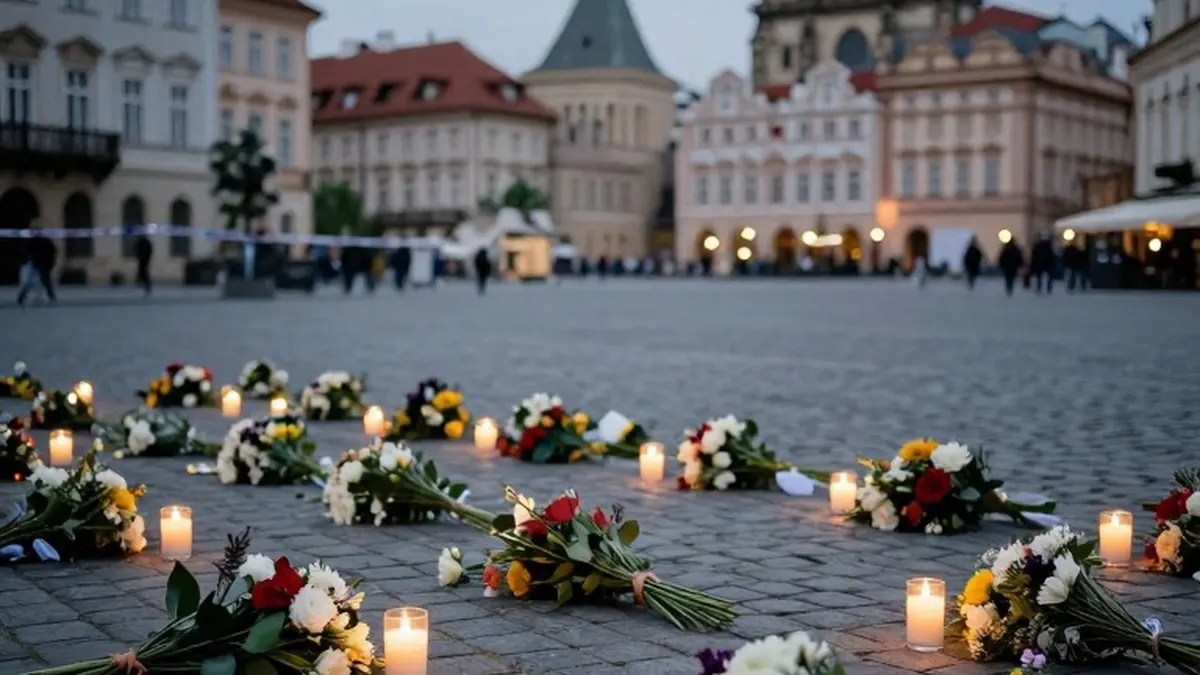
Poland has declared two national days of mourning after a gunman motivated by far-right ideologies killed six people in Kraków's main market square on Saturday, an attack the country's defense minister characterized as a terror attack. The shooting, which left four women and two men dead, is the country's deadliest in decades, and a policeman who confronted the attacker remains in critical condition.
Polish Justice Minister Waldemar Żurek said on X Sunday that the suspect is being investigated on suspicion of murder in connection with the six deaths, adding that he "acted with the aim of seriously intimidating a large number of people, making this a terrorist offence." Żurek said the same suspect faces a separate murder charge over killings in Ostrowiec Świętokrzyskie, a town about 93 miles northeast of Kraków, where three of the man's relatives were found dead in his home. He said the investigation is being led by terror offence specialists within the prosecutor's office.
Interior Minister Marcin Kierwiński did not name the suspect but described him as a Polish national in his mid-20s from Ostrowiec Świętokrzyskie who used an automatic rifle. "Everything indicates he was fascinated by far-right ideologies," Kierwiński said, describing his views as ultranationalistic. Regional governor Krzysztof Klęczar told a news conference Sunday that the suspect was shot by police at the scene and taken to a hospital around 3 p.m. local time, where he remains in critical condition.
Andrzej Fijołek, deputy inspector of Police National Headquarters, said a man and two women found dead in an apartment are believed to be the suspect's parents and sister. Żurek said early Sunday that Senior Constable Jakub Kulik "is fighting for his life in hospital" after confronting the shooter, posting that "one of his lungs is not functioning, and he needs every drop of blood he can get." Prime Minister Donald Tusk called Kulik and Senior Constable Artur Moranski "true heroes," and Klęczar said that without the officers' "efficient and selfless intervention," the number of victims could have been significantly higher. He said one officer had been brought out of a coma while the other remains in a coma.
Video posted on social media appears to show an injured police officer firing at the gunman before dropping to his knees and rolling onto his back, struggling to reload his weapon with no backup nearby. Four of the dead had been identified by Sunday, though their names were not released. Klęczar said the victims include four Polish nationals, a British national, and one non-Polish woman whose nationality has not yet been publicized. All 16 of those wounded were alive on Sunday, he said, adding that 11 are Polish and two are police officers.
World leaders offered tributes and condolences. British Foreign Secretary Ed Miliband said the U.K. government "deeply mourns the British national and other victims" and that "the U.K. stands resolutely in solidarity with the people of Poland." Ukrainian President Volodymyr Zelenskyy said his country "stands in solidarity" with Poland and called the shooting a "shocking crime." The U.S. State Department said it was not aware of any American citizens harmed. U.S. Ambassador to Poland Tom Rose wrote on X that the depth of Poland's shock at "yesterday's appalling mass murder" was remarkable, noting how rare such violence is in an "extraordinarily safe" country.
Many of those caught up in the attack were tourists. Taylor Dorfmeister, a 21-year-old American student from Santa Cruz, California, who is studying in Italy, was in the square with his roommate when the gunfire began and took shelter in a nearby building. "We ran up the stairs in the building to hide and it was a dead end, which is when I was the most terrified since the gunshots were [loud] and near," he told NBC News, adding that he thought, "This is it.. Like, there's nowhere to go, nowhere to hide."
Marie-Ange Collaer, visiting from Brussels with her family, wrote on Facebook that they "literally ran for our lives" and lay on the floor of a shop as bullets flew. "We saw a few that did not make it, true horror," she wrote. British resident Neil Thaxton said he and his wife, Nicky, initially thought the gunshots were fireworks before sheltering in a gift shop, where staff locked the doors and turned off the lights.
The Interior Ministry announced the national days of mourning for November 8 and 9 on Sunday. Kraków officials said part of the Main Market Square and surrounding streets reopened Sunday, though cordons remain in place while police continue forensic work.