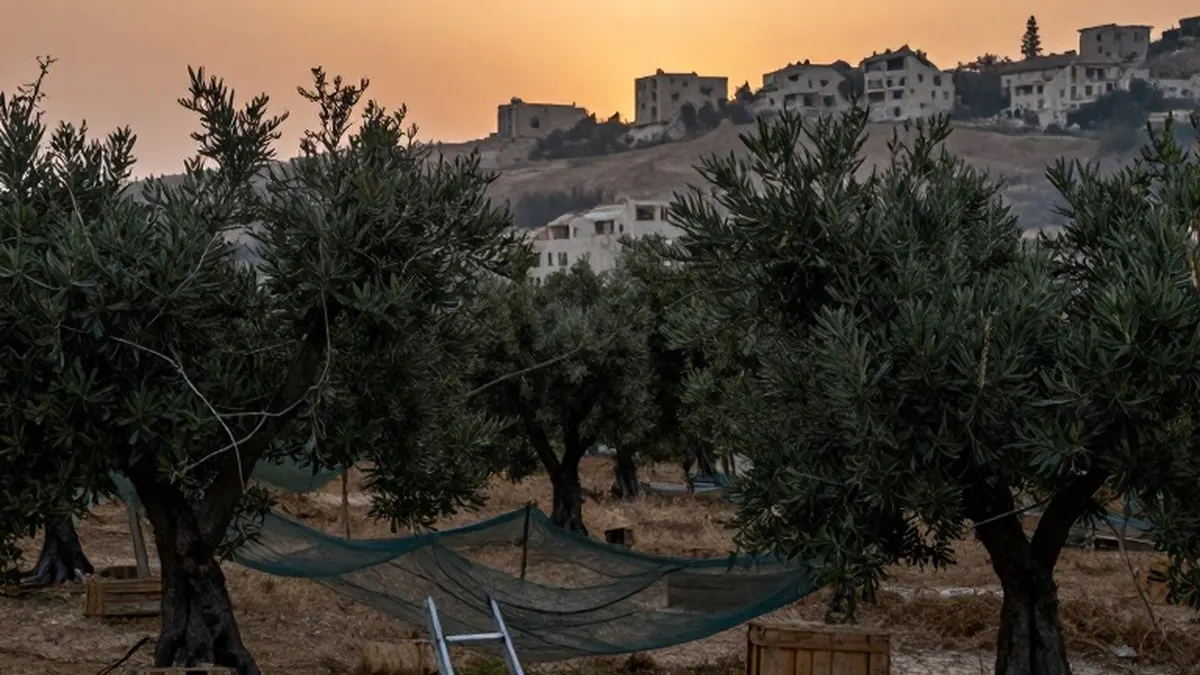
Every autumn, Khaled Farhat tends the roughly 200 olive trees he owns in the southern village of Majdel Selm, fitting the work around his duties at a school. This year, he says, the harvest is far harder, because Israel's continued occupation of parts of southern Lebanon has made even reaching his grove a complicated process.
Majdel Selm lies just north of Israel's so-called Yellow Line, below which the Israeli military is demolishing homes and local infrastructure. Farhat explained that he first had to ask his municipality for access. The request went to the Lebanese Army, which coordinates with a mechanism set up after June's Tripartite Framework Agreement between the United States, Israel and Lebanon to issue permits for locals to work their groves.
The permission came with a tight limit. Farhat said he was given just two weeks on his land, and the neglect is already visible. Weeds that would normally be cleared grew while his family was displaced. Clearing them eats into the time available for picking, and he said anything left on the trees when the window closes will go unharvested.
Danger is constant. Farhat said drones hover overhead, sometimes several at once, and warplanes occasionally carry out strikes nearby. An Israeli shell had landed near him an hour before he spoke to Al Jazeera by phone. "Drones are constantly in the sky," he said, adding that the strikes take a psychological and emotional toll.
Unexploded ordnance adds to the risk. In early October, at least two people were killed in olive groves in the south. A retired soldier died from Israeli artillery fire in Yater, and an engineer was killed when ordnance exploded as he harvested olives in Froun. Both villages are in the Bint Jbeil district. A day later, a Lebanese police officer tending farmland in Ain Ebel was also killed in an explosion.
The problem is not new. According to a Human Rights Watch report, Israeli forces dropped cluster bombs containing between 2.6 and four million submunitions in the area in the final days of the 2006 war. Hiba Ghandour, Lebanon programme manager for the Mines Advisory Group, said many failed to detonate and remain hidden in fields and orchards. She said hostilities since October 2023 have added new explosive hazards, and that her group has confirmed 444,000 square metres of hazardous farmland, a figure likely to grow as research continues.
Economic hardship pushes many back to their land before it is cleared, Ghandour said. Repeated bombardment has also made it harder for clearance teams to reach some communities.
The damage extends beyond the harvest. Environment Minister Tamara Elzein said more than 16,000 hectares of land have been burned since Israel began bombing and later invading Lebanon in October 2023, including with white phosphorus. Israel still occupies nearly 630 square kilometres of southern Lebanon. Ramy Zurayk, a professor at the American University of Beirut, described the destruction and movement limits as an effort to make the area "sterile." Zurayk also said at an October 21 university panel that there is no evidence olives or other produce from the south are dangerous to eat, despite public worries about white phosphorus.
Many families usually treat the harvest as a gathering, but this year some growers say they are leaving children and relatives at home. Farhat remains hopeful. "Hopefully, this is just a phase that will pass," he said, expressing the wish that tensions will ease.