Republicans are expressing growing concern that Libertarian candidates could influence the outcome of several closely contested U.S. Senate races this year. With the majority in the Senate hanging in the balance, party strategists fear that third-party candidates may siphon away critical votes from the Republican column. This dynamic is particularly worrying in Iowa, Kansas, Ohio, and Texas, where polls suggest the margins of victory will be razor-thin.
Although these states generally lean toward the Republican Party, dissatisfaction with President Donald Trump is fueling a movement of protest voting among some conservatives. Issues such as the unpopular war with Iran and the expansion of executive power resonate with the anti-establishment segment of the right. These themes align with the Libertarian Party platform, which emphasizes nonintervention and limited centralized authority.
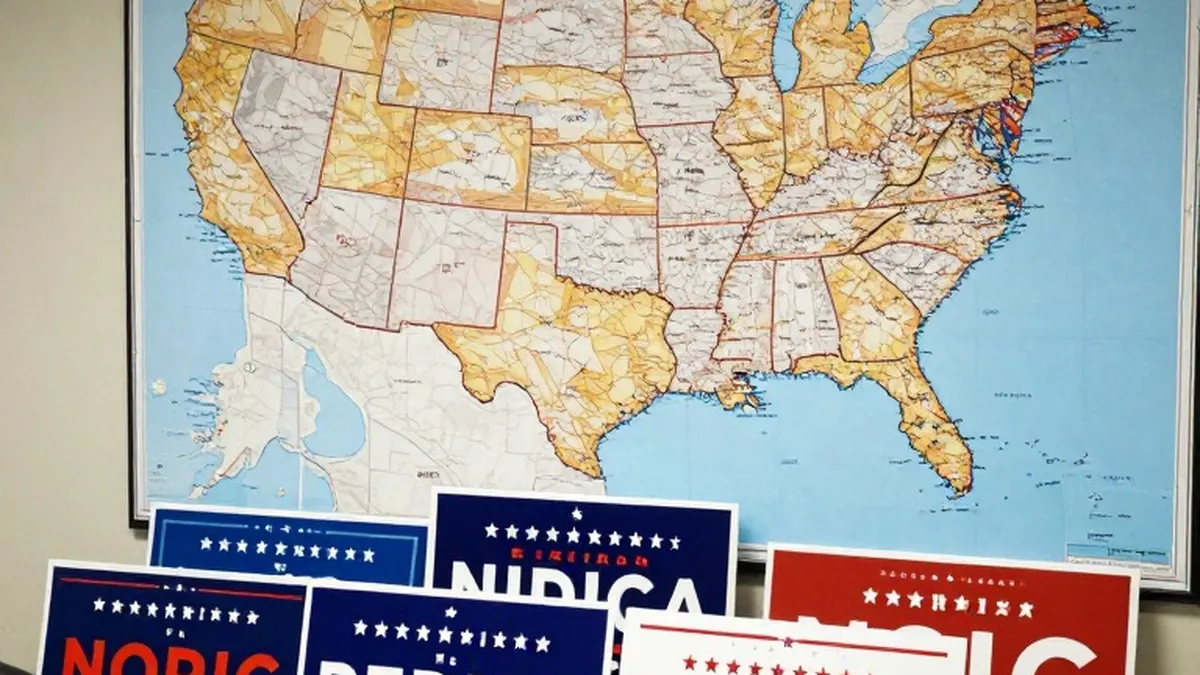
Gene Krebs, a former Ohio state lawmaker and Republican, is leading a project aimed at reducing the impact of spoiler candidates. He noted that Libertarians could draw enough votes to affect the outcome in several of these key races. In Ohio, former Libertarian Party national chairman Bill Redpath is challenging Republican Senator Jon Husted and Democratic former Senator Sherrod Brown. Krebs warned that the Libertarian candidate could easily pull enough support away from the Republican to allow the Democrat to win.
Republican campaign officials indicated that they are less concerned about Iowa, where Libertarians are not a regular presence on the ballot. Their primary focus remains on Ohio, Kansas, and Texas. These officials spoke on the condition of anonymity to discuss their internal strategy without revealing specific tactical details.
In Kansas, Libertarian David Graham is running in a tight race between Republican Senator Roger Marshall and Democrat Adam Hamilton. This is Graham’s second campaign for the seat. In his previous run, he received 3% of the vote in a race that Republican Senator Jerry Moran won by a wide 23 percentage point margin.
The situation in Texas presents a similar challenge. Libertarian Ted Brown received only 2.3% of the vote in 2024, when Republican Senator Ted Cruz secured another term with ease. However, the current race is significantly tighter, pitting Democratic nominee James Talarico against Republican Texas Attorney General Ken Paxton. Wayne Hamilton, a former executive director of the Texas Republican Party, suggested that Paxton’s history of legal and ethical issues may prompt some conservative voters to look for an alternative.
Hamilton described the Libertarian vote as a protest measure rather than a genuine endorsement of the third-party candidate. He stated that voters are choosing this option because they do not want to support Paxton. Brown, a former insurance adjuster from California and a longtime activist in the party, noted that some conservative voters have turned against Trump after he failed to fulfill his early anti-war promises.
Brown argued that the separation of powers is critical and criticized what he called the imperial presidency for seizing too much authority. His campaign operates on a modest budget of approximately $30,000, with $7,000 spent on advertising in four Texas counties where Libertarians have historically performed well. This stands in stark contrast to the roughly $390 million in combined advertising expenditures by Talarico, Paxton, and their aligned groups since the May 26 primary, according to the ad-tracking firm AdImpact.
Brown, who received 267,039 votes in the 2024 election, a record for his party in a Texas Senate race, aims to match that total in the lower-turnout midterm election. He dismisses Republican criticisms that he is spoiling Paxton’s chances, suggesting instead that the problem could be avoided by nominating a stronger candidate. He told Democrats that they cannot spoil a system that is already rotten, noting that there is good reason for many people to cast a protest vote.