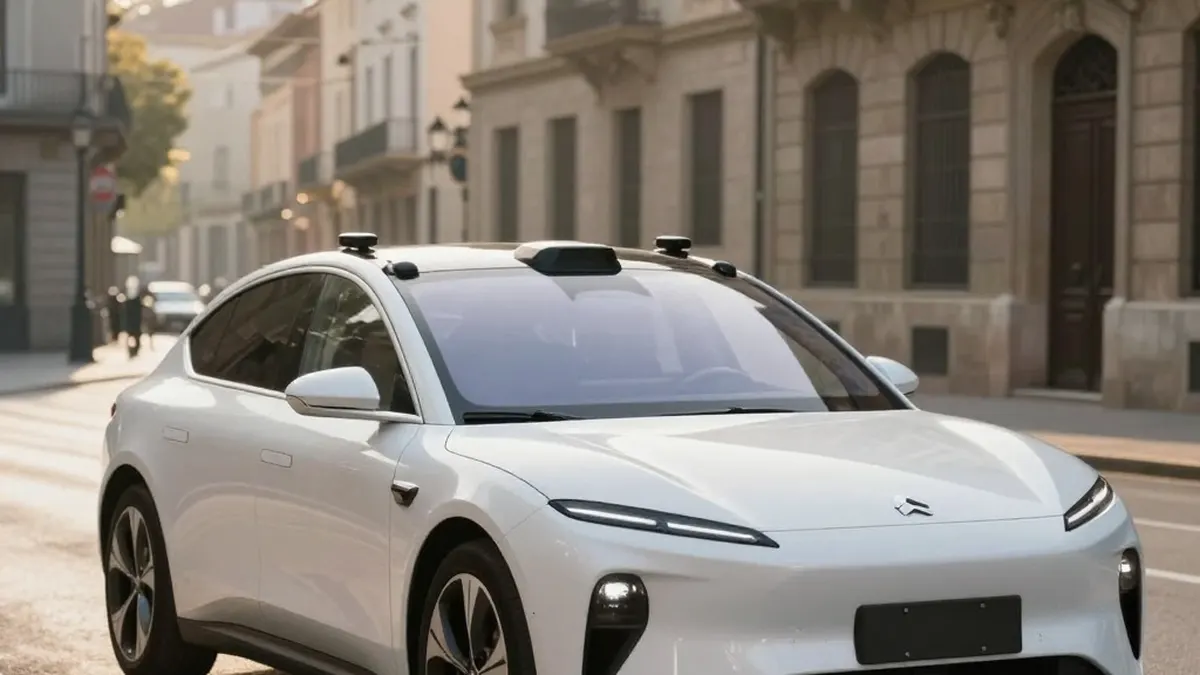
Bolt has settled the question of who will supply the driving software for its planned European robotaxi fleet. The company announced that at least 25,000 autonomous Lucid vehicles will run Nvidia's Alpamayo Stack, with a data-collection program in Madrid slated to start in 2027.
The choice gives Lucid two robotaxi customers using two different autonomy systems. In the United States, Uber's Gravity robotaxis use software from Nuro. In Europe, Bolt will rely on Nvidia.
When Lucid and Bolt unveiled the 25,000-vehicle agreement in September, the software provider was left unnamed. The vehicles were to be built around Nvidia Hyperion, a reference design for computing and sensors that is not a self-driving system by itself, and Bolt said it would add autonomous-driving partners later. It has now turned to Nvidia again. Nvidia describes Alpamayo Stack as full-stack driving software that pairs "reasoning AI" with classical perception and planning, running on Hyperion with its Halos safety tools layered on top. The two companies will adapt the software to European driving conditions, and Lucid is only the first automaker Bolt intends to use it with.
Madrid will go first. The vehicles there will not initially carry passengers; their task is to gather real-world driving data so Bolt and Nvidia can develop and validate the software. Even that stage requires regulatory approval. Germany and France have been named as the next key markets.
Jevgeni Kabanov, Bolt's president and head of autonomous driving, said the Region of Madrid is "pioneering a structured framework for commercial autonomous mobility." Kay Stepper, president of Lucid Technologies, described the "launch of data collection next year" as one of "the first steps" toward autonomous mobility in Europe.
Bolt did not say which Lucid model will be sent to Madrid. The September deal was designed around Lucid's upcoming Midsize platform, whose first vehicle, the Cosmos, was pushed to 2027 in Lucid's August operating reset, "most likely the second half." If that purpose-built vehicle is not ready in time, the first Madrid data-collection cars would have to be existing Gravity or Air vehicles. No date has been given for any rides without a driver.
Combined, the two programs represent a large order book on paper. Uber's program with Lucid and Nuro now calls for at least 35,000 Gravity vehicles worldwide, up from Uber's original commitment of 20,000. Adding Bolt's 25,000 brings the total to 60,000 vehicles. Lucid delivered 15,841 vehicles in all of 2025 and 10,852 in the first nine months of 2026, so the commitments equal almost four years of its current deliveries.
The Uber effort is further along but not yet open to the public. Uber employees have been taking test rides in Gravity robotaxis in San Francisco since April, with a safety operator behind the wheel. A public Bay Area launch is still promised for 2026, with Houston to follow in mid-2027.
Bolt is also spreading its bets. It runs a separate track with Pony.ai and Stellantis, which announced a pilot in Luxembourg in June, and it is targeting 100,000 autonomous vehicles on its platform across Europe and the wider UNECE region by 2035. For Nvidia, which has long sold chips and sensor reference designs to automakers, Alpamayo Stack marks a move into supplying the driver itself, putting it in competition with Nuro, Waymo and Tesla's software.