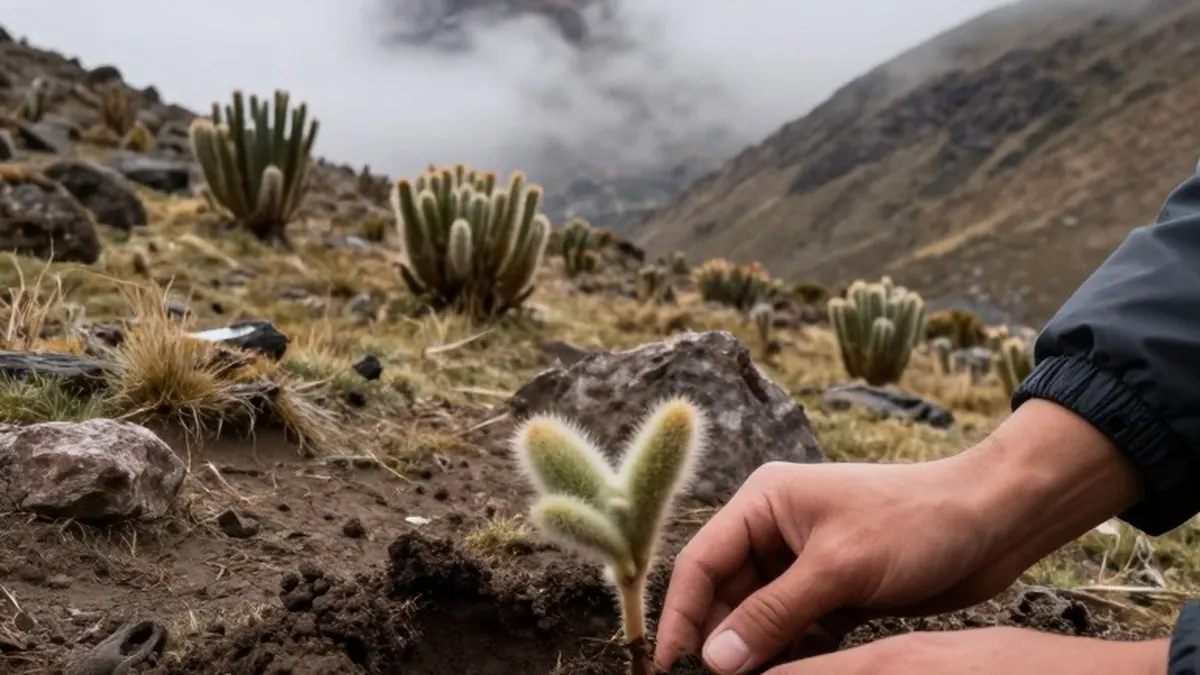
High in the Andes Mountains at an elevation of 10,000 feet, Moisés Moreno welcomes visitors to a greenhouse where he cultivates seedlings that can eventually reach heights of 30 feet. These plants, known as frailejons, are closely related to sunflowers and serve as the iconic flora of Colombia's páramos, the high mountain wetlands that are critical to the nation's water supply. Moreno often asks his guests if they know about these unique plants, though many visitors arrive with little prior knowledge of their significance.
The frailejon is distinguished by the wooly fuzz on its leaves, which serves a dual purpose. The texture protects the plant from the intense cold of the high altitude while also absorbing water from the surrounding cloud cover. This mechanism helps maintain moisture levels in the páramos, which act as the source for major rivers and a substantial portion of Colombia's freshwater resources. The Muisca Indians, who historically inhabited the region, revered these plants as sacred guardians of the water.
Despite their ecological importance, frailejons and their habitat face increasing threats. Farmers, cattle ranchers, and coal miners are gradually pushing higher into the Andes, encroaching on the wetlands. Additionally, climate change is warming the mountains, allowing invasive species to survive at altitudes previously too cold for them, thereby disrupting the fragile ecosystems. Mauricio Diazgranados, a Colombian expert and chief science officer at the New York Botanical Garden, notes that of the nearly 150 known species, two-thirds are at risk, with 17 classified as endangered. He describes them as a keystone species vital for water production but warns that most are currently in trouble.
The name frailejon, which translates to big friar, stems from the appearance of the shrubs when they first emerged from the mountain fog to explorers centuries ago, resembling hooded monks. Some species have long, thin leaves that bend toward the sky like palm fronds, while others develop stout trunks as dying leaves slump down to form a brownish outer shell rather than falling to the ground. Diazgranados recalls becoming completely captivated by the plants when he first encountered them as a teenager.
Moreno, now 53, has a personal history with the plants that reflects the shifting perceptions of the community. Growing up on a mountainside farm near the central Colombian town of Monguí, he and his neighbors viewed the frailejons as a nuisance, chopping them down to make way for potato fields and cow pastures. His perspective changed after he was injured in a coal mine cave-in, leading him to vow to work above ground. He began studying the páramo ecosystem, established his greenhouse, and started leading expeditions to replace the plants that had been lost.
Conservation efforts have expanded beyond individual initiatives. Colombia's National Parks agency and its armed forces have participated in reforestation campaigns following wildfires that scorched thousands of acres. Public awareness has also been boosted by Ernesto Pérez, a popular cartoon character shaped like a frailejon. Similar to Smokey Bear in the United States, this character promotes the conservation of Andean flora and fauna. Several volunteers on recent hikes credit the character and its catchy theme song for introducing them to the frailejon.
During a recent expedition, a group of volunteers hiked to an altitude of 11,000 feet, passing streams, waterfalls, and lagoons. The area is a state park where frailejons dot the landscape, though barbed-wire fences and grazing cows indicate ongoing human presence. Moreno and his assistants taught the volunteers to dig shallow holes, add shredded tobacco as fertilizer, and carefully plant the tiny seedlings. The survival of these plants is uncertain, as many die in the harsh climate and those that survive grow only a few inches per year.
To support the new plantings, the group held an impromptu ceremony, with one member reciting a prayer to connect with mountain spirits and another blowing on a conch shell. Some volunteers have grown emotionally attached to the specific plants they carried up the mountain, even naming them. Biologist Julieta Barba baptized her plant Gerry in honor of her mother. After securing the soil around the roots, she expressed excitement for the plant's future in the páramo.