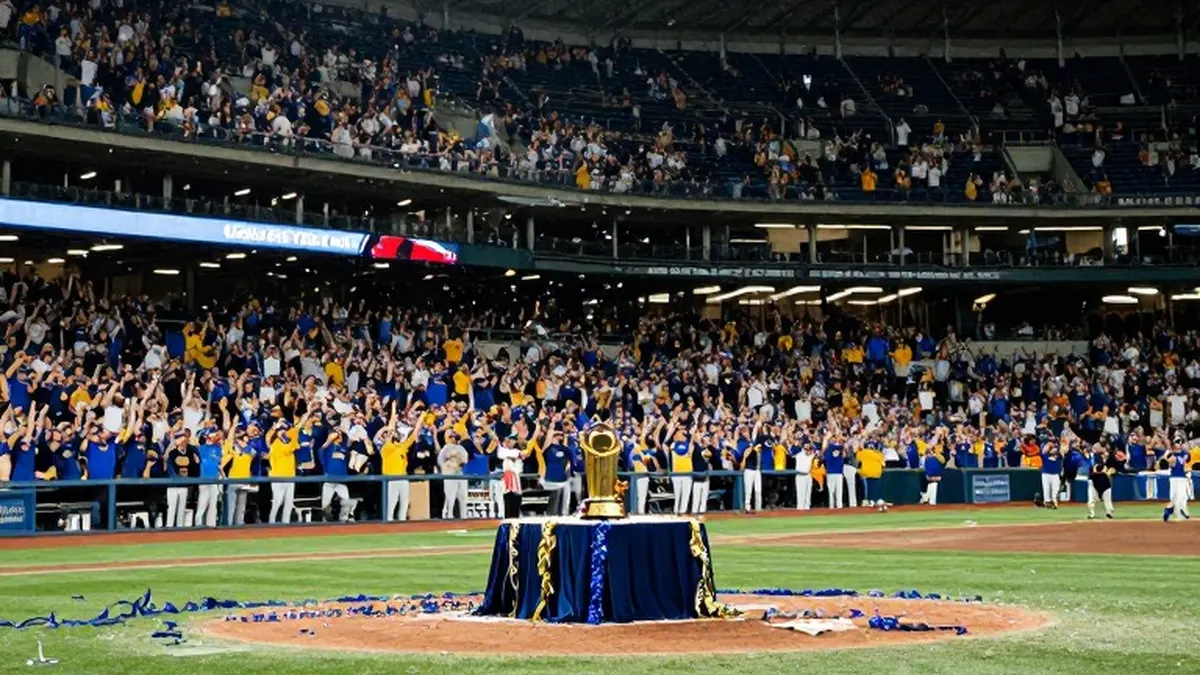
The Milwaukee Brewers closed out the Tampa Bay Rays in Game 5 on Wednesday night to win their first World Series title. Yet the 2026 season's end brings a bigger question for fans: will baseball return on schedule? Opening Day for 2027 is set for March 24, but a labor fight could threaten that date.
Players and owners are negotiating a new collective bargaining agreement, the deal between the clubs and the players' union, the MLBPA, that covers everything from payroll structure to meal money. The sharpest dispute is over a salary cap. Owners have renewed their push for one, something they have not pursued this aggressively since the 1994-95 players' strike. Owners are expected to lock out the players once the current agreement expires at 11:59 p.m. ET on Dec. 1.
A lockout is a stoppage started by management, while a strike is started by the players. Either way, there is no major-league baseball. During a lockout, anyone on a 40-man roster is barred from team facilities, including access to trainers, physicians and coaches. Transactions are frozen. MLB is also expected to remove player images and videos from MLB.com, and a league memo obtained by The Athletic discourages contact between players and club personnel, down to sending holiday cards.
The freeze would hit the offseason hard. Free agency opens Monday, Nov. 2, leaving roughly a month for trades and signings before a lockout begins. Before the 2021-22 lockout, a wave of free agents signed, and that could happen again, with a player such as Tarik Skubal, who is seeking a contract worth hundreds of millions, possibly wanting to finish a deal early. Still, uncertainty over the game's future financial rules could make clubs hesitant. A long lockout could also endanger the Winter Meetings, the major-league Rule 5 Draft, arbitration timelines and spring training.
Whether the 2027 season is affected is too early to say, and a full cancellation is not considered a strong threat this far out. There is one notable incentive for the league, though. The Athletic reported that if the lockout runs into late May and wipes out at least 60 games, most national broadcast and streaming contracts would be extended through 2029. That would delay the windfall Commissioner Rob Manfred and owners expect from centralizing and equally sharing team streaming rights, giving the league strong reason to settle before June.
Minor leaguers are largely shielded. They have their own agreement, which remains in force, so only players on 40-man rosters are locked out. The minor-league season would go on even if the lockout reaches the regular season.
Manfred has argued that an offseason lockout creates leverage and speeds up bargaining, calling it "in a bizarre way, it's actually a positive." After the last lockout began, however, owners waited about six weeks to make their first proposal. The practical purpose is to head off a strike that the union could time for maximum pressure. This would be the 10th modern labor stoppage in MLB, with five strikes and five lockouts.
The salary cap is the central issue, and the union has long treated it as a nonstarter. Local revenue sharing is another subject, and there the sides may have common ground, since the union has shown willingness to discuss it and has proposed something similar. Season length, postseason format, minimum salary, free agency, arbitration, an international draft, the qualifying offer, roster sizes, draft bonus pools and the competitive balance tax also need resolving.
There are reasons for hope. Missed games cost both sides in broadcast and gate revenue and paychecks. Attendance and revenues are rising, pace-of-play changes and the ABS challenge system are popular, and expansion to 32 teams is likely on the horizon. A season ruined by a lockout would damage those prospects, and the 1994-95 strike is a reminder of the harm possible. That shared interest in protecting the money at stake may be what pushes the sides toward compromise.