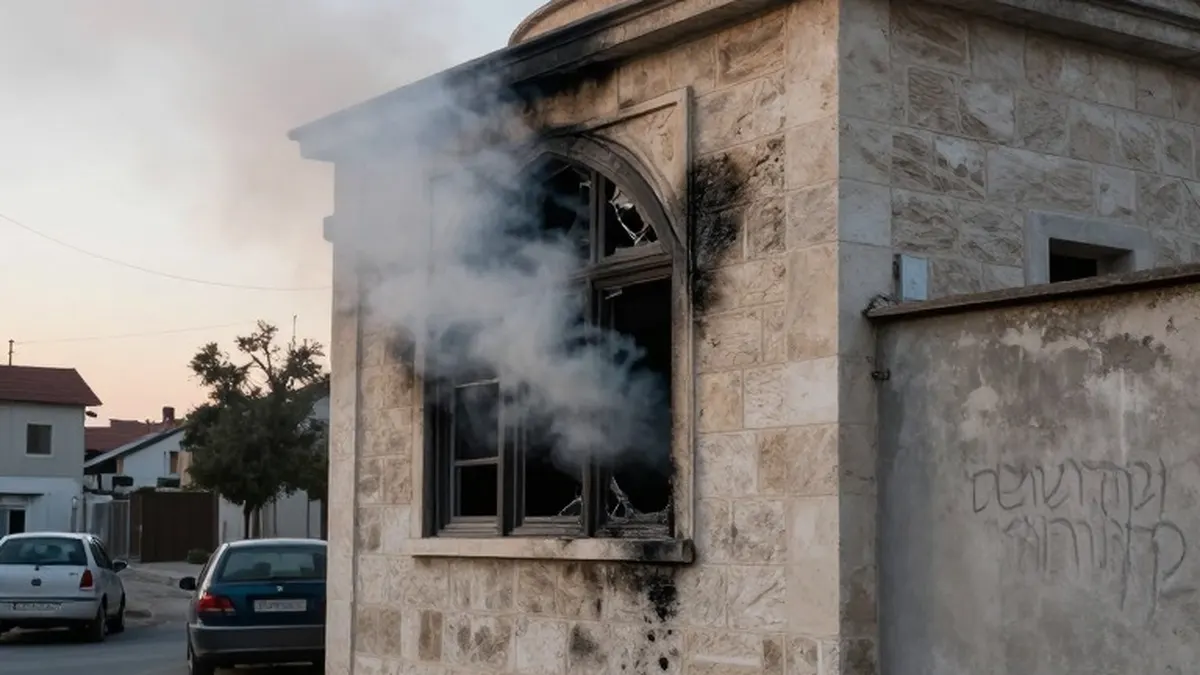
A mosque in the northern Arab village of Ed-Dahi was engulfed in flames on Thursday morning following what authorities described as an alleged arson attack. Hebrew graffiti bearing the phrase “Tefillin revenge” was discovered on a nearby wall, a detail that has led investigators to focus on a potential nationalist motive. Israeli police confirmed that a significant number of officers were deployed to the scene to conduct searches and identify the suspects.
The investigation is being carried out in close cooperation with the Shin Bet, Israel’s internal security agency. This joint effort, combined with the specific nature of the graffiti, suggests that officials are seriously examining the possibility that the fire was driven by nationalist sentiments rather than a random act of vandalism.
Footage released by Israeli media captured three individuals wearing masks as they approached the mosque, each holding what appeared to be a bottle. Shortly after, the group was seen fleeing the area. Police stated that they view any attempt to harm religious symbols with the utmost severity and pledged to act resolutely to bring those responsible to justice.
Sheik Khaled Zubi, the imam of the mosque, reported discovering the fire upon his arrival for morning prayers. He explained that the arsonists had broken a window and thrown a Molotov cocktail inside the building. Zubi noted that the community managed to extinguish the fire quickly and urged police to apprehend what he called terrorists.
Speculation has grown that the incident may serve as retaliation for a previous attack in Afula, a predominantly Jewish city located near Ed-Dahi. Last month, a 15-year-old suspect broke into a synagogue in Afula and desecrated religious texts. The indictment against the teenager alleged that the attack was motivated by antisemitism.
The graffiti found near the burned mosque included the word “Revenge” and the phrase “The whole country is a front.” It also featured the name of Yehuda Sherman, a young man who was killed in a car accident in the West Bank in March of last year. These specific details have fueled theories linking the arson to broader political and social tensions.
Political leaders from Arab, left-wing, and centrist parties quickly condemned the arson. Mansour Abbas, head of the Ra’am party, described the incident as a hate crime and an act of terror. He accused Prime Minister Benjamin Netanyahu of inciting violence against Arab citizens, noting that Netanyahu’s Likud party has frequently referred to Arab politicians as supporters of terror.
Ahmad Tibi, a leader of the Joint List, also blamed Netanyahu, stating that the mosque was set on fire by people poisoned by incitement from the prime minister and his ministers. Yair Golan, head of the Democrats party, argued that the current government’s tenure puts human lives at risk and pledged that a future coalition would crack down on what he termed Jewish terror.
Yair Lapid, leader of the centrist Yesh Atid party, called the attack a heinous hate crime, emphasizing that it is neither Jewish nor Israeli. As of the latest reports, Prime Minister Netanyahu has not issued a public comment regarding the fire. The political landscape remains tense, with Netanyahu’s bloc and the emerging coalition led by Gadi Eisenkot continuing to debate the legitimacy of a government that includes Arab-led parties.
The incident highlights ongoing tensions in northern Israel, where communities of different backgrounds live in close proximity. Authorities remain focused on identifying the perpetrators, while political leaders continue to use the event to frame their broader narratives regarding security and inter-community relations in the country.