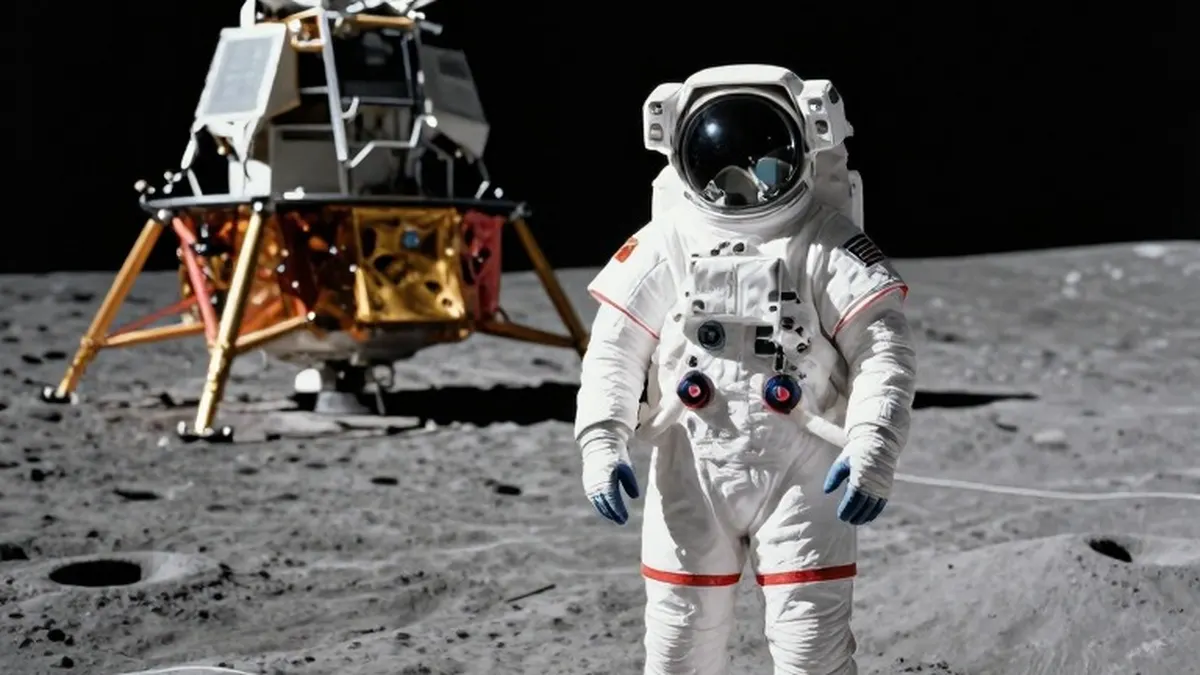
NASA has begun recruiting its next class of astronauts, opening an application window that gives U.S. citizens until midnight Eastern time on Dec. 3 to pursue what the agency describes as a chance to "live and work" on the moon.
The agency's application portal lists "few vacancies" for the role, which pays $164,395 a year. Those selected must relocate to Houston, where they will work at the Johnson Space Center.
Although the job is open to all citizens, candidates must meet specific educational criteria and bring specialized experience, meaning the pool of qualified applicants will be far narrower than the pool of dreamers.
The recruitment drive comes as the United States prepares to send crewed missions to the lunar surface. This past April, NASA flew a crew of four astronauts around the moon, a voyage that set a record for the farthest distance humans have ever traveled from Earth.
"The people we select could walk on the moon, live and work at the moon base, and help pioneer the systems and operations that will ultimately carry crews to Mars," NASA Administrator Jared Isaacman said in a statement. "Those missions will demand technical excellence, sound judgment, teamwork and courage."
On education, NASA says applicants must fit one of four profiles: a master's degree in a qualifying field of engineering, biological science, physical science, computer science or mathematics; two academic years of qualifying doctoral coursework in one of those fields; a qualifying medical degree, such as an MD, physician assistant or nurse practitioner; or completion of a recognized test pilot school by July 2027.
Candidates must also choose the discipline that best matches their work history, and NASA requires three years of professional experience after completing a degree program or pilot training. Pilots face specific flight-hour thresholds: 750 hours as lead pilot of a high-performance jet; 1,500 hours in other fixed-wing aircraft, with 750 in command; or 1,000 hours in rotary-wing aircraft, with 300 in command. Initial flight training and drone hours are excluded.
Other tracks include flight test, which requires test pilot school completion or enrollment, with completion by July 2027, plus three years of related flight test experience; medical, which calls for at least three years of professional experience after earning a medical degree, with residencies counting toward the total; and biological and medical science, physical science and engineering, each requiring three years of related work. Operations candidates need three years of experience in "high-consequence environments that require real-time decision-making and intensive teamwork, where errors carry irreversible and physical risk to personnel, missions or vehicles," NASA said.
Beyond credentials, applicants must pass a series of clearances, including medical and psychiatric exams, a background check and drug screening, and vision that can be corrected to 20/20 in each eye. They must also pass a swimming test and be able "to perform moderate to arduous physical activities, including heavy lifting, crouching, crawling and exposure to inclement weather."
Finally, NASA expects aspiring astronauts to "be willing to work in dangerous, life-threatening situations and live/work in remote, isolated, small or confined spaces for prolonged periods." On top of that, applicants must "be willing to deploy to space for 12 months or longer, accepting extreme isolation, austere living conditions and separation from loved ones."