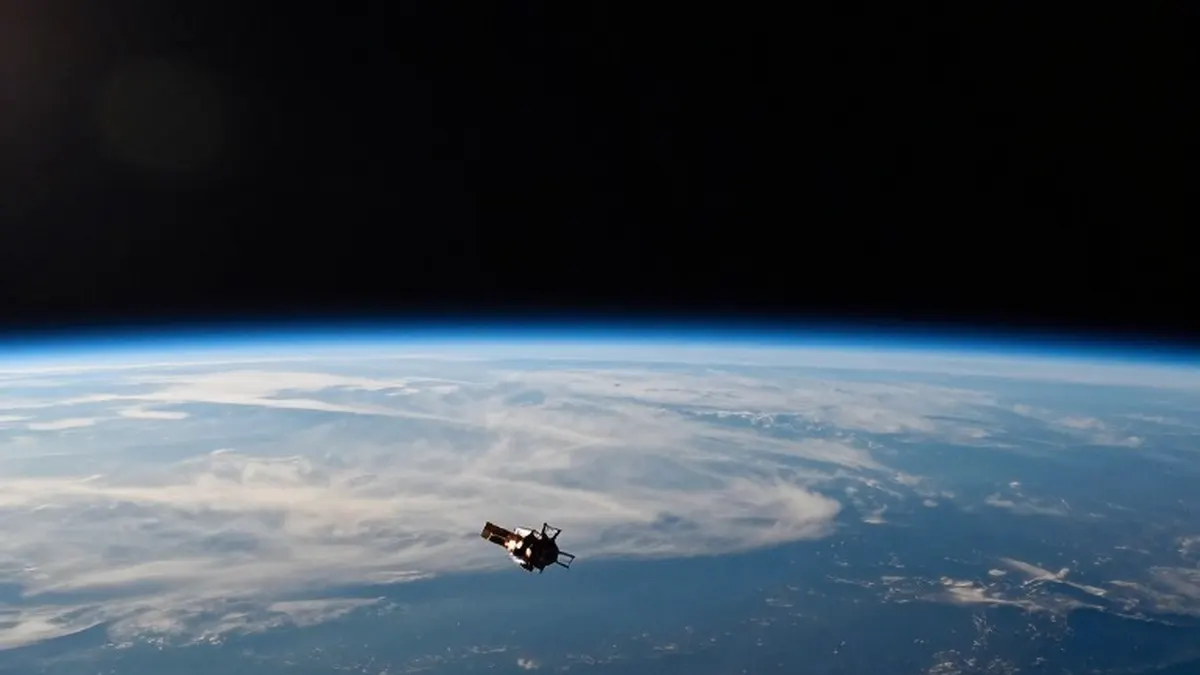
The Swift Observatory, one of NASA’s most significant space telescopes, reentered Earth’s atmosphere on Wednesday, bringing to a close a 22-year scientific campaign. The spacecraft had been dedicated to studying the universe’s most violent events, specifically gamma-ray bursts and exploding stars. Its return to Earth marks the end of an era for this premier observatory, which had served as a critical tool for astronomers for over two decades.
The U.S. Space Force confirmed that Swift reentered near Indonesia. The decision to allow the telescope to descend was driven by its sinking orbit, a phenomenon caused by intense solar activity over the past few years. These solar storms increased atmospheric drag, gradually lowering the spacecraft’s altitude until it was no longer stable in space.
This reentry follows a recent and unsuccessful effort to save the telescope. Less than three months ago, a long-shot rescue mission failed. NASA had contracted the private company Katalyst Space to perform an orbit-boosting maneuver. Katalyst launched a three-armed robotic craft in July to attach to Swift and raise its orbit. However, the robotic vehicle encountered technical difficulties shortly after launch and crashed in September, leaving Swift without a viable rescue option.
The Swift mission began in 2004 when it was launched into orbit. Originally, the project was designed as a two-year study. However, the telescope proved far more durable and productive than anticipated. It continued operating for 11 times longer than its planned duration, observing thousands of gamma-ray bursts. During this extended period, Swift acted as a first responder for the astronomical community, quickly locating events so that other telescopes could conduct deeper investigations.
The spacecraft weighed nearly one and a half tonnes. As it plunged through the atmosphere, it is expected that a significant portion of the structure burned up. NASA anticipated that some of the denser components would survive the reentry process, though it was not immediately known exactly how many pieces reached the ground intact.
The demise of Swift has prompted NASA to look toward its next aging asset: the Hubble Space Telescope. Launched in 1990, Hubble is also experiencing orbital decay due to solar storms. Recent analyses suggest that Hubble will come crashing down by the mid-2030s if no action is taken. The space agency is currently gauging industry interest in mounting a rescue mission for Hubble.
NASA is seeking input from private companies regarding various strategies for Hubble. These options include boosting its orbit, upgrading its onboard systems, or guiding it to a controlled reentry. The agency is considering the possibility of implementing all three measures. Any such mission would need to be completed by 2032 to be effective.
Nicky Fox, NASA’s science mission chief, noted that the agency has more time to explore options for saving Hubble compared to the rush job undertaken for Swift. This additional time allows for a more thorough evaluation of potential rescue strategies and partnerships with the private sector.
NASA Administrator Jared Isaacman emphasized the continued importance of the Hubble telescope. In a statement, he said, "Hubble still has important science ahead of it. And we should be looking at every reasonable opportunity to keep it delivering for as long as possible."
The successful conclusion of the Swift mission, despite its abrupt end, highlights the challenges of maintaining long-duration space assets. As solar activity continues to affect orbital dynamics, the space industry and NASA are now focused on developing sustainable solutions for preserving other vital observatories like Hubble for future generations of scientists.